Key Highlights
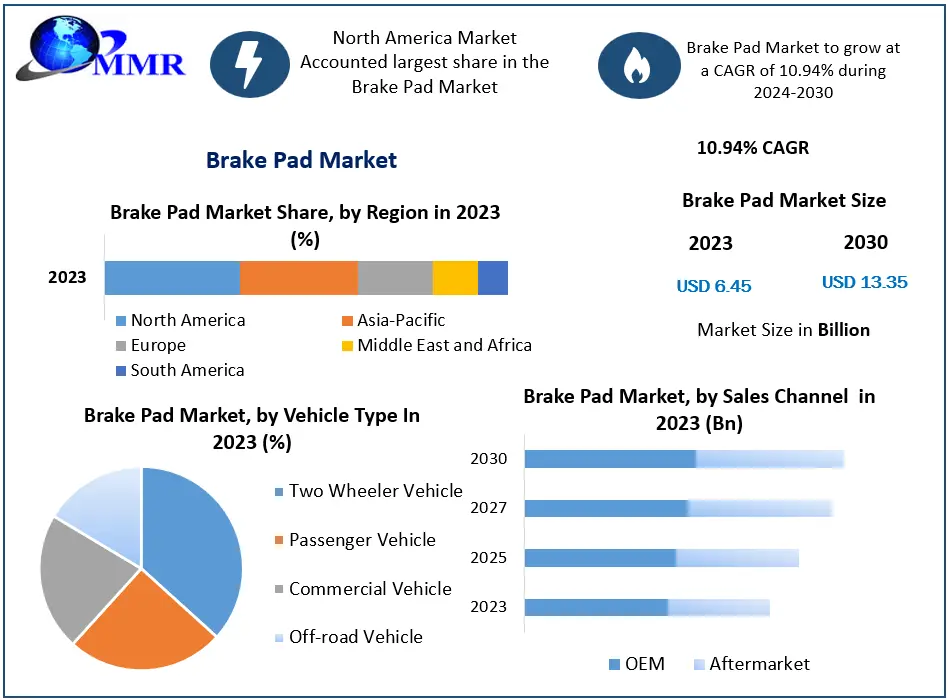
Global Brake Pad Market valued at USD 6.45 Bn in 2023, projected to reach USD 13.35 Bn by 2030 at a 10.94% CAGR.
Growth driven by rising automotive production, expanding vehicle parc and tightening safety norms that require reliable braking systems.
Passenger vehicles account for the largest share of brake pad demand, supported by strong sales in Asia Pacific, Europe and North America.
Aftermarket segment holds a significant share as brake pads wear and require regular replacement over vehicle lifecycles.
Asia Pacific dominates global volumes, with China and India leading due to high vehicle sales and rapid industrialization.
Why This Matters Now
Brake pads sit at the frontline of vehicle safety and regulatory compliance; a market doubling to USD 13.35 Bn by 2030 raises the stakes for OEMs, Tier-1 suppliers and aftermarket players. With a 10.94% CAGR, any misstep in materials, capacity or channel strategy can erode share in a segment where brand trust and safety records directly influence consumer and fleet decisions.
Fleet operators and mobility providers face a different risk. As vehicles log higher annual mileage and ADAS systems alter braking patterns, brake pad wear profiles change, affecting maintenance schedules and total cost of ownership. Investors and regulators must watch how quickly suppliers adapt to EV-specific braking needs, low-dust formulations and noise regulations, as these shifts will define which companies command pricing power and which become commodity suppliers.
Market Overview
According to Maximize Market Research, the Global Brake Pad Market was valued at USD 6.45 Billion in 2023 and is expected to reach USD 13.35 Billion by 2030, growing at 10.94% during 2024–2030. Brake pads are critical friction components that convert kinetic energy into heat, enabling vehicles to decelerate and stop safely in both disc and drum brake systems.
Demand is anchored in two forces: rising vehicle production across emerging and developed markets and a growing in-use vehicle parc that needs frequent pad replacement. Regulatory pressure on braking performance, stopping distance and safety standards further supports the adoption of advanced materials and designs.
OEM and aftermarket channels both contribute: OEM fitment volumes track new vehicle sales, while the aftermarket captures recurring replacement revenue over the life of the vehicle. This dual exposure allows brake pad suppliers to balance cyclical swings in production against more stable replacement demand.
Key Trends Driving Growth
Material Shift to Semi-Metallic and Ceramic Pads
The market is moving from traditional organic pads toward semi-metallic and ceramic formulations that offer better heat resistance, reduced fade, and lower noise. These materials improve braking performance and lifespan, which matters for both high-performance passenger cars and commercial fleets.
Environmental and comfort expectations add pressure. Low-dust and low-noise pads are increasingly favored in premium segments and urban markets, pushing suppliers to invest in R&D and specialized compounds. This trend raises entry barriers for low-cost producers and rewards firms with strong testing and validation capabilities.
EV Adoption and Regenerative Braking Dynamics
Electric vehicles use regenerative braking to recover energy, reducing pad usage in many conditions but increasing demand for pads that can resist corrosion and maintain performance under infrequent mechanical braking. As EV penetration grows, friction profiles change: brake pads see fewer cycles but face longer intervals, more exposure to moisture, and the need for consistent performance after long rests.
Suppliers who design EV-optimized pads—balancing corrosion resistance, noise control and compatibility with brake-by-wire systems—can secure new supply contracts and differentiate in a segment that could otherwise see reduced volume due to regen. Those who treat EVs as equivalent to ICE vehicles risk misalignment with OEM requirements and warranty expectations.
Safety, ADAS and Regulatory Pressure
Stricter safety regulations and NCAP-type rating systems indirectly drive brake pad market growth by forcing OEMs to meet higher braking standards. Advanced driver assistance systems (ADAS) such as automatic emergency braking rely on predictable and strong friction performance, which raises the technical demands on pad materials and design.
In many regions, regulations also push for reduced particulate emissions from braking, adding a new environmental dimension to pad development. Compliance pressures increase R&D and testing costs but create opportunities for leaders to lock in OEM relationships and command better margins.
Request a Free Sample Copy or View Report Summary: https://www.maximizemarketresearch.com/request-sample/96833/
Segment Insights
Dominant Segment – Passenger Vehicles
Passenger vehicles form the largest share of the brake pad market, supported by high volumes of cars and SUVs sold globally, particularly in Asia Pacific and Europe. Their large parc and regular maintenance cycles drive consistent replacement demand, making this segment critical for both OEM and aftermarket suppliers.Fastest-Growing Segment – Not Explicitly Stated
The report segments the market by vehicle type (passenger vehicles, commercial vehicles, others), by material and by sales channel (OEM and aftermarket), but does not explicitly state which segment is growing fastest. In line with the source rule, no additional segment growth claims are made beyond the stated overall CAGR.Commercial vehicles—trucks, buses and LCVs—generate high-intensity braking demand due to heavier loads and longer duty cycles, driving significant replacement volumes. For fleet operators, pad selection influences downtime, lifecycle cost and safety performance.
The aftermarket channel is highlighted as holding a significant share, fueled by the expanding vehicle parc and need for frequent pad replacement. This segment is especially important in emerging markets where independent workshops and multi-brand retailers dominate the service landscape.
Regional Growth Story
Asia Pacific leads the Global Brake Pad Market, driven by strong vehicle sales and rapid industrialization in countries such as China and India. The region’s large and growing vehicle parc, combined with rising safety awareness and regulatory enforcement, generates substantial OEM and aftermarket demand for pads.
Europe and North America also contribute significantly, supported by high safety standards, strong presence of global OEMs and early adoption of advanced materials. These regions see a growing focus on eco-friendly and low-noise pads, shaped by environmental regulation and consumer expectations.
Other regions such as the Middle East, Africa and Latin America show steady to moderate growth, driven by improving economic conditions and rising vehicle ownership. Differences in regulation, maintenance culture and price sensitivity influence the mix of premium versus budget pads and the structure of local aftermarket channels.
Competitive Landscape
The market is intensely competitive, with global and regional players contending across price, performance and brand trust. Major companies named in global market analyses include Robert Bosch GmbH, Akebono Brake Industry, Federal-Mogul (Tenneco), Nisshinbo Holdings and other friction specialists. These players leverage scale, R&D and deep OEM relationships to secure platform positions.
Competition is sharpened by the shift to advanced materials and regulatory expectations for safety and environmental performance. Firms able to deliver ceramic and semi-metallic pads with low noise and dust gain an advantage in higher-value segments, while budget segments remain contested by regional manufacturers and private-label brands.
For OEMs, supplier choices now impact not only cost but also compliance risk and brand reputation in safety and comfort. For suppliers, platform wins on global vehicle architectures can create multi-year revenue streams, while failure to meet technical or quality requirements can quickly lead to disqualification.
Recent Developments
Technological Advancements in Materials
Global research points to rising use of ceramic and semi-metallic compounds to improve braking efficiency and reduce wear and noise. This reflects continued investment in material science to balance performance, cost and environmental constraints.Shift Towards Eco-Friendly Pads
Environmental concerns are driving development of eco-friendly brake pads made from recycled or low-emission materials across multiple regions. These products respond to regulatory pressure on particulate emissions and appeal to sustainability-focused consumers and fleets.Increasing Focus on Aftermarket Quality
The presence of counterfeit and low-quality pads in some markets is pushing regulators, OEMs and major suppliers to emphasize certified products and quality control in the aftermarket. This opens room for branded players to differentiate and tighten control over distribution networks.
Strategic Implications
OEMs must treat brake pads as strategic safety components rather than commodity parts. Material choices, supplier partnerships and testing standards need to align with ADAS integration, EV platforms and regional regulations, especially where stopping performance feeds directly into safety ratings.
Tier-1 suppliers and friction specialists must invest in R&D for EV-compatible pads, low-dust and low-noise compounds, and eco-friendly solutions. They also need to segment their offerings carefully between OEM and aftermarket channels, balancing high-spec products for new platforms with cost-optimized pads for replacement markets.
For aftermarket distributors and workshop networks, the growth of the vehicle parc and tightening safety rules create an opportunity to move up the value chain by promoting certified, branded pads over unbranded low-cost imports. Regulatory enforcement and consumer education will shape how quickly premium products gain share.
Future Outlook
With the Global Brake Pad Market on track to climb from USD 6.45 Bn in 2023 to USD 13.35 Bn by 2030, braking systems will remain a core battleground for safety, comfort and regulatory compliance. EV adoption and ADAS integration will continue to reshape friction requirements and create niches for specialized pad solutions.
Future leaders will be the companies that treat brake pads as a high-innovation, high-trust component—investing in advanced materials, EV-ready designs and robust OEM and aftermarket channels—while laggards will be those that remain trapped in low-cost, low-spec segments exposed to commoditization and regulatory risk.
Related Reports
Global Garbage Collection Vehicle Market: https://www.maximizemarketresearch.com/market-report/global-garbage-collection-vehicle-market/85054/
Global Port & Industrial Tire Market https://www.maximizemarketresearch.com/market-report/global-port-industrial-tire-market/79246/
Power Tiller and Weeder Market https://www.maximizemarketresearch.com/market-report/power-tiller-and-weeder-market/263188/
Analyst Perspective
“The Brake Pad Market is growing faster than overall automotive production because safety, regulation and the expanding vehicle parc all converge here,” “As revenue rises from USD 6.45 Billion to USD 13.35 Billion by 2030, the winners will be suppliers and OEMs that align friction technology with EV platforms, ADAS requirements and tightening environmental standards instead of treating brake pads as commodity parts.”-Tejaswini Kakade
About Maximize Market Research
Maximize Market Research Pvt. Ltd. (MMR) is a global market research and consulting company that provides reliable, data-focused, and practical business insights. The firm serves a wide range of industries, including healthcare, pharmaceuticals, technology, automotive, electronics, chemicals, personal care, and consumer goods. Through market forecasts, competitive analysis, strategic consulting, and industry impact assessments, MMR helps organizations understand changing market conditions, identify growth opportunities, and make informed business decisions for long-term success.
2nd Floor, Navale IT Park Phase 3
Pune Banglore Highway, Narhe
Pune, Maharashtra 411041, India
+91 9607365656
sales@maximizemarketresearch.com
