Key Highlights
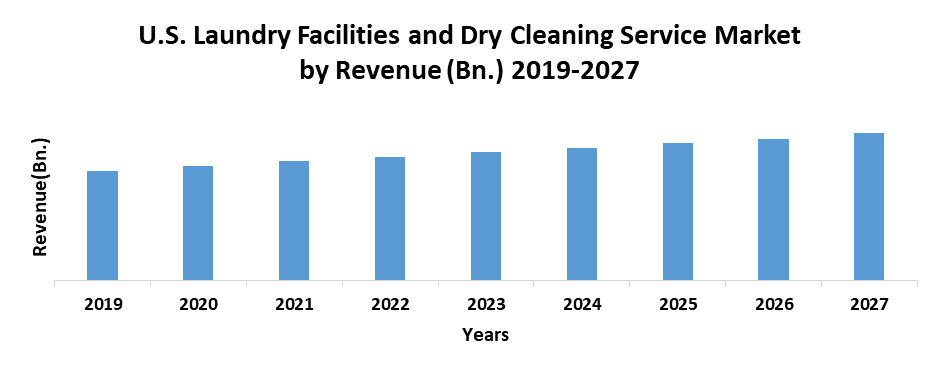
U.S. Laundry Facilities and Dry-Cleaning Service Market size was valued at US$ 9.82 Bn in 2019 and is expected to reach nearly US$ 13.24 Bn by 2027, growing at 3.8% between 2021 and 2027; this re-routes fabric care demand from retail shelves into B2B contracts where a few service operators decide product specifications and brand choice.
Coin-operated services and retail laundry/dry-cleaning jointly frame the consumer-facing side of the market; for FMCG players, this means a shift from one-bottle-per-household economics to high-volume, machine-optimized detergents and fabric care sold through professional channels rather than supermarkets.
Corporate and industrial laundry services emerge as a structurally important segment; food & beverage manufacturers, foodservice operators, and hospitality chains see hygiene-critical uniforms, linens, and textiles increasingly managed by outsourced providers, tightening compliance expectations for detergent and disinfection solutions.
Mode-of-operation splits between store pick-up & delivery and site pick-up & delivery highlight rising logistics complexity; detergent and hygiene suppliers must align with these operational models to secure bundled chemical and service agreements.
Regional fragmentation across Southeast, West, Southwest, and Midwest U.S. creates differing demand curves; FMCG companies can no longer assume uniform national penetration and must target regional service leaders with tailored fabric care propositions.
Why This Matters Now
U.S. laundry facilities and dry-cleaning services are converting fragmented household washing habits into consolidated, professionally managed volume. Each new outsourced contract shifts detergent and hygiene consumption from retail to B2B channels, compressing margins but creating larger, more predictable demand pools. For FMCG and Food & Beverage brands, the risk is clear: lose share of these high-volume accounts and watch retail growth stagnate, even as total fabric care consumption rises.
At the same time, professional operators standardize product choices around performance, safety, cost-per-wash, and regulatory compliance. Brands that do not meet these thresholds will be locked out of the fastest-growing pockets of fabric care demand, especially in industrial and foodservice environments where hygiene standards are non-negotiable.
Market Overview
The U.S. laundry facilities and dry-cleaning services market aggregates coin-operated laundries, retail dry-cleaners, and industrial/commercial service providers into a single value pool that is forecast to grow steadily to US$ 13.24 Bn by 2027 at a 3.8% growth rate. That growth rate signals a market that is not speculative but durable, built on everyday garment and textile care rather than discretionary spending spikes.
For FMCG and Food & Beverage players, the market functions as a distribution and usage layer for detergents, solvents, fabric conditioners, and hygiene chemicals. As more garments, uniforms, and hospitality linens flow through professional channels, brand equity in fabric care is increasingly tested not in households but in machine rooms and procurement meetings.
Key Trends Driving Growth
Professionally managed laundry is expanding on the back of time-poor urban lifestyles, rising labor costs, and the need for consistent hygiene outcomes in foodservice, hospitality, and healthcare. This reinforces demand for high-efficiency detergents, specialized dry-cleaning solvents, and process chemicals tuned to industrial cycles rather than home machines.
Parallel to this, store-based and on-site pick-up & delivery modes point to growing expectations of convenience and service integration. Chemical and detergent suppliers that can support these models with dosing systems, training, and technical service stand to capture recurring, contract-based revenues instead of episodic retail sales.
Request a Free Sample Copy or View Report Summary: https://www.maximizemarketresearch.com/request-sample/115591/
Segment Insights
Dominant Segment: Coin-Operated Services
Coin-operated laundry services, spanning apartment blocks, campus facilities, and urban laundromats, hold a significant share of the U.S. market. For FMCG brands, this segment can lock in bulk detergent and softener volumes through machine-level agreements, effectively reassigning household fabric care spend to a small number of equipment and service operators.Fastest-Growing Segment: Corporate/Industrial Laundry Services
Industrial and corporate laundry services, handling workwear, uniforms, and linens for sectors including food & beverage manufacturing, foodservice, and hospitality, are expanding as companies outsource non-core activities. This creates a concentrated demand node for high-performance detergents and disinfectants that must meet occupational safety and hygiene regulations, pushing suppliers toward more technical, compliant product portfolios.Retail Laundry & Dry Cleaning
Retail dry-cleaners continue to serve premium garments and delicate fabrics, sustaining demand for specialized solvents and gentle detergents. This segment offers margin-rich niches for brands able to support stain-specific solutions and fabric-preserving chemistries, but volumes are constrained relative to industrial contracts.Other Specialized Services
Ancillary services, such as niche textile treatment and specialty garment care, remain smaller but strategically relevant for innovation-led FMCG players. These providers often pilot advanced chemistries or sustainable formulations that can later scale into mainstream industrial or retail applications.
Regional Growth Story
The market is explicitly segmented across Southeast, West, Southwest, and Midwest U.S., indicating that growth is not uniform and is highly sensitive to regional demographics, urbanization patterns, and industry mix. For example, regions with dense hospitality and foodservice footprints will drive higher demand for outsourced linen and uniform care, intensifying competition for industrial laundry accounts.
This regional fragmentation means national FMCG and Food & Beverage brands must adopt a more targeted approach, engaging regional service champions with tailored offerings, pricing, and service support. Ignoring regional dynamics risks ceding key growth pockets to nimble competitors or private-label suppliers embedded with local operators.
Competitive Landscape
The U.S. market features a mix of large service networks and regional operators across coin-operated, retail, and industrial laundry services. Their decisions on equipment procurement, detergent usage, and hygiene protocols effectively determine which FMCG and chemical suppliers win or lose volume over the next decade.
Consolidation or strategic alliances in the laundry services space will reshape bargaining power. As leading operators scale, they will demand more integrated solutions—bundling machines, chemicals, and maintenance—creating pressure on traditional FMCG brands to evolve beyond selling packaged detergents into full-service fabric care partnerships. Competitors that cannot compete on technology, service, and compliance will be gradually sidelined from key B2B segments.
Recent Developments
Expansion of store-based and on-site pick-up & delivery models is tightening expectations on service reliability and turnaround times. This encourages operators to standardize on high-performance, low-error detergents and process chemicals, favoring suppliers that can prove consistent results.
Rising focus on industrial and corporate laundry services is pulling more hygiene-critical textiles, including food & beverage uniforms and linens, into controlled cleaning environments. This shifts compliance responsibility from individual employees to service providers and their chemical partners.
Continued relevance of coin-operated laundries in residential clusters keeps a significant share of consumer textile care outside traditional retail channels. FMCG brands that secure machine-level dosing and supply agreements can stabilise demand even as retail patterns fluctuate.
Strategic Implications
For FMCG players, the critical strategic move is to reframe laundry and dry-cleaning operators as core customers rather than peripheral channels. That means building dedicated B2B sales and technical teams, customizing formulations for industrial and coin-operated machines, and offering service and training rather than just products.
Food & Beverage manufacturers and foodservice operators must, in turn, treat outsourced laundry contracts as integral to their hygiene and brand risk management. Aligning detergent and textile care standards with corporate food safety protocols reduces operational risk, but it also positions them as more demanding buyers, pushing service providers and chemical partners toward higher-spec, audited solutions.
Future Outlook
The steady 3.8% growth trajectory through 2027 points to a market that will keep absorbing garment and textile volume from households and in-house laundries into professional ecosystems. Winners will be FMCG and Food & Beverage players who pivot quickly to B2B fabric care, secure long-term contracts with industrial and coin-operated operators, and embed technical support into their offer; losers will cling to a shrinking, purely retail-centric view of detergent and textile hygiene demand.
Related Reports
Global Down and Feather Market https://www.maximizemarketresearch.com/market-report/global-down-and-feather-market/21816/
Global Compostable Packaging Materials Market https://www.maximizemarketresearch.com/market-report/global-compostable-packaging-materials-market/87381/
Global Hermetic Laser Packaging Market https://www.maximizemarketresearch.com/market-report/global-hermetic-laser-packaging-market/102413/
Analyst Perspective
“Sustained growth in the U.S. laundry facilities and dry-cleaning services market is not just a service-sector story; it is a redistribution of fabric care value from households to professional providers,” “FMCG and Food & Beverage companies that recognize this shift early and build deep partnerships with coin-operated, retail, and industrial operators will own the next wave of detergent, hygiene, and textile care demand; those that do not will watch volume migrate away from their brands, even as overall market size expands.”-Siddhi Dole
About Maximize Market Research
Maximize Market Research Pvt. Ltd. (MMR) is a global market research and consulting company that provides reliable, data-focused, and practical business insights. The firm serves a wide range of industries, including healthcare, pharmaceuticals, technology, automotive, electronics, chemicals, personal care, and consumer goods. Through market forecasts, competitive analysis, strategic consulting, and industry impact assessments, MMR helps organizations understand changing market conditions, identify growth opportunities, and make informed business decisions for long-term success.
2nd Floor, Navale IT Park Phase 3
Pune Banglore Highway, Narhe
Pune, Maharashtra 411041, India
+91 9607365656
sales@maximizemarketresearch.com
