Key Highlights
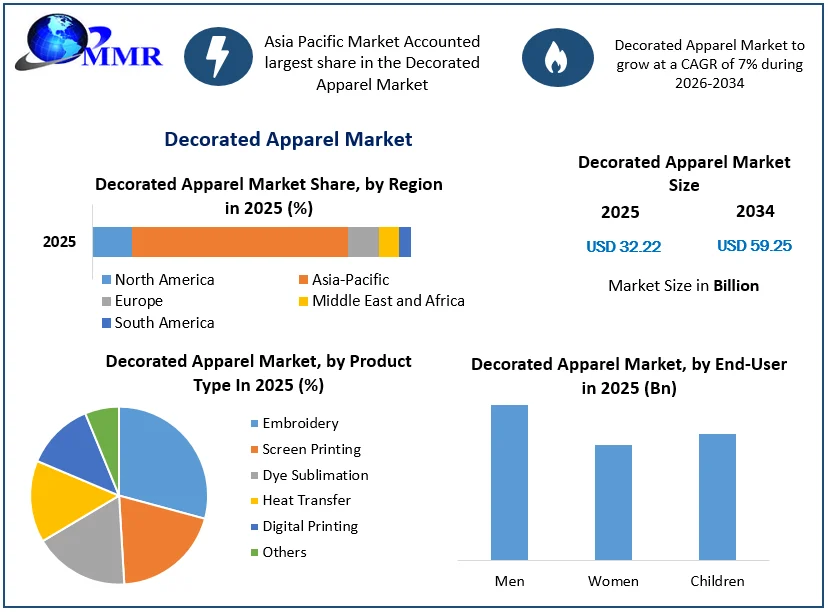
Decorated Apparel Market size stood at USD 32.22 Billion in 2025, confirming that branded, printed, and embroidered clothing is already a major global industry with direct relevance to consumer-facing sectors.
Market revenue is expected to grow at a 7% CAGR from 2026 to 2034, reaching nearly USD 59.25 Billion, signaling strong momentum in wearable branding as consumers embrace logo-driven lifestyle products.
This growth suggests expanding budgets for promotional apparel, uniforms, and fan merchandise, providing FMCG and Food & Beverage players with a scalable canvas for storytelling and retention.
The global scale and pace of expansion position decorated apparel as a durable channel for cross-category collaboration between clothing decorators and consumer brands.
Why This Matters Now
FMCG and Food & Beverage brands are fighting for attention in crowded retail aisles and fragmented digital feeds. Decorated apparel shifts the battleground from shelf to street, putting logos, slogans, and product imagery on what consumers wear, not just what they buy.
With the market climbing from USD 32.22 Billion in 2025 toward nearly USD 59.25 Billion by 2034 at a 7% CAGR, boardrooms can no longer treat apparel as a peripheral marketing giveaway. It becomes a living media channel: every hoodie, cap, or T-shirt carries the brand into workplaces, gyms, festivals, and social feeds, compounding exposure long after a campaign ends.
Market Overview
The jump from USD 32.22 Billion to almost USD 59.25 Billion in less than a decade reflects a strong appetite for customization, identity, and community expressed through clothing. A 7% CAGR is robust in any consumer category, especially one that sits at the intersection of fashion, branding, and lifestyle.
For FMCG and Food & Beverage companies, decorated apparel merges product marketing with culture. Limited-edition merch drops tied to new launches, seasonal campaigns, or iconic flavors can generate hype, reward loyal customers, and build tribes around everyday products. Instead of relying solely on packaging and advertising, brands gain a durable physical artifact that keeps them in the consumer’s daily rotation.
Key Trends Driving Growth
The 7% CAGR from 2026 to 2034 points to powerful structural trends: rising demand for personalization, growing comfort with brand loyalty as identity, and the normalization of merchandise as part of mainstream wardrobes. Consumers now treat branded apparel less as advertising and more as a badge of belonging.
Food and beverage names have long histories, emotional connections, and strong visual assets—colors, mascots, logos—that translate well into apparel. As decorated apparel grows, those assets become vehicles for lifestyle positioning: “this drink is who I am,” “this snack is my team,” “this restaurant is my community.” That alignment between taste and textile is why the growth rate matters so much to FMCG leaders.
At the same time, promotional budgets increasingly move toward experiences and tangible rewards. Decorated apparel fits that shift by offering something concrete, reusable, and social-media-friendly. A campaign T-shirt or cap can outlast a single discount or a limited-time ad burst, extending engagement across months or years.
Segment Insights
Dominant Segment – Promotional and Loyalty Apparel
Given the overall market size and strong growth, promotional apparel for events, loyalty programs, and giveaways is likely a dominant use-case, where food and beverage brands convert marketing spend into wearable items. This segment is crucial because it ties decorated apparel directly to repeat purchase incentives and sustained brand recall.Fastest-Growing Segment – Lifestyle and Fan Merchandise
A 7% CAGR suggests accelerating traction in lifestyle merchandise—apparel that consumers buy outright because they identify with the brand, not just receive as free promotion. For FMCG players, this fast-growing segment signals an opportunity to move from “promotional T-shirt” to “fashion collaboration,” monetizing brand equity and deepening emotional connection.Employee uniforms and staff apparel form another strategic layer, turning frontline workers into consistent brand carriers. In foodservice, QSR chains, and beverage distribution, decorated apparel serves operational and marketing roles simultaneously.
Collaborations between food brands and designers or influencers create specialized apparel micro-lines, tapping into new audiences and storytelling formats without the need to run full clothing operations internally.
Regional Growth Story
Without regional splits from the report, we can only interpret the global growth curve: a near-doubling of market value by 2034 at 7% CAGR signals broad geographic adoption. That matters for multinational FMCG and Food & Beverage companies, because it means decorated apparel can be deployed as a common playbook across multiple regions, then localized with language and cultural cues.
In developed markets, decorated apparel becomes an extension of established fan cultures—sports, music, gaming—into food and beverage fandom. In emerging markets, it often intersects with aspirational branding and the rise of organized retail and quick-service chains, giving local consumers new symbols of affiliation. In both contexts, apparel is a lever to move brand perception up the value curve.
Competitive Landscape
As a nearly USD 59.25 Billion market by 2034, decorated apparel will host intense competition among printers, embroiderers, designers, and brand owners. For FMCG and Food & Beverage companies, the competitive signal is not just “many suppliers,” but “many brands fighting to own the same torso and head space.”
If a snack or beverage brand secures strong decorated apparel presence—through signature pieces, recurring drops, or long-term collaborations—it can lock in a unique visual territory. Rivals who lag on apparel risk being confined to shelf presence while competitors occupy streets, events, and social media grids via clothing.
Over the next 12–24 months, expect more structured partnerships between apparel decorators and food brands: exclusive contracts for certain categories, co-investment in design studios, and integrated campaign planning that treats clothing as a core asset, not a late add-on. That shift will raise the bar on quality, design, and sustainability expectations across the market.
Recent Developments
Food and beverage brands are increasingly bundling decorated apparel into loyalty programs, contests, and limited-time promotions, upgrading the perceived value of participation.
Retailers and QSR chains are experimenting with capsule merch lines tied to flagship stores, anniversaries, or marquee menu items, using apparel to drive store visits and social sharing.
Digital channels and e-commerce platforms support direct-to-consumer sales of branded apparel, allowing FMCG companies to test designs, collect data, and refine offerings without full-scale retail distribution.
Strategic Implications
For boardrooms, the decorated apparel market’s trajectory demands a shift in how brand assets are managed. Logos, color palettes, mascots, and tagline systems must be designed not only for packs and screens, but for fabric, fit, and wearability. That can require new skill sets, from fashion design partnerships to merchandising operations.
FMCG and Food & Beverage leaders should view decorated apparel as part of their brand architecture, not just promotional spend. Clear strategies are needed around: which brands merit apparel, what stories each line tells, how collections tie into product pipelines, and how to manage lifecycle—from drop to archive. The 7% CAGR provides a solid basis for multi-year investment plans, forecasting both demand and required creative capacity.
Future Outlook
As the Decorated Apparel Market grows from USD 32.22 Billion in 2025 to nearly USD 59.25 Billion by 2034, wearable branding will become a central front in the competition for consumer attention and loyalty. The winners will be food and beverage brands that treat apparel as a serious, design-led, data-informed extension of their core business, while the losers will be those that keep handing out low-effort T-shirts and caps and watch their share of the wearable shelf quietly migrate to more ambitious rivals.
Related Reports
Global Almond Oil Market https://www.maximizemarketresearch.com/market-report/global-almond-oil-market/106999/
India Water Free/Waterless Urinals Market https://www.maximizemarketresearch.com/market-report/india-water-free-waterless-urinals-market/44959/
Tennis Overgrip Market https://www.maximizemarketresearch.com/market-report/global-tennis-overgrip-market/69705/
Analyst Perspective
“Decorated apparel is moving from the margins of marketing to the core of brand strategy,” “With the market scaling from USD 32.22 Billion in 2025 to nearly USD 59.25 Billion by 2034 at a 7% CAGR, FMCG and Food & Beverage companies that invest in truly wearable, desirable, and data-driven merchandise will build communities around their brands; those that treat apparel as disposable giveaways will be left behind in the next decade of consumer engagement.”- Siddhi Dole
About Maximize Market Research
Maximize Market Research Pvt. Ltd. (MMR) is a global market research and consulting company that provides reliable, data-focused, and practical business insights. The firm serves a wide range of industries, including healthcare, pharmaceuticals, technology, automotive, electronics, chemicals, personal care, and consumer goods. Through market forecasts, competitive analysis, strategic consulting, and industry impact assessments, MMR helps organizations understand changing market conditions, identify growth opportunities, and make informed business decisions for long-term success.
2nd Floor, Navale IT Park Phase 3
Pune Banglore Highway, Narhe
Pune, Maharashtra 411041, India
+91 9607365656
sales@maximizemarketresearch.com
