Key Highlights
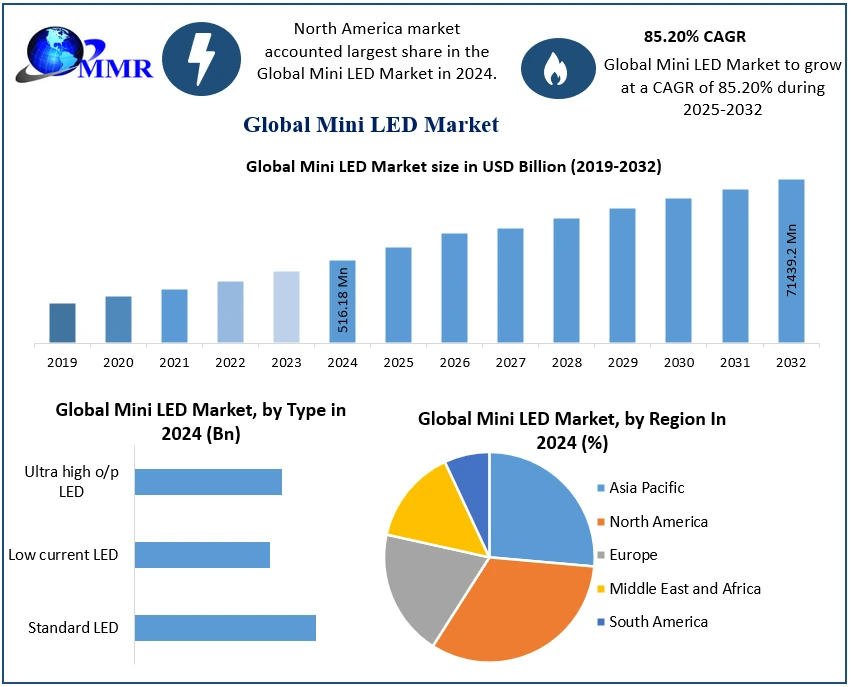
The global mini LED market achieved a definitive valuation of USD 516.18 million in 2024, creating an expansive infrastructure foundation for high-performance hardware.
Total revenue expands at a projected compound annual growth rate (CAGR) of 85.20% through the forecast period, climbing to USD 71,439.2 million by 2032.
Component export volume is anticipated to exceed 370 thousand units by the end of 2032, validating high-volume adoption across localized assembly operations.
The standard mini LED category stands as the most profitable component variation, presenting a valuable opportunity of USD 490 million over the studied timeframe.
Consumer electronics commands the dominant application share, with a trajectory designed to generate USD 1 billion in economic value by 2032.
The automotive sector represents the fastest-growing application vector, advancing at a projected 21% CAGR from 2024 to 2032 due to digital cockpit displays.
Why This Matters Now
Electronics OEMs and foundry operators face an immediate display technology inflection point. High power consumption and contrast limitations in legacy designs are forcing a massive transition toward miniature light-emitting diode components. The commercialization of sub-200 micrometer architectures allows manufacturers to achieve higher contrast ratios, increased brightness, and a broader color gamut without the excessive manufacturing cost penalties linked to alternative formats.
For conventional display manufacturers, this structural transition presents an immediate asset utilization opportunity. Foundries do not need to construct entirely new fabrication plants; they only require modifications to driver ICs and targeted equipment investments within existing standard LCD production lines. This hardware compatibility enables fab operators to upgrade their product properties rapidly, protect corporate margins, and achieve immediate scale as consumer electronics brands demand superior display innovation.
Market Overview
A Mini LED Market functions by packaging arrayed light sources scaled down to 100-200 micrometers, with pioneering fabs aggressively engineering 50-micrometer variants. The global mini LED market stood at USD 516.18 million in 2024. Expanding at a massive 85.20% CAGR from 2025 to 2032, total industry revenue is projected to hit USD 71,439.2 million by 2032, demonstrating extensive integration across smart consumer electronics and military control cockpits.
This extreme expansion curve highlights a technical shift away from legacy lighting formats. Mini LEDs achieve superior performance metrics compared to organic light-emitting diodes (OLEDs), systematically reducing the latter’s market share in premium device categories. The combination of rapid response times and low power consumption positions mini LEDs as an essential component choice for devices operating within advanced internet of things (IoT) networks and next-generation telecommunication hubs.
Key Trends Driving Growth
The rolling deployment of the Next Generation Network (NGN) and expanding IoT ecosystems act as major catalysts for component procurement. High-performance smartphones, smartwatches, laptops, and advanced projectors require low-power displays that remain readable under harsh ambient lighting conditions. Component supply chains are shifting toward ultra-high output options to meet these design requirements, particularly as high-end gaming monitors demand localized dimming capabilities.
Simultaneously, engineering focus is centering on the atomic layer deposition (ALD) process to improve wavelength and thickness uniformity during chip manufacturing. Overcoming these technical challenges allows fabrication operators to stabilize yields, reduce electronic scrap, and accelerate the commercialization of sub-100 micrometer dies. The growing utilization of high-contrast display architectures across aerospace, defense, and military equipment further provides component suppliers with stable, high-margin revenue streams that balance out consumer market cyclicality.
Segment Insights
Dominant Segment: Consumer electronics commands the largest application share, positioned to hit a definitive USD 1 billion in standalone economic value by 2032 as smart televisions, smartphones, and LED projectors experience rising adoption.
Fastest-Growing Segment: The automotive application category registers as the fastest-advancing segment, expanding at a 21% CAGR through 2032 due to the rapid integration of digital instrumentation displays and custom cabin lighting environments.
Most Profitable Product Type: Standard mini LEDs remain the highest revenue generator, offering a verified market opportunity of USD 490 million over the forecast window due to widespread adoption across mid-tier consumer electronics.
High-Performance Growth Vector: Ultra-high output mini LEDs capture over one-third of the total market share by the end of 2032, driven by consumer demand for high-performance visual displays.
Application Spectrum: Component usage spreads horizontally across consumer electronics, automotive interiors, large-format advertising displays, aerospace cockpits, and defense applications.
Regional Growth Story
Geographic investment trends demonstrate a distinct division between dominant consumer markets and highly concentrated fabrication regions. North America held the highest market share in 2024, driven by high demand for high-end gaming laptops and premium electronics in the United States. US-based start-ups, including pioneers like Rohinni LLC, have accelerated market commercialization by launching integrated mini LED lights and panels at major global display expositions.
Conversely, East Asia operates as the most profitable manufacturing hub for mini LED arrays. China and South Korea hold dominant positions in the production and export distribution of these components, leveraging existing economies of scale inside their mature semiconductor industries. This massive production footprint allows East Asian foundries to drive down unit costs for smart displays with longer lifespans. Meanwhile, South Asia functions as a high-growth consumption zone, tracking an estimated 16% CAGR throughout the studied period, fueled by expanding domestic electronics manufacturing services.
Competitive Landscape
The global microelectronics marketplace features active competition between established semiconductor giants and highly focused optoelectronic specialists. Market operations are shaped by major global players including Acuity Brands, Savant Systems, JKL Component Corporation, ERP Power, Osram, Zumtobel Group, SmartKem, FW Thorpe, Aurora Lichtwerke, Micledi, Philips Lighting, Nichia Corporation, Seoul Semiconductor, Everlight Electronics, Core Electronics, Lijing Microelectronics Technology, Leady Intelligent Technology, Ouyidi, Shivan Microelectronics, PanelSemi Corporation, and Nanolumi.
Strategic moves reveal that market leaders are moving away from basic component manufacturing toward integrated display sub-systems. Companies like Innolux Corporation have showcased 10.1-inch automotive display modules featuring 1,000 local dimming zones alongside massive 65-inch 8K mini LED concepts. Similarly, groups like TCL Corporation’s CSOT have unveiled flexible 8-inch panels achieving 60% transparency and a minimal 0.55mm panel thickness. These advancements demonstrate that technology leadership belongs to firms that control the assembly process, allowing them to deliver thin form factors directly to global automotive and consumer electronics OEMs.
Recent Developments
Advanced foundries have optimized the atomic layer deposition process, delivering superior thickness uniformity across high-volume mini LED production runs.
Premium hardware brands have executed full-scale commercial deployment of mini LED backlit panels across premium gaming monitor lines, improving local contrast performance.
South Asian manufacturing facilities have expanded their lines, accelerating component integration into mid-tier smartphones and smart wearable technology.
Specialized automotive display suppliers have successfully qualified 10-inch localized dimming modules for integration into upcoming electric vehicle digital cockpits.
Strategic Implications
For procurement executives and hardware directors, the mini LED market’s 85.20% CAGR creates a complex supply chain environment. Relying on legacy display configurations exposes consumer brands to competitive disadvantages as consumers favor high-brightness, energy-efficient interfaces. OEMs must engage in long-term supply agreements with East Asian foundries to secure adequate component allocations.
Furthermore, engineering executives must look for ways to mitigate the high R&D costs linked to wavelength non-uniformity. The logical solution involves leveraging existing standard LCD infrastructure while modifying driver IC architectures to support localized dimming zones. By partnering with established packaging experts like Nichia Corporation or Everlight Electronics, hardware developers can bypass initial yield challenges and deliver high-contrast products that satisfy evolving regulatory and consumer energy mandates.
Future Outlook
The next stage of display innovation will focus on the complete digitization of transit, workspace, and residential surfaces into interactive, energy-efficient smart nodes. As 5G adoption and NGN deployment expand, the requirement for highly responsive visual electronics will outpace standard consumer electronics production.
Future market leadership will belong to semiconductor manufacturers who can scale sub-100 micrometer chip architectures using existing fabrication assets. Fabs that achieve absolute wavelength uniformity while keeping modification costs minimal will secure long-term contracts with global automotive and consumer technology brands. In contrast, component suppliers unable to transition away from bulky legacy LED layouts will face decreasing margins and diminishing market share.
Analyst Perspective
“The extraordinary growth curve of the mini LED market highlights a significant structural upgrade across global display manufacturing pipelines. With the consumer electronics sector projected to reach USD 1 billion in economic value and standard mini LEDs creating a USD 490 million opportunity, foundries have a clear path to maximize asset returns. The ability to upgrade existing standard LCD infrastructure without building new fabrication plants provides a cost-effective opportunity to challenge alternative display formats, enabling immediate scale across major manufacturing hubs.” — Alpana Patil, Lead Analyst, Maximize Market Research
About Maximize Market Research
Maximize Market Research Pvt. Ltd. (MMR) is a global market research and consulting company that provides reliable, data-focused, and practical business insights. The firm serves a wide range of industries, including healthcare, pharmaceuticals, technology, automotive, electronics, chemicals, personal care, and consumer goods. Through market forecasts, competitive analysis, strategic consulting, and industry impact assessments, MMR helps organizations understand changing market conditions, identify growth opportunities, and make informed business decisions for long-term success.
2nd Floor, Navale IT Park Phase 3
Pune Banglore Highway, Narhe
Pune, Maharashtra 411041, India
+91 9607365656
sales@maximizemarketresearch.com
