Key Highlights
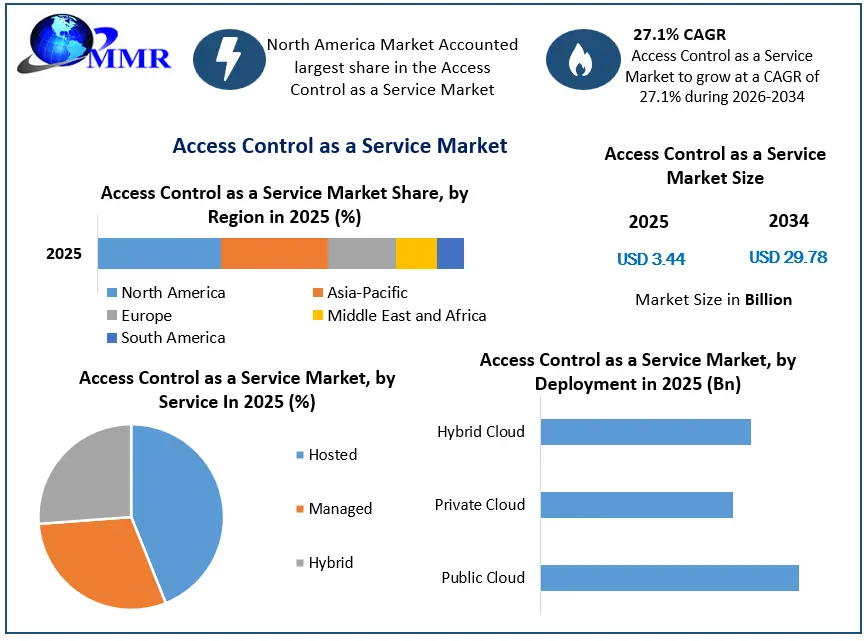
Market valuation expanding from USD 2.13 billion in 2023 to USD 11.41 billion by 2030 at a 27.1% CAGR.
Hosted services dominated the service segment in 2023, driven by web-accessible third-party server management.
Managed services represent the fastest-growing service delivery format, expanding at a 27.10% CAGR through 2030.
The public cloud model held the dominant deployment market share in 2023, leveraging centralized cost efficiencies.
North America commanded the global geographic market share in 2023 due to concentrated cloud virtualization investments.
Why This Matters Now Enterprise perimeters are dissolving rapidly as corporate technology environments shift toward decentralized cloud topologies, making legacy physical access management systems a major operational vulnerability. Chief information officers and enterprise risk managers face immediate operational exposure if they fail to replace rigid on-premise security architectures with agile, cloud-native identity validation frameworks. The transition to remote identity validation allows organizations to enforce uniform corporate security policies across distributed footprints while minimizing upfront capital requirements. This operational pivot ensures immediate defensive continuity against escalating network security breaches while facilitating smooth mobile workforce expansion.
Furthermore, the widespread adoption of bring-your-own-device policies and distributed office setups requires the implementation of centralized security controls that operate independently of local hardware. For enterprise technology buyers and security strategists, migrating to cloud-managed access environments provides the baseline scalability needed to protect modern industrial platforms. The immediate transition to automated identity verification models allows modern enterprises to build resilient, compliant operations that adapt instantly to changing workforce distributions. Ultimately, modernizing access infrastructure serves as a foundational step toward securing corporate assets within highly integrated hybrid cloud ecosystems.
Market Overview The Access Control as a Service Market accelerated migration of enterprise application workloads to public cloud networks is fundamentally reshaping the global identity verification and facility security landscape. The global Access Control as a Service market reached a valuation of USD 2.13 billion in 2023 and is on track to achieve a projected size of USD 11.41 billion by 2030, advancing at a steady 27.1% compound annual growth rate. This significant capital expansion indicates an industrial shift toward flexible subscription-based security architectures that track real-time access events while storing system logs in off-site environments.
What changed across the contemporary enterprise landscape is the rapid obsolescence of localized hardware controllers that require continuous on-site technical maintenance. Why now? The sharp increase in corporate network security breaches combined with aggressive enterprise virtualization demands immediate deployment of flexible access nodes. This modernization shift directly benefits multi-site commercial enterprises, highly regulated banking environments, and healthcare networks by eliminating physical server upkeep and reducing system downtime. What happens next is the broader structural displacement of traditional mechanical facility security, as organizations leverage open web APIs to link remote lock control directly with centralized identity databases.
Key Trends Driving Growth Escalating cybersecurity threats and the logistical complexity of managing disconnected physical locations are driving corporate infrastructure buyers to prioritize centralized cloud security models over legacy hardware panels. To capture expanding market share, technology vendors are focusing on the core advantages of ACaaS, including rapid software updates, high systemic availability, and seamless mobile access synchronization. This operational flexibility allows corporate IT teams to adjust system permissions globally from unified web interfaces without requiring field technicians to service individual door controllers.
Simultaneously, the widespread adoption of corporate mobility initiatives and user-owned device policies is altering the baseline requirements for workspace threat management. Modern enterprises require highly secure, web-accessible applications that authenticate employee credentials over encrypted internet connections before granting physical or digital system access. This operational shift reduces the total volume of localized server maintenance, providing mid-sized and large enterprises with predictable operating expense models rather than unpredictable capital infrastructure costs. Additionally, the continuous growth of global internet connectivity allows remote service providers to deploy high-availability security frameworks that remain operational during localized enterprise hardware failures.
Segment Insights
Dominant Segment: Hosted services held the leading position in the service market segment in 2023. This dominant position is driven by enterprise preferences for web-accessible software infrastructure that shifts system maintenance responsibilities, database backups, and server patching routines directly to external technology vendors.
Fastest-Growing Segment: Managed services represent the fastest-expanding format, moving at an expected 27.10% CAGR throughout the 2024 to 2030 forecast timeframe. This rapid expansion occurs because managed delivery models optimize corporate cost controls, minimize internal technical overhead, and improve corporate risk management protocols by delivering continuously monitored security applications.
Dominant Deployment Segment: Public cloud frameworks captured the primary deployment market share in 2023. This sustained market dominance is supported by the rapid deployment capabilities and low upfront infrastructure costs associated with shared, isolated computing multi-tenant models like Microsoft Azure.
Regional Growth Story North America maintained the dominant global market position in 2023, capturing the largest aggregate revenue share across the international landscape. This top position is driven by the rapid, large-scale integration of cloud computing technologies across enterprise IT environments in the United States and Canada. Furthermore, the rapid deployment of electronic security components, extensive corporate internet-of-things initiatives, and advanced enterprise virtualization frameworks continue to accelerate regional demand for cloud-delivered access platforms.
Concurrently, the international market expands across key industrial economies including Europe and the Asia-Pacific region, where organizations are modernizing physical infrastructure to secure distributed supply chains. The increasing focus on asset protection within European industrial centers like Germany and the United Kingdom drives the transition toward cloud-linked identity tracking frameworks. Similarly, rapid infrastructure construction across major Asian technology hubs including China, India, Japan, and South Korea requires the implementation of centralized security applications to monitor dense corporate hubs.
Competitive Landscape The competitive architecture of the global Access Control as a Service market is characterized by a mix of cloud-native innovators and established security systems providers, including Brivo Inc., Centrify Corporation, Cloudastructure Inc., Datawatch Systems Inc., Digital Hands, dormakaba Group, Feenics, Fleming Companies, Forcefield Systems Inc., Gemalto N.V., Honeywell International Inc., IBM Corporation, Johnson Controls Inc., Kastle Systems, Kisi Inc., M3T Corporation, Microsoft Corporation, Oracle Corporation, Spica International, Symantec Corporation, and Vanderbilt Industries Gmbh. The strategic investments of these dominant industry participants signal a clear shift away from isolated access points toward integrated, identity-focused platform ecosystems.
Market position and pricing power are increasingly tied to a vendor’s ability to offer secure public cloud hosting alongside flexible web interfaces that connect with external business applications. Leading technology suppliers are using their engineering capabilities to capture long-term enterprise subscriptions by integrating identity verification directly into broader corporate virtualization suites. This operational approach changes how large enterprises buy security tools, shifting focus from individual physical locks to comprehensive, cloud-managed zero-trust frameworks. As corporate operations continue to decentralize, providers that deliver high systemic resiliency alongside certified global data storage options are gaining a clear competitive edge over local hardware suppliers.
Recent Developments
System providers are integrating advanced cloud-based directory structures into hosted access panels to automate employee credential provisioning during corporate hiring cycles.
Engineering teams are increasing the integration of secure mobile application credentials with public cloud hosting platforms to replace legacy physical proximity cards.
Industry participants are expanding their managed service catalogs to incorporate continuous remote hardware monitoring, lowering system maintenance requirements for corporate security teams.
Strategic Implications For technology buyers, chief information officers, and institutional investors, the transition toward Access Control as a Service represents a fundamental shift in corporate asset protection strategies. As organizations adopt hybrid cloud deployments and broad mobility initiatives, relying on rigid, localized security controllers introduces unacceptable compliance and operational risks. Corporate leaders must approach identity management modernization as a core component of their overall digital transformation and cloud migration strategies.
Allocating capital toward hosted and managed access environments allows modern enterprises to build scalable, highly responsive infrastructure that reduces technical debt while lowering on-site maintenance expenses. Investors evaluating the digital infrastructure sector must carefully assess a provider’s cloud architecture maturity, as long-term market competitiveness depends on delivering secure, low-maintenance remote platforms.
Future Outlook The global trajectory for identity tracking and facility security will be defined by the absolute transition of access validation systems to centralized, multi-tenant public cloud architectures. As enterprise operational models demand continuous digital sovereignty and automated asset oversight, physical security boundaries will merge completely into unified cloud access management ecosystems.
The division between future industry participants will be clear: digital leaders will deploy hosted and managed security platforms to achieve rapid operational scaling and uniform threat mitigation, while digital laggards will face rising operational costs, technical resource shortages, and severe vulnerabilities from outdated, isolated hardware.
Analyst Perspective “The rapid expansion of enterprise cloud migration and corporate bring-your-own-device policies is forcing a structural rewrite of traditional physical security architectures,” states Yash Ghosalkar, Research Analyst at Maximize Market Research. “Organizations can no longer justify the operational overhead of localized access servers; market value is shifting decisively toward hosted and managed public cloud models that deliver instant scalability and centralized visibility.”
About Maximize Market Research
Maximize Market Research Pvt. Ltd. (MMR) is a global market research and consulting company that provides reliable, data-focused, and practical business insights. The firm serves a wide range of industries, including healthcare, pharmaceuticals, technology, automotive, electronics, chemicals, personal care, and consumer goods. Through market forecasts, competitive analysis, strategic consulting, and industry impact assessments, MMR helps organizations understand changing market conditions, identify growth opportunities, and make informed business decisions for long-term success.
2nd Floor, Navale IT Park Phase 3
Pune Banglore Highway, Narhe
Pune, Maharashtra 411041, India
+91 9607365656
sales@maximizemarketresearch.com
