Key Highlights
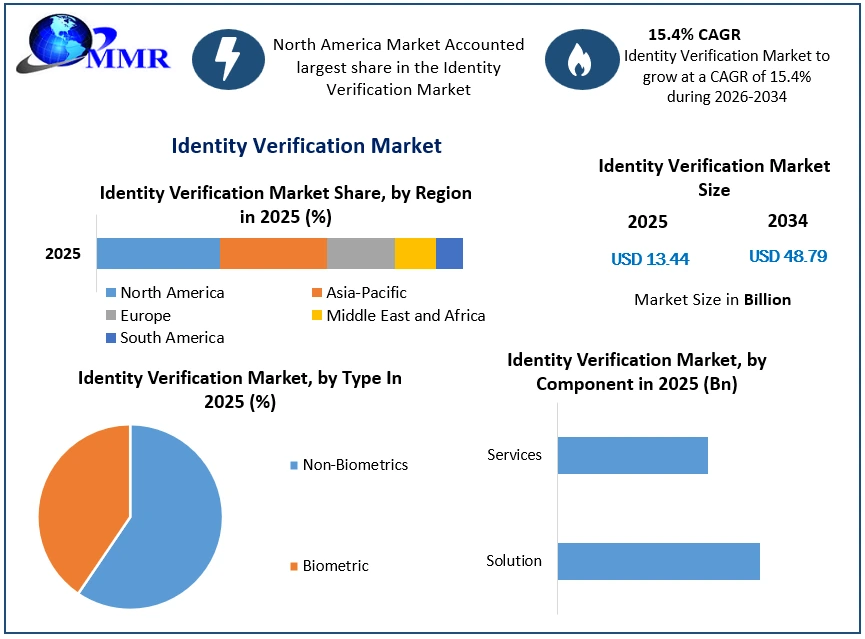
Global market scale expanding from USD 13.44 billion in 2025 to USD 48.79 billion by 2034.
Market compounding at a documented 15.4% CAGR through the 2026 to 2034 forecast horizon.
Software solutions secured the dominant market share position compared to dedicated integration services.
Biometric verification tools led the structural segment distribution, outperforming traditional non-biometric options.
North America commanded the global geographic landscape, securing the largest regional market share in 2025.
Why This Matters Now Enterprise trust perimeters are fracturing rapidly as rising identity fraud, sophisticated synthetic credentials, and AI-generated deepfakes expose massive holes in traditional cryptographic key structures. Chief information officers, enterprise technology buyers, and telecom operators face immediate system exposure if they continue to rely on brittle, password-based security systems that are easily cracked by modern attack vectors. Transitioning to advanced remote onboarding automation and software-defined credential tracking is no longer an optional upgrade project, but a baseline architectural dependency required to secure distributed cloud applications and achieve true digital sovereignty.
Furthermore, the extensive transition toward hybrid workforces, bring-your-own-device (BYOD) policies, and digital services access requires real-time identity validation that legacy on-premise hardware cannot sustain. Corporate technology leaders are prioritizing biometric verification software equipped with video analytics and advanced liveness detection to distinguish real users from screen injections or mask replicas. For technology strategists and institutional investors, allocating capital to cloud authentication infrastructure offers immediate optimization advantages within highly regulated commercial sectors. The ongoing rollout of high-speed 5G infrastructure and edge computing nodes further allows enterprises to execute instantaneous verification workflows, ensuring exceptional customer experience transformation benchmarks without compromising cybersecurity resilience.
Market Overview Identity Verification Market size Expanding digital transformation initiatives across both private and public sectors are forcing global organizations to shift substantial capital budgets directly into scalable identity proofing architectures. The global identity verification market achieved a clear valuation of USD 13.44 billion in 2025 and is projected to reach an estimated USD 48.79 billion by 2034, advancing at a steady 15.4% compound annual growth rate from 2026 to 2034. This aggressive influx of enterprise capital marks a widespread industrial shift toward automated, risk-based access flows that protect operational margins while reducing manual review overhead.
What changed across the contemporary enterprise landscape is the definitive replacement of manual, paper-driven customer onboarding steps that introduced extreme operational friction and prolonged onboarding timelines. Why now? The rapid evolution of mobile device access combined with strict international compliance mandates like Know Your Customer (KYC) and Anti-Money Laundering (AML) demands immediate verification capabilities at the individual point of transaction. This modernization shift directly benefits hyper-scale cloud providers, digital banking networks, and automated software platforms by optimizing user trust validation. What happens next is a complete transition toward continuous identity risk management, where automated platforms evaluate behavioral signals dynamically over secure API ecosystems without interrupting the end-user journey.
Key Trends Driving Growth Escalating digital literacy rates and the falling cost of household internet access are prompting corporate infrastructure buyers to implement advanced cloud-native identity tools over legacy physical tracking methods. To capture expanding market share, global software vendors are embedding advanced machine learning algorithms directly into active SaaS business models. This structural shift allows enterprise compliance teams to execute automated document cropping, glare detection, and tamper checks instantly during user enrollment cycles.
Simultaneously, the large-scale rollout of state-backed electronic identity card (eID) initiatives and smart infrastructure project structures has altered the baseline requirements for public-sector threat management. Municipalities and airport networks are responding to these connectivity updates by deploying smart border control setups that use high-speed facial recognition and automated video analytics to verify travelers in real time. By eliminating manual identification queues before they cause severe system delays, these intelligent platforms enhance transactional output while protecting critical data assets through modern cybersecurity resilience measures. Additionally, the continuous improvement of global edge computing nodes allows hardware developers to run heavy predictive analytical models directly at local access terminals, optimizing validation speed across decentralized operational footprints.
Segment Insights
Dominant Component Segment: The Solutions segment dominated the market share in 2025. This leading market presence is sustained by enterprise demand for pre-built, productized compliance toolkits that provide automated recordkeeping, consent capture, and configurable verification checks out of the box, avoiding the need to maintain fragile internal custom systems.
Dominant Technology Segment: Biometric verification secured the largest segment share compared to non-biometric options. This dominant position is driven by rapid smartphone penetration across merging countries and the widespread adoption of fingerprint and facial recognition sensors that bind identity directly to unalterable physical traits.
Fastest-Growing Segment: The Cloud-based deployment segment represents the fastest-expanding format within the industry landscape. This rapid growth occurs because modern multi-site organizations require flexible, multi-tenant cloud platforms that automatically update to changing regional regulations and emerging fraud patterns without requiring local physical hardware maintenance.
Regional Growth Story North America maintained the dominant global market position in 2025, capturing the largest aggregate revenue share and positioning itself to lead technical development throughout the forecast period. This top geographic standing is supported by the concentration of major remote identity verification companies across the United States and Canada, alongside an intense enterprise focus on combatting advanced authentication fraud. This highly mature technology ecosystem ensures a continuous regional demand for high-capacity security automation tools as corporate and financial buyers look to modernize their access architecture.
Concurrently, the Asia-Pacific region has emerged as the fastest-growing geographical market, projected to achieve the highest compound annual growth rate over the coming years. Rapid virtualization, expanding mobile infrastructure, and the massive BYOD trend across developing giants like China and India drive this intense growth curve. The presence of large software development centers and outsourcing hubs in China, paired with extensive investments in domestic smart city systems, creates a perfect environment for the immediate rollout of API-first identity validation stacks across high-density consumer and industrial applications.
Competitive Landscape The competitive architecture of the global identity verification market features prominent technology specialists and enterprise software giants, including Acuant, Applied Recognition, Au10Tix, Authenteq, Equifax, Experian, GB Group plc (GBG), Idemia, NEC Corporation, Samsung SDS, Thales Group, TELUS, Tessi, and Daon. The strategic movements of these primary industry participants indicate a major transition away from simple standalone validation steps toward comprehensive, interconnected digital identity platform ecosystems. Competitive strength is no longer determined by basic data matching features, but by a vendor’s capacity to deliver unified API ecosystems that orchestrate document checks, biometric liveness verification, and behavioral data streams simultaneously.
Leading industry participants are leveraging their extensive software footprints to secure strong pricing power by bundling standard validation tools with long-term, AI-driven fraud monitoring subscriptions. This operational integration shifts corporate procurement parameters away from simple per-check cost evaluations toward long-term total cost of ownership reductions and platform adaptability optimizations. As international enterprise software requirements continue to consolidate, providers offering standardized global validation frameworks paired with certified regional data sovereignty architectures are winning key corporate accounts from specialized niche vendors.
Recent Developments
Identity platform providers have increased the integration of advanced machine learning software layers into standard verification suites to automate anomaly detection during high-risk transactional flows.
Primary application creators have expanded native integration between local smartphone biometric hardware and centralized cloud authentication layers to minimize user onboarding latency for corporate clients.
Core product providers have introduced enhanced anti-spoofing algorithms within their liveness detection portfolios to counteract sophisticated deepfake injection attacks across digital banking systems.
Strategic Implications For enterprise executives, chief information officers, and institutional investment groups, the exponential scaling of the digital identity sector dictates an immediate modernizing of access control pipelines. Relying on legacy, disconnected internal verification tools introduces severe transaction friction, undermining digital transformation investments and eroding baseline operational productivity. Corporate leaders must view remote identity automation deployment as a mandatory requirement for executing scalable multi-site enterprise modernization strategies.
Allocating substantial capital toward integrated cloud security allows modern enterprises to build highly responsive, self-correcting compliance frameworks that reduce technical debt while stabilizing long-term operational expenses. Furthermore, investors evaluating the digital infrastructure space must thoroughly analyze the software integration capabilities of target corporations, as future financial returns depend entirely on executing high-volume cloud migrations smoothly across highly distributed physical ecosystems.
Future Outlook The global trajectory of the digital security market will be defined by the absolute integration of physical identity markers with highly scalable, cloud-hosted enterprise orchestration networks. As multi-site corporate business models require continuous asset oversight and real-time threat optimization, identification operations will shift toward intelligent, self-monitoring ecosystems that execute access validation adjustments autonomously.
The divide between future corporate market participants will be absolute: digital leaders will exploit highly automated, cloud-linked identity platforms to achieve unmatched transaction velocity and superior resource efficiency, while digital laggards will struggle with escalating operational expenses, technical data blindness, and catastrophic security breaches associated with legacy authentication architectures.
Analyst Perspective “The rapid expansion of enterprise cloud migration and the sudden emergence of highly sophisticated synthetic identity fraud are forcing a structural rewrite of traditional validation methods,” states Yash Ghosalkar, Research Analyst at Maximize Market Research. “Enterprise value is migrating rapidly away from traditional cryptographic keys toward automated, platform-wide cloud networks that process biometric, document, and behavioral data instantly at the global edge.”
About Maximize Market Research
Maximize Market Research Pvt. Ltd. (MMR) is a global market research and consulting company that provides reliable, data-focused, and practical business insights. The firm serves a wide range of industries, including healthcare, pharmaceuticals, technology, automotive, electronics, chemicals, personal care, and consumer goods. Through market forecasts, competitive analysis, strategic consulting, and industry impact assessments, MMR helps organizations understand changing market conditions, identify growth opportunities, and make informed business decisions for long-term success.
2nd Floor, Navale IT Park Phase 3
Pune Banglore Highway, Narhe
Pune, Maharashtra 411041, India
+91 9607365656
sales@maximizemarketresearch.com
