Key Highlights
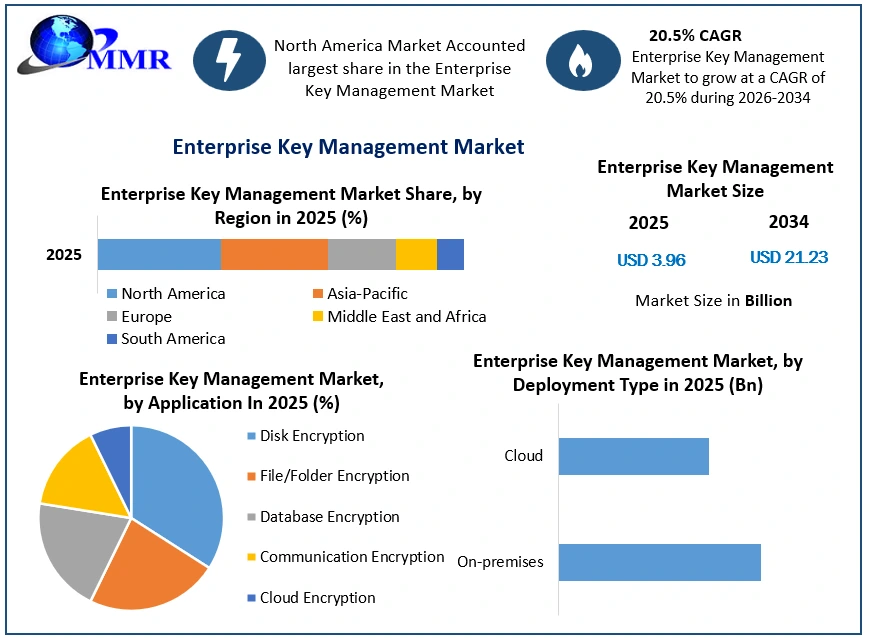
Global market scale expanding from USD 3.96 billion in 2025 to USD 21.23 billion by 2034.
Market revenue compounding at an accelerated 20.5% CAGR during the 2026 to 2034 forecast period.
Specialized software solutions captured the largest market share compared to pure professional deployment services.
Cloud-based key management deployments represent the dominant and fastest-growing implementation model.
The banking, financial services, and insurance (BFSI) vertical led sector demand due to strict data sovereignty rules.
Why This Matters Now Enterprise trust domains are experiencing unprecedented exposure as massive multi-cloud migrations, machine learning workloads, and distributed edge computing setups cause rapid cryptographic sprawl across modern IT infrastructures. Chief information officers, enterprise technology buyers, and telecom operators face massive operational vulnerabilities if they attempt to govern complex network virtualization architectures using fragmented, localized key storage panels. Moving toward centralized cryptographic key orchestration is no longer an optional security project, but a baseline architectural dependency required to secure sensitive microservices, prevent unauthorized database access, and satisfy international digital sovereignty directives.
Furthermore, the widespread adoption of zero-trust architecture requires continuous, automated validation of cryptographic assets that legacy on-premises infrastructure cannot manage without introducing severe system lag. Corporate technology leaders are prioritizing scalable cloud key management service setups to enforce automated key rotation policies dynamically across diverse software-as-a-service (SaaS) environments. For chief technology officers and institutional investors, allocating capital to integrated key lifecycle automation tools offers a primary competitive edge by lowering structural IT overhead while reducing the average financial damage of modern network data breaches. The rapid expansion of global 5G networks and automated edge device fleets makes the implementation of advanced, low-latency cryptographic protection systems an immediate priority for maintaining core platform economics.
Market Overview Enterprise Key Management Market size Accelerating global data center investments and broad digital transformation initiatives are forcing commercial institutions to transition upfront capital expenditures directly into flexible, subscription-based key management platforms. The global enterprise key management market achieved a clear valuation of USD 3.96 billion in 2025 and is projected to reach an estimated USD 21.23 billion by 2034, advancing at a steady 20.5% compound annual growth rate from 2026 to 2034. This significant multi-billion-dollar expansion highlights a major industrial shift away from manual, spreadsheet-based cryptographic tracking toward automated lifecycle orchestration setups that reduce administrative friction and prevent human error.
What changed across the modern enterprise footprint is the definitive replacement of isolated password vaults and hardcoded application secrets that left corporate assets exposed to sophisticated internal and external attack vectors. Why now? The rapid rollout of multi-tenant cloud software platforms, paired with strict international standard updates like PCI-DSS v4.0, requires continuous, auditable proof of key generation, storage, and revocation. This modernization shift directly benefits hyper-scale cloud providers, distributed e-commerce hubs, and global telecommunications operators by eliminating physical infrastructure bottlenecks and providing unbroken operational visibility. What happens next is a definitive industry movement toward automated key discovery systems, where cloud-hosted architectures locate and manage orphaned cryptographic assets across vast corporate networks without manual IT intervention.
Key Trends Driving Growth Escalating cybersecurity threats and the high complexity of governing multi-cloud application layers are driving corporate technology buyers to install centralized cloud security software over legacy internal hardware solutions. To capture growing customer segments, global software vendors are embedding advanced machine learning capabilities directly into active key lifecycle automation frameworks. This strategic transition allows corporate compliance teams to detect usage anomalies instantly, monitor credential access patterns globally, and isolate compromised systems before data exposure occurs.
Simultaneously, the large-scale rollout of state-mandated data localization rules and strict digital sovereignty regulations has completely altered the baseline requirements for public-sector threat management. Financial firms and healthcare providers are responding to these connectivity updates by deploying secure cloud key management service architectures that enable “Bring Your Own Key” (BYOK) configurations, ensuring organizations keep full ownership of their cryptographic assets while utilizing external multi-tenant public cloud services. By removing the risk of vendor lock-in and minimizing structural data breach vulnerabilities, these agile systems maximize operational flexibility while protecting critical data properties through modern cybersecurity resilience measures. Additionally, the continuous development of post-quantum key migration consulting toolkits allows forward-looking companies to prepare for emerging algorithmic threats without disrupting active production environments.
Segment Insights
Dominant Deployment Segment: Cloud-based deployment systems secured the largest segment share compared to traditional on-premises models. This leading configuration footprint expands rapidly because global decentralized organizations require elastic scaling, automated software updates, and location-independent management screens that connect seamlessly with multi-cloud workloads.
Dominant Vertical Segment: The Banking, Financial Services, and Insurance (BFSI) sector led vertical deployment distributions. This dominant market presence is driven by mandatory compliance rules like SOX and international transaction standards that require financial firms to run highly secure hardware security modules storage configurations to safeguard customer data.
Fastest-Growing Segment: Small and Medium-Sized Enterprises (SMEs) represent the fastest-expanding segment by organization size. This rapid growth occurs because mid-market firms face strict supply-chain compliance demands, forcing them to adopt managed KMS-as-a-Service platforms to avoid losing lucrative enterprise contracts.
Regional Growth Story North America maintained the dominant global market position in 2025, capturing the largest aggregate revenue share and positioning itself to lead technical development throughout the forecast period. This top geographic standing is supported by the rapid integration of zero-trust architecture designs across enterprise IT environments in the United States and Canada, alongside an intense focus on combatting sophisticated ransomware attacks. This highly mature technology ecosystem ensures a continuous regional demand for high-capacity security automation tools as corporate and financial buyers look to modernize their protection layer.
Concurrently, the Asia-Pacific region has emerged as the fastest-growing geographical market, projected to achieve the highest compound annual growth rate over the coming years. Rapid virtualization, expanding mobile infrastructure, and the massive adoption of 5G technologies across developing giants like China, India, and South Korea drive this intense growth curve. The continuous introduction of updated national data protection rules, such as amendments to South Korea’s PIPA and new privacy frameworks in India, creates a perfect environment for the immediate rollout of API-first cryptographic orchestration suites across high-density consumer and industrial applications.
Competitive Landscape The competitive architecture of the global enterprise key management market features prominent technology specialists and enterprise software giants, including Amazon Web Services Inc., Box Inc., Broadcom Inc., Dell Technologies Inc., Google LLC, Hewlett Packard Enterprise Company, International Business Machines Corporation, Microsoft Corporation, Oracle Corporation, Thales Group, Townsend Security, Unbound Security, and WinMagic Inc. The strategic actions of these leading market participants signal a clear industry transition away from isolated hardware devices toward comprehensive, cross-platform security ecosystems. Technical leadership is no longer judged solely on baseline storage capacity, but on a vendor’s capacity to deliver unified API ecosystems that orchestrate keys across multiple public cloud networks simultaneously.
Leading industry participants are leveraging their massive cloud footprints to secure strong pricing power by bundling core key management applications with broader cloud compute agreements, building high technical barriers for incoming market followers. This operational integration shifts corporate procurement parameters away from simple per-device cost evaluations toward long-term total cost of ownership reductions and platform adaptability optimizations. As international enterprise software requirements continue to consolidate, providers offering standardized global validation frameworks paired with certified regional data sovereignty architectures are winning key corporate accounts from specialized niche vendors.
Recent Developments
Global enterprise software creators have increased the integration of advanced machine learning software layers into cloud key management platforms to automate anomaly detection during high-risk transactional flows.
Primary application creators have expanded native integration between local hardware security modules and centralized cloud authentication layers to minimize key synchronization latency for corporate clients.
Core product providers have introduced enhanced post-quantum cryptographic algorithms within their key generation portfolios to counteract emerging code-breaking threats across digital banking systems.
Strategic Implications For enterprise executives, chief information officers, and institutional investment groups, the exponential scaling of the cryptographic security sector dictates an immediate modernizing of access control pipelines. Relying on legacy, disconnected internal verification tools introduces severe transaction friction, undermining digital transformation investments and eroding baseline operational productivity. Corporate leaders must view remote key management automation deployment as a mandatory requirement for executing scalable multi-site enterprise modernization strategies.
Allocating substantial capital toward integrated cloud security allows modern enterprises to build highly responsive, self-correcting compliance frameworks that reduce technical debt while stabilizing long-term operational expenses. Furthermore, investors evaluating the digital infrastructure space must thoroughly analyze the software integration capabilities of target corporations, as future financial returns depend entirely on executing high-volume cloud migrations smoothly across highly distributed physical ecosystems.
Future Outlook The global trajectory of the digital security market will be defined by the absolute integration of physical identity markers with highly scalable, cloud-hosted enterprise orchestration networks. As multi-site corporate business models require continuous asset oversight and real-time threat optimization, cryptographic operations will shift toward intelligent, self-monitoring ecosystems that execute key rotation adjustments autonomously.
The divide between future corporate market participants will be absolute: digital leaders will exploit highly automated, cloud-linked key management platforms to achieve unmatched transaction velocity and superior resource efficiency, while digital laggards will struggle with escalating operational expenses, technical data blindness, and catastrophic security breaches associated with legacy authentication architectures.
Analyst Perspective “The rapid expansion of enterprise cloud migration and the sudden emergence of highly sophisticated multi-cloud environments are forcing a structural rewrite of traditional validation methods,” states Yash Ghosalkar, Research Analyst at Maximize Market Research. “Enterprise value is migrating rapidly away from traditional cryptographic keys toward automated, platform-wide cloud networks that process biometric, document, and behavioral data instantly at the global edge.”
About Maximize Market Research
Maximize Market Research Pvt. Ltd. (MMR) is a global market research and consulting company that provides reliable, data-focused, and practical business insights. The firm serves a wide range of industries, including healthcare, pharmaceuticals, technology, automotive, electronics, chemicals, personal care, and consumer goods. Through market forecasts, competitive analysis, strategic consulting, and industry impact assessments, MMR helps organizations understand changing market conditions, identify growth opportunities, and make informed business decisions for long-term success.
2nd Floor, Navale IT Park Phase 3
Pune Banglore Highway, Narhe
Pune, Maharashtra 411041, India
+91 9607365656
sales@maximizemarketresearch.com
