Key Highlights
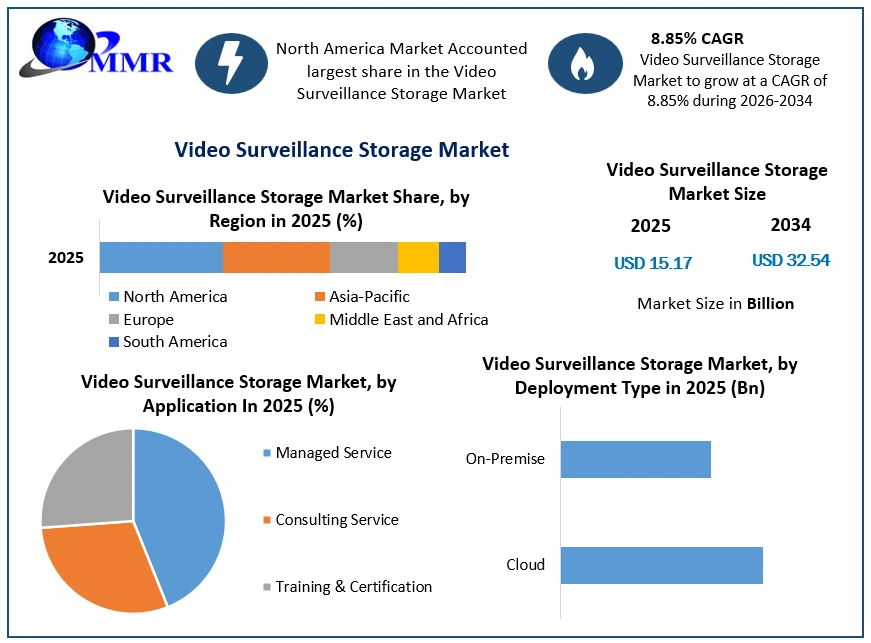
Global market scale expanding from USD 15.17 billion in 2025 to USD 32.54 billion by 2034.
Total market revenue compounding at a documented 8.85% CAGR during the 2026 to 2034 forecast period.
The cloud deployment segment captured the largest market share in 2024 and exhibits the highest growth momentum.
Cloud storage architectures are projected to grow at the fastest CAGR of 18.1% over the forecast timeframe.
North America commanded the global geographic landscape, securing the largest market share due to corporate digitization.
Why This Matters Now Physical security boundaries are dissolving rapidly as the deployment of high-resolution cameras and the integration of AI vision systems generate massive, continuous streams of unstructured video data. Chief information officers, enterprise technology buyers, and telecom operators face sudden operational bottlenecks if they attempt to capture, process, and store heavy high-bitrate security footage using legacy, rigid physical storage setups. Migrating toward advanced cloud video surveillance architectures is no longer a simple facilities upgrade project, but a baseline architectural dependency required to secure physical sites, preserve evidence trails, and protect overall corporate operations.
Furthermore, the widespread corporate switch toward hybrid cloud strategies and extensive enterprise software modernization requires centralizing physical facility data streams into analytics-ready platforms. Corporate technology leaders are prioritizing scalable storage repositories to satisfy evolving regional data safety requirements while maintaining deep visibility over multi-site operational networks. For chief technology officers and institutional investors, dedicating substantial capital to cloud-managed video retention tools offers immediate efficiency gains by lowering upfront on-premises infrastructure investments. The ongoing rollout of high-speed 5G networks and automated edge device connections further allows security nodes to transfer real-time files safely without overloading internal corporate networks. Ultimately, updating these critical storage environments provides the exact data handling capabilities needed to exploit deep learning analytics without creating additional technical debt.
Market Overview Video Surveillance Storage market size Expanding regulatory requirements across global business environments, paired with intense public security initiatives, are forcing modern commercial enterprises to shift substantial capital budgets directly into modern storage infrastructure. The global video surveillance storage market reached a clear valuation of USD 15.17 billion in 2025 and is projected to reach an estimated USD 32.54 billion by 2034, advancing at a steady 8.85% compound annual growth rate from 2026 to 2034. This broad capital expansion highlights a major industrial transition toward software-defined video lifecycle management, where physical files connect seamlessly with automated retrieval structures to reduce investigation timelines.
What changed across the contemporary enterprise landscape is the definitive replacement of isolated, low-capacity localized recording drives that restricted search access and frequently dropped video frames during heavy system loads. Why now? The rapid evolution of AI vision based surveillance systems, combined with global mandates directing businesses to monitor critical workspace areas, demands flexible storage scalability that legacy hardware lines cannot sustain. This modernization shift directly benefits hyper-scale cloud providers, security developers, and network virtualization vendors by creating massive, ongoing demands for high-density public and private storage space. What happens next is a complete transition toward autonomous storage tiering, where integrated cloud platforms dynamically manage video retention windows and automatically clear unneeded archived frames to control costs.
Key Trends Driving Growth Escalating structural data volumes and the growing complexity of protecting distributed physical assets are driving corporate technology buyers to install flexible cloud infrastructure over legacy internal storage devices. To capture expanding market segments, global technology vendors are embedding advanced data protection and real-time monitoring capabilities directly into active Video Surveillance as a Service (VSaaS) platforms. This tactical transition allows corporate facility teams to access remote video feeds securely through standard mobile applications, web interfaces, or centralized command screens from any international location.
Simultaneously, the widespread digitization of corporate operational workflows and the adoption of multi-tenant service models have altered the baseline requirements for workspace security optimization. Merchants and industrial organizations are responding to these connectivity trends by deploying secure hybrid architectures that balance local edge recording with geo-redundant cloud archives, ensuring system resilience during localized network failures. By identifying behavioral security threats automatically before they disrupt operations, these intelligent platforms enhance facility uptime while safeguarding critical files through modern cybersecurity resilience protocols. Additionally, the continuous improvement of global edge computing frameworks allows hardware creators to optimize local video compression routines, lowering the total storage footprint across complex, multi-camera enterprise layouts.
Segment Insights
Dominant Deployment Segment: The Cloud deployment segment captured the largest share in the video surveillance storage market in 2024. This leading position is driven by enterprise software modernization demands, where organizations leverage remote internet connections to lower initial capital expenditure and achieve frictionless multi-site data scaling.
Fastest-Growing Segment: Cloud storage structures represent the fastest-expanding model across the industry landscape, projected to grow at the highest CAGR of 18.1% over the forecast duration. This rapid expansion occurs because subscription-based storage models eliminate local server maintenance constraints while providing rapid, secure remote access to files.
Core Downstream Verticals: Traffic management, smart parking systems, logistics networks, and healthcare facilities represent primary deployment hubs, using real-time video data to optimize daily operations.
Regional Growth Story North America maintained the dominant global market position in 2025, capturing the largest aggregate revenue share and positioning itself to lead technical development throughout the forecast period. This top geographic standing is supported by the rapid digitization of organizations across major industry verticals, alongside the extensive adoption of cloud technologies and advanced service models in the United States and Canada. This highly mature technology ecosystem ensures a continuous regional demand for high-capacity security automation tools as corporate and public buyers look to modernize their physical protection structures.
Concurrently, international market expansion accelerates across key industrial zones in Europe and the Asia-Pacific region, where organizations are modernizing logistics and transport hubs. The increasing focus on asset protection within European industrial networks drives the transition toward cloud-linked identity and video tracking platforms. Similarly, rapid infrastructure construction across major Asian technology hubs requires the immediate implementation of centralized storage applications to manage dense metropolitan networks smoothly.
Competitive Landscape The competitive matrix of the global video surveillance storage market features prominent technology specialists and enterprise software providers, including Optiva, Inc., Genetec, Avigilon Corporation, March Networks, Alcatel-Lucent SA, Amdocs, Inc., Dell, and IBM Corporation. The ongoing strategic moves of these primary industry participants indicate a major transition away from selling basic hardware drives toward securing comprehensive, cloud-native software ecosystems. Technical leadership is no longer determined by raw storage space metrics alone, but by a vendor’s capacity to deliver flexible API ecosystems that connect physical video nodes directly with broader corporate analytics suites.
Leading industry participants are leveraging their extensive distribution networks to bundle hardware installations with long-term, cloud-hosted remote management plans, building high barriers to entry for incoming market followers. This operational approach changes corporate procurement parameters, shifting business buyers away from simple device price comparisons toward long-term total cost of ownership reductions and platform compatibility optimizations. As global commercial infrastructure demands continue to centralize, providers offering standardized global storage lines paired with certified regional data sovereignty architectures are winning key corporate accounts from specialized niche vendors.
Recent Developments
Global software developers have increased the deployment of secure multi-tenant cloud storage structures to automate real-time video streaming across decentralized commercial footprints.
Primary application creators have expanded native integration between local edge gateways and centralized cloud repositories to minimize file synchronization lag for corporate clients.
Core product providers have introduced enhanced video compression and encryption protocols within their software portfolios to satisfy evolving regional digital sovereignty mandates.
Strategic Implications For enterprise executives, chief information officers, and institutional investment groups, the exponential scaling of the digital security sector dictates an immediate modernizing of physical asset monitoring pipelines. Relying on legacy, disconnected internal verification tools introduces severe transaction friction, undermining digital transformation investments and eroding baseline operational productivity. Corporate leaders must view remote storage automation deployment as a mandatory requirement for executing scalable multi-site enterprise modernization strategies.
Allocating substantial capital toward integrated cloud security allows modern enterprises to build highly responsive, self-correcting compliance frameworks that reduce technical debt while stabilizing long-term operational expenses. Furthermore, investors evaluating the digital infrastructure space must thoroughly analyze the software integration capabilities of target corporations, as future financial returns depend entirely on executing high-volume cloud migrations smoothly across highly distributed physical ecosystems.
Future Outlook The global trajectory of the physical security market will be defined by the absolute integration of physical automated nodes with highly scalable, cloud-hosted enterprise orchestration networks. As multi-site corporate business models require continuous asset oversight and real-time threat optimization, storage operations will shift toward intelligent, self-monitoring ecosystems that execute archiving adjustments autonomously.
The divide between future corporate market participants will be absolute: digital leaders will exploit highly automated, cloud-linked analytics platforms to achieve unmatched transaction velocity and superior resource efficiency, while digital laggards will struggle with escalating operational expenses, technical data blindness, and prohibitive maintenance costs associated with legacy legacy architectures.
Analyst Perspective “The convergence of heavy digital transformation requirements and real-time data needs is forcing a wholesale reconfiguration of corporate software deployment models,” states Yash Ghosalkar, Research Analyst at Maximize Market Research. “Enterprise value is migrating rapidly away from traditional on-premise systems toward automated, platform-wide cloud networks that process transaction, inventory, and collaboration data instantly at the global edge.”
About Maximize Market Research
Maximize Market Research Pvt. Ltd. (MMR) is a global market research and consulting company that provides reliable, data-focused, and practical business insights. The firm serves a wide range of industries, including healthcare, pharmaceuticals, technology, automotive, electronics, chemicals, personal care, and consumer goods. Through market forecasts, competitive analysis, strategic consulting, and industry impact assessments, MMR helps organizations understand changing market conditions, identify growth opportunities, and make informed business decisions for long-term success.
2nd Floor, Navale IT Park Phase 3
Pune Banglore Highway, Narhe
Pune, Maharashtra 411041, India
+91 9607365656
sales@maximizemarketresearch.com
