Key Highlights
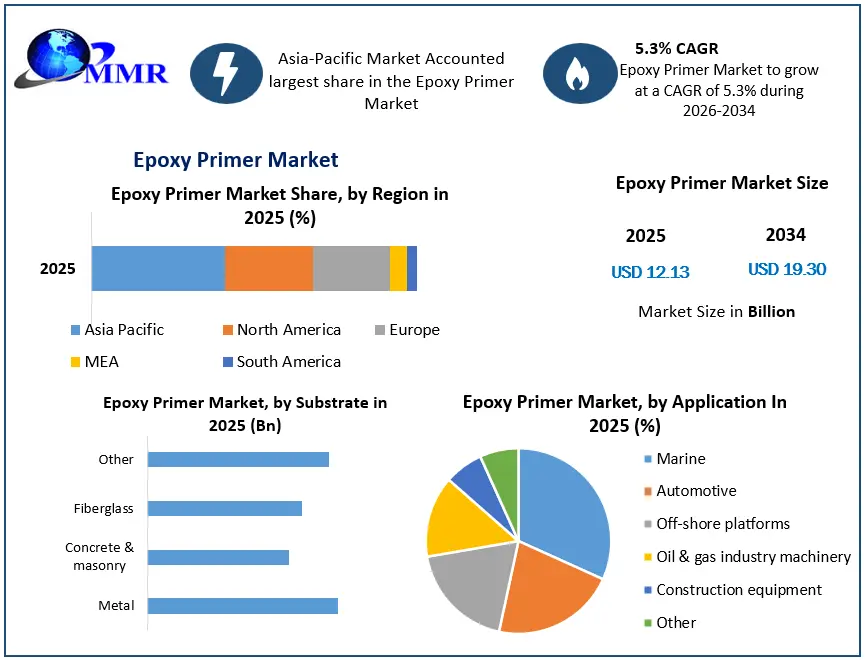
- Epoxy Primer Market was valued at USD 12.13 Billion in 2025.
- Market revenue is projected to reach USD 19.30 Billion by 2034.
- Expected CAGR stands at 5.3% during 2025–2034.
- Infrastructure modernization continues to strengthen protective coating demand.
- Automotive, marine, construction, and industrial manufacturing remain major downstream consumers.
- Sustainability regulations are encouraging development of low-emission and environmentally compliant coating technologies.
- Capacity investments are increasingly focused on high-performance specialty coatings rather than commodity products.
Why This Matters Now
Industrial manufacturers are facing tighter corrosion standards, longer asset life requirements, and increasing sustainability obligations simultaneously. These forces are changing procurement priorities across construction, transportation, energy, and heavy manufacturing.
The Epoxy Primer Market, valued at USD 12.13 Billion in 2025 and expected to reach USD 19.30 Billion by 2034 at a 5.3% CAGR, signals sustained investment in protective coating technologies. For coating manufacturers, the implication is clear: demand is increasingly shifting toward higher-performance formulations that reduce maintenance costs while meeting evolving environmental regulations.
Market Overview
The Epoxy Primer Market primers remain one of the most widely used protective coating systems because they combine strong adhesion, corrosion resistance, chemical durability, and compatibility with multiple topcoat systems. Their importance continues to increase as governments and private investors commit to long-term infrastructure projects that require extended service life and lower maintenance costs.
Demand is also expanding across automotive manufacturing, marine applications, industrial machinery, oil and gas equipment, and commercial construction. Every additional infrastructure investment translates into higher consumption of corrosion-resistant coating systems, creating consistent downstream demand for epoxy-based primers.
At the same time, the industry is experiencing structural changes beyond simple volume growth. Customers increasingly evaluate coatings based on lifecycle economics rather than upfront purchase price. Procurement teams are placing greater emphasis on durability, environmental compliance, and maintenance reduction.
Manufacturers are responding through investments in advanced formulations designed to improve application efficiency, enhance corrosion protection, and comply with stricter environmental standards. This transition strengthens the position of specialty coating suppliers capable of delivering differentiated performance instead of competing primarily on price.
Key Trends Driving Growth
Infrastructure investment remains the market’s most influential growth catalyst. Governments continue expanding transportation networks, industrial facilities, ports, bridges, and public utilities. These projects require protective coating systems capable of preventing corrosion over extended operating periods, making epoxy primers an essential material rather than an optional specification.
Automotive manufacturers also continue demanding higher-performance primer systems. Improved corrosion resistance directly supports longer vehicle warranties while reducing maintenance costs. This increases the value proposition of premium coating technologies.
Marine applications represent another stable source of demand. Ships, offshore structures, and port infrastructure operate in highly corrosive environments where protective coatings significantly influence asset longevity. As global shipping fleets modernize, coating requirements continue to evolve toward higher-performance systems.
Environmental regulation is simultaneously reshaping product development. Manufacturers are increasingly investing in formulations that reduce emissions while maintaining coating performance. Compliance is becoming a competitive advantage rather than merely a regulatory obligation.
Raw material management is also receiving greater strategic attention. Epoxy resin availability, specialty additives, curing agents, and pigment costs influence production economics across the coatings industry. Companies with diversified sourcing strategies are better positioned to manage pricing volatility and maintain supply continuity.
Technology development continues moving toward coatings that improve application efficiency, curing performance, and long-term durability. These innovations help industrial customers reduce maintenance shutdowns, lower lifecycle costs, and improve operational reliability.
Together, these trends indicate that competitive advantage will increasingly depend on innovation, manufacturing efficiency, regulatory compliance, and supply chain resilience rather than production scale alone.
Segment Insights
- Dominant Segment: Not specified in the supplied report.
- Fastest-Growing Segment: Not specified in the supplied report.
- Demand continues to be supported by multiple downstream industries including construction, automotive, industrial equipment, and marine applications. This diversified customer base reduces dependence on any single end-use industry and improves long-term market stability.
- Specialty epoxy primer formulations are attracting greater attention as customers prioritize corrosion resistance, durability, and compatibility with increasingly sophisticated coating systems.
- Procurement decisions are increasingly based on total lifecycle performance rather than initial material cost. This benefits manufacturers capable of demonstrating measurable reductions in maintenance frequency and asset downtime.
Regional Growth Story
Asia-Pacific continues to benefit from large-scale industrialization, manufacturing expansion, and infrastructure investment. China and India remain central production and consumption markets because of ongoing construction activity, transportation development, and industrial capacity additions.
The United States continues investing in infrastructure modernization and advanced manufacturing facilities. These investments support consistent demand for protective coatings used across bridges, transportation equipment, industrial plants, and energy infrastructure.
Germany remains an important European market due to its advanced automotive manufacturing, engineering capabilities, and industrial equipment production. Coating performance standards remain particularly high across these sectors.
Japan and South Korea continue emphasizing technologically advanced coating systems for automotive, electronics manufacturing, and precision industrial applications where durability and quality remain critical purchasing criteria.
Across all major regions, regulatory requirements concerning environmental performance continue influencing product portfolios. Manufacturers capable of balancing regulatory compliance with high-performance corrosion protection are likely to strengthen their competitive positions in both developed and emerging markets.
Competitive Landscape
Competition increasingly favors companies capable of combining product innovation with manufacturing efficiency and supply chain resilience. Rather than competing exclusively on pricing, leading suppliers are differentiating through performance, durability, and regulatory compliance.
Capacity investments increasingly signal confidence in long-term industrial demand rather than short-term market cycles. Expansion strategies also indicate efforts to improve regional supply availability, shorten delivery times, and reduce logistics risks for industrial customers.
Technology investments demonstrate that competitive positioning is moving toward specialty coatings offering enhanced corrosion resistance, faster application, and improved environmental performance. These capabilities create stronger pricing power compared with standard commodity coating products.
Strategic investments across manufacturing, research, and product development also suggest that market participants expect customer requirements to become increasingly sophisticated. Suppliers capable of delivering technical support alongside product performance are likely to strengthen long-term customer relationships while improving capacity utilization and protecting margins.
Recent Developments
- Increased investment focus on advanced corrosion-resistant coating technologies.
- Growing emphasis on environmentally compliant epoxy primer formulations.
- Continued manufacturing investments supporting industrial coating demand.
- Rising adoption of high-performance specialty coating solutions across infrastructure and transportation applications.
Strategic Implications
For manufacturers, product differentiation is becoming more valuable than production volume alone. Investment in advanced formulations, application efficiency, and sustainability will increasingly determine competitive success.
Industrial buyers should prioritize suppliers capable of ensuring consistent raw material availability while meeting increasingly demanding performance specifications. Supply continuity has become as important as product quality.
Investors should monitor companies expanding specialty coating portfolios instead of relying solely on conventional protective coatings. Higher-value specialty products typically offer stronger margins and greater resilience against commodity pricing pressure.
Future Outlook
The Epoxy Primer Market is entering a period where technological capability will increasingly determine competitive leadership. Infrastructure investment, industrial modernization, automotive production, and marine asset protection continue providing structural demand support across global markets.
Sustainability requirements are expected to accelerate innovation in coating chemistry, encouraging manufacturers to develop products that combine environmental compliance with superior corrosion protection. Companies investing in resilient supply chains, specialty formulations, and manufacturing efficiency will be better positioned to capture premium market opportunities.
The companies that combine performance innovation with sustainable manufacturing and reliable supply networks will define the next phase of competition in the global Epoxy Primer Market.
Analyst Perspective
“The Epoxy Primer Market is transitioning from volume-driven competition toward value-driven innovation. Companies that strengthen product performance, regulatory compliance, and manufacturing resilience will be best positioned to capitalize on expanding industrial demand over the coming decade.” — Ankita Kagwade
About Maximize Market Research
Maximize Market Research Pvt. Ltd. (MMR) is a global market research and consulting company that provides reliable, data-focused, and practical business insights. The firm serves a wide range of industries, including healthcare, pharmaceuticals, technology, automotive, electronics, chemicals, personal care, and consumer goods. Through market forecasts, competitive analysis, strategic consulting, and industry impact assessments, MMR helps organizations understand changing market conditions, identify growth opportunities, and make informed business decisions for long-term success.
2nd Floor, Navale IT Park Phase 3
Pune Banglore Highway, Narhe
Pune, Maharashtra 411041, India
+91 9607365656
sales@maximizemarketresearch.com
