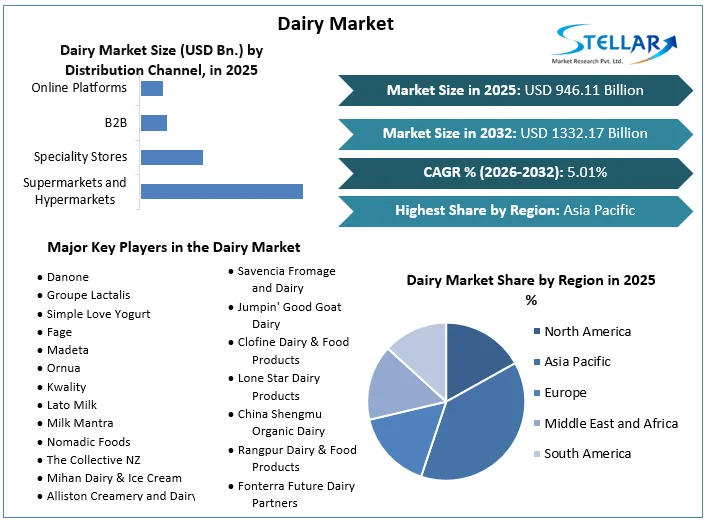
Dairy Market size was valued at USD 946.11 Bn. in 2025 and the Dairy revenue is expected to grow at a CAGR of 5.01% from 2026 to 2032, reaching nearly USD 1332.17 Bn. by 2032.
The global Dairy Market continues to play a fundamental role in the food and beverage industry, supplying essential nutrition to billions of consumers worldwide. From fresh milk and cheese to yogurt, butter, cream, and value-added dairy products, the industry has evolved significantly in response to changing consumer preferences, technological advancements, and sustainability initiatives. Increasing demand for protein-rich foods, functional dairy products, and convenient ready-to-consume offerings is creating new growth opportunities for dairy manufacturers.
Urbanization, rising disposable incomes, expanding retail networks, and growing awareness of the nutritional benefits of dairy products are driving market expansion across both developed and emerging economies. At the same time, manufacturers are investing in digital technologies, advanced processing equipment, and environmentally responsible production methods to improve efficiency and meet evolving consumer expectations.
Download Free PDF Brochure: https://www.stellarmr.com/report/req_sample/Dairy-Market/1986
Market overview
The dairy market encompasses the production, processing, packaging, and distribution of milk and a wide range of dairy products derived from cattle, buffalo, goats, sheep, and other livestock. Products include drinking milk, yogurt, cheese, butter, cream, condensed milk, ice cream, whey protein, lactose, and specialty dairy ingredients used across the food processing industry.
The market has shifted beyond traditional dairy consumption toward premium, fortified, lactose-free, organic, and high-protein products that cater to modern dietary preferences. Manufacturers are also expanding product portfolios with flavored milk, probiotic beverages, Greek yogurt, and functional dairy snacks that offer additional health benefits.
Growing demand from the foodservice sector, bakery industry, confectionery manufacturers, and nutritional supplement companies continues to strengthen global dairy consumption.
Key market growth drivers
Growing demand for protein-rich nutrition
Consumers are increasingly adopting healthier eating habits and seeking foods rich in calcium, protein, vitamins, and probiotics. Dairy products remain among the most trusted sources of essential nutrients, supporting demand across all age groups.
The popularity of sports nutrition, functional foods, and wellness-focused diets has further increased demand for high-protein dairy products such as Greek yogurt, whey protein, and fortified milk beverages.
Expansion of value-added dairy products
Traditional milk consumption is gradually being complemented by premium dairy products offering improved taste, convenience, and nutritional value. Functional yogurt, flavored milk, probiotic drinks, specialty cheese, lactose-free milk, and premium butter are attracting consumers looking for differentiated food experiences.
Continuous product innovation enables manufacturers to capture higher-value market segments while improving profitability.
Technological advancements in dairy processing
Automation, digital quality control systems, and advanced processing technologies are improving production efficiency while ensuring product consistency and food safety. Modern dairy plants increasingly utilize robotics, smart sensors, artificial intelligence, and real-time monitoring systems to optimize production and reduce operational costs.
These innovations help manufacturers meet growing global demand while maintaining strict quality standards.
Emerging opportunities
One of the most significant opportunities within the dairy market lies in functional and fortified dairy products. Consumers increasingly seek products enriched with probiotics, vitamins, minerals, omega-3 fatty acids, and immune-supporting ingredients.
Organic dairy products also continue gaining popularity as environmentally conscious consumers prioritize clean-label and sustainably produced foods.
Emerging economies across Asia-Pacific, Latin America, and Africa present substantial growth opportunities due to increasing urbanization, rising middle-class populations, expanding cold chain infrastructure, and growing retail penetration.
Export opportunities for premium cheese, butter, milk powder, infant nutrition products, and dairy ingredients continue expanding as international food trade grows.
Technology trends transforming the market
Technology is reshaping the dairy industry from farm to consumer. Smart dairy farms increasingly use automated milking systems, wearable livestock sensors, artificial intelligence, and Internet of Things (IoT) technologies to monitor animal health, improve milk yield, and optimize farm operations.
Advanced pasteurization, ultra-high temperature (UHT) processing, membrane filtration, and precision fermentation technologies enhance product quality while extending shelf life.
Artificial intelligence also assists manufacturers in demand forecasting, supply chain optimization, predictive maintenance, and quality assurance throughout dairy production facilities.
Digital traceability platforms enable manufacturers to monitor milk quality from farms to retail shelves, strengthening consumer confidence and regulatory compliance.
Sustainability and regulatory landscape
Sustainability has become a strategic priority across the global dairy industry. Manufacturers are investing in renewable energy, water conservation technologies, recyclable packaging, and methane emission reduction initiatives to minimize environmental impact.
Responsible animal welfare practices, sustainable feed management, and carbon footprint reduction programs are increasingly influencing purchasing decisions among environmentally conscious consumers.
Governments continue strengthening food safety regulations, quality standards, labeling requirements, and traceability systems to ensure safe dairy production and consumer protection. Compliance with international food safety certifications also supports expanding export opportunities.
These sustainability initiatives not only improve environmental performance but also strengthen long-term business resilience.
Regional insights
Asia-Pacific dominates the global dairy market due to its large population, increasing disposable incomes, and rising demand for nutritional foods. Countries such as India and China continue expanding dairy production while investing in modern processing infrastructure and cold chain logistics.
Europe remains a major producer of premium dairy products, particularly cheese, butter, and specialty milk ingredients. Strong dairy traditions, advanced processing capabilities, and export-oriented production support regional market leadership.
North America represents another important market driven by innovation in functional dairy products, premium cheese, protein ingredients, and sports nutrition. Advanced dairy farming practices and technological leadership continue strengthening regional competitiveness.
Latin America benefits from expanding dairy farming and growing domestic consumption, while the Middle East & Africa are witnessing increasing dairy demand supported by population growth, urbanization, and investments in food processing infrastructure.
Competitive landscape
- Groupe Lactalis
- Simple Love Yogurt
- Fage
- Madeta
- Ornua
- Kwality
- Lato Milk
- Milk Mantra
- Nomadic Foods
- The Collective NZ
Download Free PDF Brochure: https://www.stellarmr.com/report/req_sample/Dairy-Market/1986
Future outlook
The future of the Dairy Market remains highly promising as global demand for nutritious, convenient, and value-added dairy products continues to increase. Technological innovation, sustainable farming practices, digital transformation, and premium product development will remain key growth drivers throughout the coming years.
Manufacturers will continue investing in automation, artificial intelligence, precision dairy farming, and environmentally responsible production systems to improve efficiency and reduce environmental impact. Functional dairy products, organic offerings, and high-protein nutrition will continue attracting health-conscious consumers worldwide.
As consumer expectations evolve and global food demand increases, the dairy industry will remain one of the most dynamic segments of the food sector. Companies that successfully combine innovation, sustainability, food safety, and premium product development will be well positioned to capitalize on long-term opportunities in the global Dairy Market.
Media Contact
Stellar Market Research
Website: Stellar Market Research – Global Research Reports & Consulting
Email: sales@stellarmr.com
