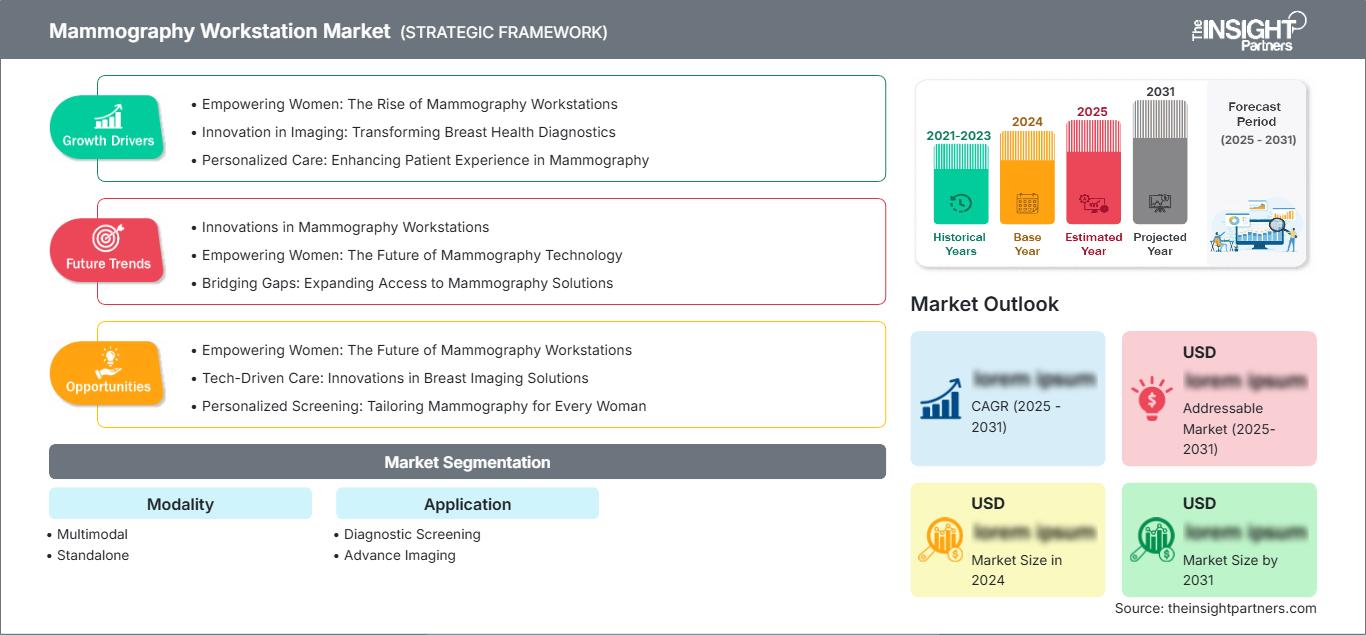
Mammography workstations are advanced medical imaging platforms designed to support the interpretation, analysis, storage, and management of digital mammography images. These systems enable radiologists to review high-resolution breast images, compare historical examinations, perform image enhancement, generate diagnostic reports, and integrate with hospital information systems and picture archiving and communication systems (PACS). Modern mammography workstations increasingly incorporate artificial intelligence, computer-aided detection (CAD), breast density analysis, and 3D tomosynthesis visualization to improve diagnostic accuracy and workflow efficiency. Growing emphasis on early breast cancer detection continues driving adoption of advanced mammography imaging technologies worldwide.
Market Overview
The Mammography Workstation Market is projected to grow from US$ 2.08 Billion in 2025 to US$ 3.48 Billion by 2034. The market is anticipated to register a CAGR of 6.68% during the forecast period 2026-2034. Market growth is supported by increasing breast cancer screening programs, expanding healthcare infrastructure, rising adoption of digital breast imaging, growing demand for AI-assisted diagnostics, and continuous advancements in medical imaging technologies.
Key Market Insights
- Market Size (2025): US$ 2.08 Billion
- Forecast Market Size (2034): US$ 3.48 Billion
- CAGR (2026-2034): 6.68%
- Key Growth Driver: Increasing breast cancer screening and early diagnosis initiatives
- Major Trend: AI-powered mammography interpretation and 3D breast imaging
- Forecast Period:2026-2034
Get a Sample PDF of the Report: https://www.theinsightpartners.com/sample/TIPRE00019103
Market Drivers
Growing Breast Cancer Screening Programs
Governments and healthcare organizations continue expanding national breast cancer screening initiatives to improve early detection and increase survival rates, driving demand for advanced mammography workstations.
Increasing Adoption of Digital Mammography
Healthcare providers are replacing conventional imaging systems with digital mammography platforms that deliver higher image quality, faster diagnosis, and improved clinical workflow.
Rising Integration of Artificial Intelligence
Artificial intelligence and computer-aided detection technologies are enhancing image interpretation, lesion identification, workflow automation, and diagnostic confidence for radiologists.
Expansion of Healthcare Infrastructure
Increasing investments in hospitals, diagnostic imaging centers, specialty clinics, and women’s healthcare facilities are supporting widespread adoption of modern mammography workstations.
Market Trends
3D Digital Breast Tomosynthesis
Healthcare providers increasingly utilize digital breast tomosynthesis workstations to improve cancer detection rates, particularly in women with dense breast tissue.
Cloud-Based Medical Imaging
Cloud-enabled imaging platforms improve image storage, remote collaboration, tele-radiology services, and secure access to patient imaging records across healthcare networks.
Advanced Visualization Tools
Modern workstations include high-resolution displays, image enhancement software, automated measurements, and integrated reporting capabilities that improve diagnostic efficiency.
Workflow Automation
Automation technologies are streamlining image acquisition, case prioritization, reporting, and clinical decision support to improve radiology department productivity.
Regional Analysis
North America
North America remains the largest market due to high breast cancer screening rates, advanced healthcare infrastructure, widespread digital imaging adoption, and strong investments in AI-powered diagnostic technologies.
Europe
Europe continues witnessing significant market growth supported by organized screening programs, healthcare modernization, increasing digital healthcare adoption, and growing demand for precision diagnostics. Germany, France, the United Kingdom, Italy, and Spain remain key contributors.
Asia-Pacific
Asia-Pacific is expected to register the fastest growth owing to expanding healthcare infrastructure, increasing awareness of breast cancer screening, rising healthcare expenditure, growing medical imaging investments, and rapid adoption of digital healthcare technologies. China, Japan, India, South Korea, and Australia continue driving regional demand.
Middle East and Africa
The Middle East and Africa are increasingly investing in women’s healthcare services, cancer screening programs, diagnostic imaging centers, and hospital modernization initiatives, creating new opportunities for mammography workstation providers.
Get the Premium Research Report @ https://www.theinsightpartners.com/buy/TIPRE00019103
Competitive Landscape
The Mammography Workstation Market remains highly competitive as medical imaging companies, healthcare technology providers, radiology software developers, and diagnostic equipment manufacturers continue investing in artificial intelligence, cloud imaging, advanced visualization, computer-aided detection, and integrated diagnostic platforms. Companies are focusing on improving image quality, workflow efficiency, clinical decision support, interoperability, and patient outcomes while expanding digital breast imaging capabilities.
Key Players
- GE HealthCare Technologies Inc.
- Siemens Healthineers AG
- Hologic, Inc.
- FUJIFILM Holdings Corporation
- Canon Medical Systems Corporation
- Koninklijke Philips N.V.
- Carestream Health
- Agfa-Gevaert Group
- Planmed Oy
- Konica Minolta, Inc.
Emerging Trends
The mammography workstation industry continues advancing through artificial intelligence, digital breast tomosynthesis, cloud-based radiology platforms, computer-aided diagnosis, deep learning image analysis, tele-radiology, advanced visualization software, breast density assessment, precision oncology, and integrated healthcare information systems. Manufacturers are developing next-generation workstations capable of delivering faster image processing, enhanced diagnostic accuracy, automated reporting, and seamless integration with enterprise healthcare platforms. Growing investments in digital healthcare transformation are expected to create significant opportunities throughout the forecast period.
Future Outlook
The future outlook for the Mammography Workstation Market remains highly promising as healthcare providers continue prioritizing early breast cancer detection and precision diagnostics. Rising adoption of AI-powered imaging, expanding screening initiatives, increasing digital healthcare investments, and continuous innovation in medical imaging technologies will continue driving market growth. Future developments are expected to focus on intelligent clinical decision support, fully automated image analysis, cloud-native imaging workflows, and personalized breast cancer diagnostics.
Related Market Research Reports
Temperature Indicator Market Size, Growth & Trends by 2034
Optical Data Storage Devices Market Growth, Trends & Forecast by 2034
Industrial Tablet PC Market Size, Trends & Growth by 2034
Source Measure Unit Market Growth, Demand & Size by 2034
About The Partners
The Insight Partners is a Insight global leader in market research, delivering comprehensive analysis and actionable insights across diverse industries. The company empowers decision-makers with data-driven intelligence to navigate evolving markets and accelerate growth.
Contact Us:
- Contact Person: Ankit Mathur
- E-mail: ankit.mathur@theinsightpartners.com
- Phone: +1-646-491-9876
Also Available in :
