Key Highlights
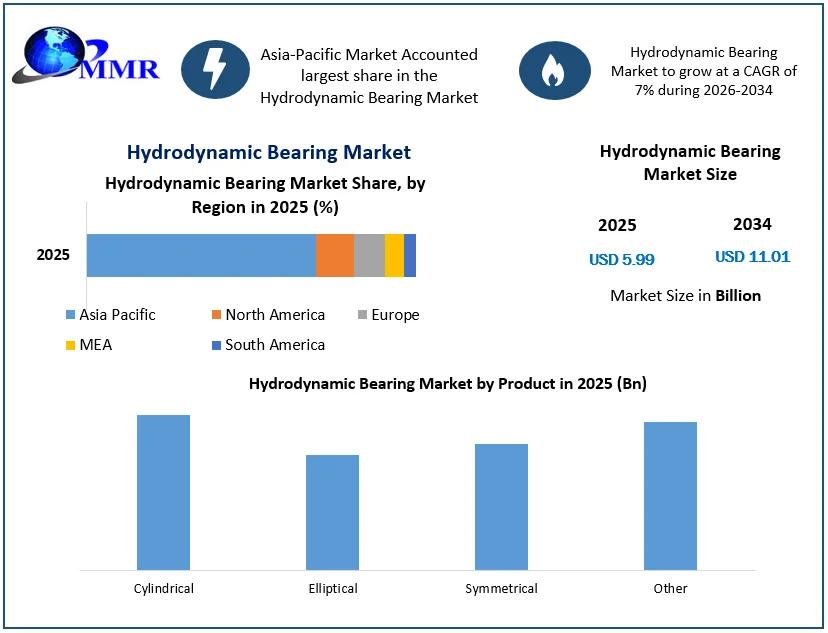
- Global Hydrodynamic Bearing Market was valued at USD 5.99 billion in 2025.
- The market is projected to reach USD 11.01 billion by 2034, expanding at a 7% CAGR from 2026 to 2034.
- Automotive manufacturing remains a major demand center for high-performance hydrodynamic bearings.
- Growing investments in EV production, industrial automation, and precision engineering are supporting long-term demand.
- OEMs continue prioritizing durable, low-friction bearing technologies to improve efficiency and equipment reliability.
- Asia-Pacific remains the leading manufacturing region supported by strong automotive and industrial production capacity.
Why This Matters Now
Automotive manufacturers are redesigning powertrains while industrial producers are demanding longer equipment life and higher operating efficiency. These shifts are increasing the strategic importance of hydrodynamic bearing technologies across modern manufacturing.
Bearings have become more than mechanical components. They now influence vehicle efficiency, production reliability, maintenance costs, and overall equipment performance. Manufacturers investing in advanced bearing technologies are strengthening operational resilience while meeting increasingly demanding performance standards.
Market Overview
The Global Hydrodynamic Bearing Market Size was valued at USD 5.99 billion in 2025 and is expected to reach USD 11.01 billion by 2034, growing at a CAGR of 7% during the forecast period.
Hydrodynamic bearings are designed to support rotating shafts through a lubricant film that minimizes direct surface contact. Their ability to reduce friction, vibration, and wear makes them essential across automotive engines, industrial machinery, turbines, compressors, pumps, rail transportation, marine systems, and heavy manufacturing equipment.
Market expansion is increasingly linked to investments in manufacturing modernization and advanced mobility technologies. Automotive OEMs continue improving drivetrain efficiency while industrial operators seek equipment capable of delivering higher reliability with reduced maintenance requirements.
The projected growth rate demonstrates healthy long-term investment momentum. Rising industrial output, expanding transportation infrastructure, and technological improvements continue supporting demand across both replacement and new equipment installations.
Key Trends Driving Growth
Powertrain innovation remains one of the strongest growth drivers. Manufacturers continue optimizing engines, transmissions, and rotating assemblies to improve fuel efficiency, durability, and operating performance. Hydrodynamic bearings help reduce mechanical losses while supporting high-speed operations under demanding conditions.
Electric vehicle production is reshaping engineering priorities. Although EV architectures differ from conventional internal combustion vehicles, manufacturers continue requiring precision rotating components for electric motors, auxiliary systems, and production equipment. New manufacturing facilities increasingly incorporate advanced bearing technologies designed for automated production environments.
Industrial automation is also expanding market opportunities. Smart factories depend on reliable rotating machinery operating with minimal downtime. Hydrodynamic bearings contribute to equipment longevity while supporting predictive maintenance strategies through stable operating performance.
Sustainability objectives are further influencing purchasing decisions. Manufacturers seek components capable of reducing energy consumption through lower friction and improved mechanical efficiency. This creates opportunities for suppliers offering advanced bearing designs and optimized lubrication technologies.
Supply chain resilience remains another strategic priority. Manufacturers increasingly evaluate suppliers based on production capacity, engineering expertise, delivery reliability, and long-term technical support. Stable sourcing has become essential as global industrial production continues expanding.
Segment Insights
- Dominant Segment: Automotive applications continue to represent one of the largest demand segments due to continuous vehicle production and ongoing powertrain improvements.
- Fastest-Growing Segment: Advanced industrial machinery and automated manufacturing applications continue expanding as industries invest in precision equipment and higher operational efficiency.
- Hydrodynamic bearings reduce friction while extending equipment operating life across automotive and industrial applications.
- High-performance lubrication technologies improve reliability under demanding operating conditions.
- Precision-engineered bearing systems support manufacturers pursuing higher productivity and lower maintenance costs.
Regional Growth Story
Asia-Pacific continues leading the Hydrodynamic Bearing Market through its extensive automotive manufacturing ecosystem and growing industrial production capacity. China, Japan, India, and South Korea remain major production centers supporting both domestic demand and international exports.
China continues investing in electric vehicle production, industrial automation, and advanced manufacturing facilities. These developments create sustained demand for precision mechanical components used across automotive assembly and industrial equipment.
Japan maintains leadership in precision engineering and high-quality automotive manufacturing. Continued investments in advanced production technologies support demand for reliable bearing systems capable of operating under increasingly demanding manufacturing conditions.
South Korea continues strengthening automotive and industrial production through technology-focused manufacturing investments. Growing exports further reinforce demand for high-performance bearing solutions.
India continues expanding automotive manufacturing alongside broader industrial development. Rising domestic production and infrastructure investment contribute to increasing demand for industrial machinery and transportation equipment utilizing advanced bearing technologies.
North America maintains steady demand supported by industrial modernization, heavy equipment manufacturing, and transportation infrastructure investment. Manufacturers continue upgrading production facilities to improve efficiency and operational reliability.
Europe remains focused on manufacturing quality, sustainability, and engineering excellence. Germany continues serving as a major automotive manufacturing hub where advanced bearing technologies support premium vehicle production and industrial automation initiatives.
Competitive Landscape
Competition increasingly centers on engineering capability rather than production volume alone. Manufacturers are differentiating through materials innovation, precision manufacturing, advanced lubrication technologies, and long-term equipment reliability.
Capacity expansions and technology investments indicate confidence in growing industrial demand. Companies investing in research and development strengthen their ability to serve automotive OEMs seeking higher-performance drivetrain components alongside industrial customers pursuing productivity improvements.
Strategic partnerships and manufacturing investments increasingly focus on expanding production capability while improving technological differentiation. Suppliers capable of delivering customized engineering solutions gain stronger positioning within increasingly competitive automotive and industrial supply chains.
Aftermarket support is also becoming an important competitive advantage. Customers increasingly value technical services, maintenance expertise, and long-term product availability alongside initial equipment performance.
Recent Developments
- Manufacturers continue expanding precision engineering capabilities to improve bearing durability and operational efficiency.
- Automation investments are increasing demand for advanced bearing systems across industrial production facilities.
- Automotive manufacturers continue modernizing powertrain technologies, supporting demand for high-performance rotating components.
- Sustainability initiatives are encouraging development of bearing solutions designed to reduce friction, improve efficiency, and extend equipment service life.
Strategic Implications
Hydrodynamic bearings are becoming increasingly important as manufacturers pursue operational efficiency across transportation and industrial production. Their influence extends beyond mechanical performance into maintenance planning, equipment availability, production costs, and lifecycle economics.
Automotive OEMs benefit from improved drivetrain performance and higher equipment reliability. Tier-1 suppliers capable of delivering advanced engineering solutions strengthen long-term relationships with vehicle manufacturers seeking durable, precision components.
Industrial equipment manufacturers also gain competitive advantages through reduced maintenance requirements and improved operational productivity. Investors should view continued market expansion as an indicator of broader manufacturing modernization rather than isolated component demand.
The growing emphasis on efficiency, automation, and sustainability positions advanced bearing technologies as strategic investments across global manufacturing industries.
Future Outlook
The Hydrodynamic Bearing Market is expected to maintain strong growth through 2034 as automotive innovation, industrial automation, and precision manufacturing continue accelerating worldwide. Companies investing in engineering innovation, manufacturing quality, and global supply capabilities will define future market leadership, while suppliers relying on conventional production strategies risk losing competitiveness in an increasingly technology-driven industry.
Analyst Perspective
Dharati Raut, Analyst at Maximize Market Research, said: “Hydrodynamic bearing technologies are becoming increasingly valuable as manufacturers prioritize efficiency, reliability, and long-term equipment performance. Companies investing in advanced engineering, precision manufacturing, and sustainable production capabilities will strengthen their competitive position across automotive and industrial markets.”
About Maximize Market Research
Maximize Market Research Pvt. Ltd. (MMR) is a global market research and consulting company that provides reliable, data-focused, and practical business insights. The firm serves a wide range of industries, including healthcare, pharmaceuticals, technology, automotive, electronics, chemicals, personal care, and consumer goods. Through market forecasts, competitive analysis, strategic consulting, and industry impact assessments, MMR helps organizations understand changing market conditions, identify growth opportunities, and make informed business decisions for long-term success.
2nd Floor, Navale IT Park Phase 3
Pune Banglore Highway, Narhe
Pune, Maharashtra 411041, India
+91 9607365656
sales@maximizemarketresearch.com
