Key Highlights
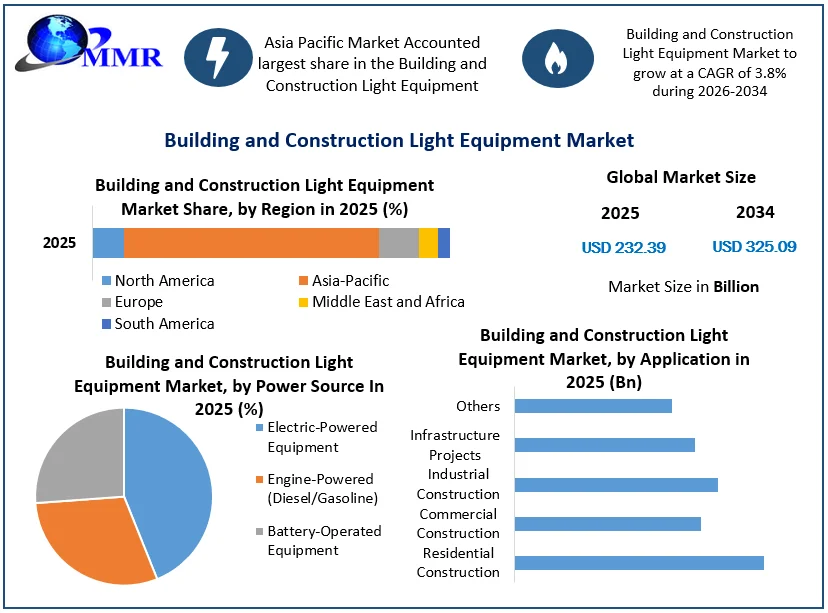
- The Building and Construction Light Equipment Market was valued at USD 232.39 billion in 2025.
- The market is projected to reach USD 325.09 billion by 2034.
- Revenue is expected to grow at a CAGR of 3.8% between 2026 and 2034.
- Growth is supported by expanding infrastructure projects and increased government spending.
- Demand for efficient, productive, and cost-effective construction equipment continues to rise.
- Manufacturers are investing in technology, sustainability, and fleet modernization to remain competitive.
Why This Matters Now
Infrastructure investment is becoming a strategic economic priority across major economies. Equipment manufacturers, construction contractors, fleet operators, and investors face growing pressure to expand capacity while improving productivity and meeting stricter environmental expectations.
The Building and Construction Light Equipment Market is benefiting directly from this shift. As governments increase spending on transportation, urban development, industrial facilities, and public infrastructure, demand for compact, efficient construction equipment continues to strengthen. Companies capable of delivering reliable equipment with lower operating costs are positioned to gain market share throughout the forecast period.
Market Overview
The Building and Construction Light Equipment Market Size was valued at USD 232.39 billion in 2025 and is expected to reach USD 325.09 billion by 2034, expanding at a CAGR of 3.8% from 2026 to 2034.
Light construction equipment plays an essential role across residential, commercial, industrial, and infrastructure projects. Equipment designed for portability, operational flexibility, and productivity enables contractors to complete projects more efficiently while reducing labor intensity and operating costs.
Global construction activity continues to increase as governments prioritize transportation infrastructure, affordable housing, industrial expansion, and urban modernization. These investments create sustained demand for equipment capable of supporting excavation, compaction, concrete work, material handling, and site preparation.
The market also benefits from rising equipment replacement cycles. Contractors increasingly seek machinery offering improved fuel efficiency, durability, lower maintenance requirements, and enhanced operator safety. These purchasing priorities encourage manufacturers to invest in product innovation while strengthening long-term customer relationships.
Key Trends Driving Growth
Infrastructure investment remains the strongest market catalyst. Public spending on highways, rail networks, airports, ports, utilities, and urban development projects continues to generate stable equipment demand across developed and emerging economies.
Contractors are increasingly prioritizing operational efficiency. Compact equipment capable of performing multiple functions helps reduce project timelines while improving labor productivity. This creates demand for advanced light construction machinery that combines mobility with high performance.
Rental fleets continue to influence purchasing decisions. Construction companies increasingly rely on rental providers to manage project-specific equipment needs while reducing capital expenditure. Manufacturers with strong relationships across rental networks gain broader market access and recurring replacement demand.
Digital technologies are gradually improving equipment performance. Fleet monitoring, predictive maintenance, telematics, and connected equipment help contractors reduce downtime while improving asset utilization. Equipment manufacturers incorporating these technologies strengthen customer value propositions beyond traditional machinery sales.
Environmental considerations also shape product development. Demand is increasing for equipment that improves fuel efficiency, reduces emissions, and complies with evolving environmental regulations across major construction markets.
Segment Insights
- Dominant Segment: The report identifies the leading segment based on product and application analysis.
- Fastest-Growing Segment: The report highlights the fastest-expanding segment supported by infrastructure investments and construction modernization.
- Infrastructure construction continues to represent a major application area due to sustained public investment.
- Residential and commercial construction projects support consistent replacement demand for compact equipment.
- Equipment emphasizing productivity, operational efficiency, and lower lifecycle costs continues to attract contractor investment.
Regional Growth Story
Infrastructure development remains the primary growth driver across major construction markets.
Asia-Pacific continues to benefit from rapid urbanization, industrial expansion, transportation infrastructure development, and large-scale government investments. China and India remain major contributors through ongoing investments in highways, railways, commercial buildings, industrial facilities, and smart city initiatives.
North America maintains stable demand through transportation modernization, residential construction, energy infrastructure projects, and equipment fleet replacement. Contractors increasingly invest in technologically advanced machinery capable of improving operational efficiency and reducing ownership costs.
Europe focuses on infrastructure renewal, sustainable construction, and modernization of transportation networks. Equipment manufacturers emphasizing environmental performance and productivity improvements remain well positioned across mature European markets.
Germany continues to support advanced equipment manufacturing through engineering capabilities and industrial construction activity. Japan and South Korea maintain demand through infrastructure maintenance, urban redevelopment, and technological innovation within construction machinery production.
Emerging economies continue expanding construction capacity as governments prioritize economic development through transportation, utilities, housing, and industrial investment. These markets create long-term opportunities for manufacturers capable of delivering durable equipment supported by strong distribution networks.
Competitive Landscape
Competition increasingly depends on technological differentiation rather than equipment availability alone. Manufacturers investing in productivity improvements, connected equipment, fleet management solutions, and operator safety strengthen competitive positioning while supporting premium pricing.
Capacity expansion signals confidence in long-term infrastructure investment. Companies increasing production capabilities prepare for growing equipment demand while improving responsiveness to regional construction cycles.
Investment in research and development enables manufacturers to introduce equipment offering higher fuel efficiency, lower maintenance requirements, and enhanced durability. These improvements help contractors reduce total ownership costs, creating stronger customer retention.
Strategic partnerships across dealer networks, rental companies, and equipment service providers also strengthen competitive advantages. Companies capable of combining manufacturing excellence with aftermarket support improve long-term revenue stability while reinforcing customer loyalty.
Recent Developments
- Manufacturers continue investing in advanced construction equipment technologies.
- Infrastructure investment programs support expanding equipment demand worldwide.
- Fleet modernization initiatives encourage replacement of aging construction machinery.
- Product innovation focuses on improving fuel efficiency, operator safety, and equipment productivity.
- Distribution and service network expansion strengthens aftermarket support and customer retention.
Strategic Implications
Equipment manufacturers should prioritize innovation that delivers measurable productivity improvements rather than incremental design changes. Contractors increasingly evaluate machinery based on operational efficiency, lifecycle costs, and equipment reliability.
Rental companies remain influential purchasing partners. Expanding rental fleets generate recurring equipment demand while accelerating replacement cycles. Manufacturers capable of supporting rental operators with maintenance services, digital fleet management, and rapid parts availability strengthen long-term market positions.
Investors should monitor companies expanding manufacturing capacity alongside technological capabilities. Businesses combining production scale with product innovation are likely to strengthen margins as infrastructure spending continues over the coming decade.
Construction firms should also evaluate equipment investments through total cost of ownership rather than purchase price alone. Higher productivity and lower maintenance costs increasingly determine project profitability.
Future Outlook
The Building and Construction Light Equipment Market will continue benefiting from sustained infrastructure spending, construction modernization, and demand for efficient project execution. Technology integration, fleet modernization, and equipment innovation will increasingly determine competitive leadership as contractors prioritize productivity and operational efficiency.
Manufacturers that invest early in innovation, manufacturing capacity, and customer support will lead the next phase of market expansion, while companies competing primarily on equipment pricing will struggle to sustain long-term growth.
Analyst Perspective
“The Building and Construction Light Equipment Market continues to benefit from expanding infrastructure investment, government-backed construction programs, and increasing demand for productive, efficient machinery. Manufacturers that combine equipment innovation with operational efficiency and strong aftermarket support will be best positioned to capture long-term opportunities across global construction markets,” says Dharati Raut, Analyst, Maximize Market Research.
About Maximize Market Research
Maximize Market Research Pvt. Ltd. (MMR) is a global market research and consulting company that provides reliable, data-focused, and practical business insights. The firm serves a wide range of industries, including healthcare, pharmaceuticals, technology, automotive, electronics, chemicals, personal care, and consumer goods. Through market forecasts, competitive analysis, strategic consulting, and industry impact assessments, MMR helps organizations understand changing market conditions, identify growth opportunities, and make informed business decisions for long-term success.
2nd Floor, Navale IT Park Phase 3
Pune Banglore Highway, Narhe
Pune, Maharashtra 411041, India
+91 9607365656
sales@maximizemarketresearch.com
