Key Highlights
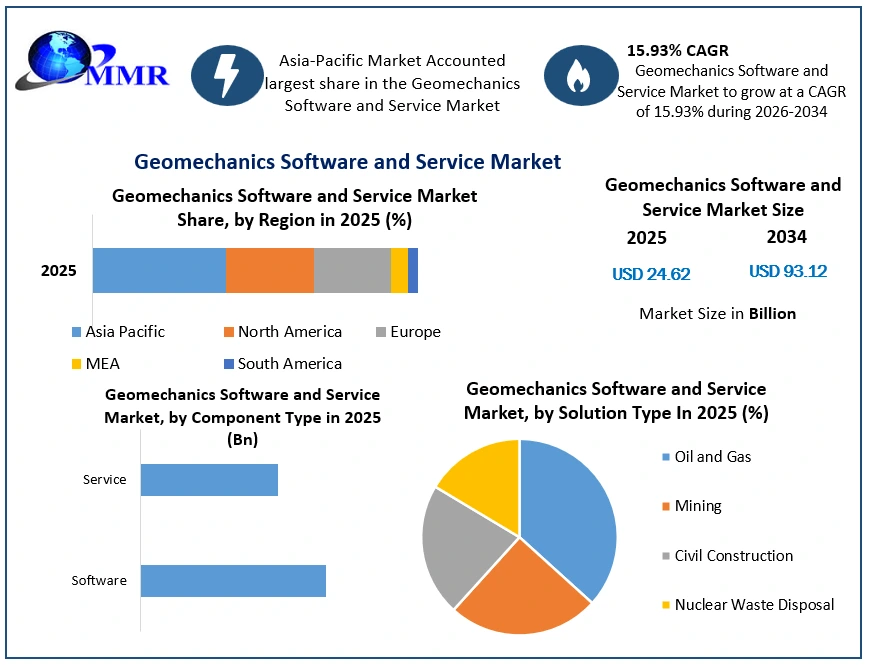
Market Valuation: Valued at US$ 24.62 Billion in 2025, the market is projected to reach US$ 93.12 Billion by 2034, expanding at a CAGR of 15.93%.
Dominant Segment: Software licensing, specifically integrated 3D modeling and multi-physics simulation platforms, commands the majority market share.
Fastest-Growing Segment: Real-time geomechanics consulting and cloud-based Software-as-a-Service (SaaS) subscription models are expanding at the highest CAGR.
Core Drivers: Rising deepwater exploration complexity, carbon capture and storage (CCS) site characterization, and strict regulatory mandates for structural asset safety.
Why This Matters Now
Subsurface operational risks are escalating for chemical manufacturers, upstream energy operators, and mining conglomerates. Drilling into deeper, ultra-pressurized formations requires precise, real-time stress modeling to prevent catastrophic borewell collapses, reservoir failures, and fluid leaks. This shift from reactive geology to predictive, multi-physics geomechanical modeling is no longer optional; it is a critical baseline for securing insurance, regulatory approvals, and capital investments.
Geomechanics software allows engineers to construct high-fidelity, three-dimensional models of rock mechanics and pore pressures. By predicting how rock formations will deform under stress, thermal variations, and fluid chemical interactions, operators can optimize drilling trajectories, prevent sand production, and secure the structural integrity of carbon sequestration wells. The technology directly shields downstream supply chains from supply shocks by preventing upstream extraction failures.
Market Overview
The global Geomechanics Software and Service Market is experiencing a structural demand shift as industries transition toward highly complex geologic environments. The market, valued at US$ 24.62 Billion in 2025, is on a trajectory to reach US$ 93.12 Billion by 2034, accelerating at a CAGR of 15.93%. This high-growth path reflects a transition from simplistic 2D empirical profiling to fully integrated, dynamic 3D numerical simulations.
In the energy sector, traditional easy-to-reach reservoirs are depleting, forcing operators to target complex high-pressure, high-temperature (HPHT) fields. This exploration environment requires sophisticated rock mechanics software to prevent expensive drill-string failures and fluid losses. Simultaneously, civil infrastructure projects—ranging from deep urban transit tunnels to massive hydroelectric dams—rely heavily on geomechanical analysis to ensure ground stability in densely populated zones.
Key Trends Driving Growth
1. The Carbon Capture, Utilization, and Storage (CCUS) Surge
The global push toward carbon neutrality has positioned CCUS as a critical demand driver. Injecting millions of tons of supercritical carbon dioxide into depleted reservoirs or saline aquifers alters subsurface pressure and thermal equilibrium. Geomechanical software is essential to model these pressure changes, ensuring the sealing caprock does not fracture and leak gas over centuries.
2. Integration of Artificial Intelligence and Machine Learning
Traditional geomechanical workflows require weeks of manual data integration and computation. The industry is actively adopting AI-driven modeling, which reduces computing time from days to minutes. Machine learning algorithms process real-time drilling data (such as rate of penetration and mud weight) to instantly update subsurface stress models, allowing active adjustments to prevent borehole collapse.
Segment Insights
Dominant Segment (Software): Integrated 3D modeling and simulation suites remain the dominant segment, accounting for over 54% of market revenue. These platforms combine geological, geophysical, and geomechanical workflows into a single interface.
Fastest-Growing Segment (Services): Implementation, maintenance, and expert consulting services are growing at the fastest rate. The scarcity of specialized in-house geomechanical engineers is driving operators to outsource complex rock physics analysis to specialized software vendors.
End-Use Leader (Oil & Gas): The upstream energy sector continues to hold the largest market share, driven by deepwater drilling and reservoir optimization.
Emerging End-Use (Mining & Civil Infrastructure): Deep-underground mining operations and high-speed rail tunneling projects represent the fastest-growing civil applications, aiming to minimize rockbursts and soil subsidence.
Regional Growth Story
North America’s Tech and Shale Dominance
North America dominates the global market, holding approximately 38% of total revenue. This position is sustained by intense unconventional shale development in the Permian Basin and extensive deepwater assets in the Gulf of Mexico. Furthermore, the region’s early adoption of cloud-based simulation software and rigorous EPA regulations on injection wells drive sustained software procurement.
Europe’s Regulatory and Geothermal Focus
Europe represents the second-largest market, with demand highly concentrated in Germany, Norway, and the United Kingdom. European growth is driven by strict environmental safety mandates and a rapid expansion of deep geothermal energy projects, which require geomechanical modeling to avoid micro-seismic events during hydraulic stimulation.
Asia-Pacific’s Infrastructure Boom
The Asia-Pacific region, led by China and India, is the fastest-growing market. Massive public investments in high-speed rail systems, underground gas storage facilities, and deep coal mining safety drive rapid software adoption. Governments in this region are actively mandating advanced geotechnical risk assessments to minimize industrial accidents.
Competitive Landscape
The geomechanics software and service market is consolidated among a few major oilfield service providers and specialized engineering firms. This structure grants established players high pricing power, though cloud-native startups are beginning to challenge traditional on-premise licensing models.
The competitive strategy is defined by consolidation and integration. Major oilfield service providers are actively acquiring niche software developers to incorporate advanced rock mechanics directly into their broader petrotechnical platforms, offering clients a single, end-to-end workflow.
Recent Developments
API and Interoperability Focus: Leading software vendors are rewriting legacy codebases to run natively on open cloud architectures, enabling seamless data transfer between competing geological packages.
Real-time Edge Computing: Partnerships between geomechanics providers and drilling-equipment manufacturers have yielded real-time closed-loop systems, where software automatically adjusts drilling parameters based on predicted shear stresses.
Geothermal Partnerships: Providers are releasing specialized simulation modules tailored specifically for hot dry rock fractures, moving beyond traditional hydrocarbon-centric models.
Strategic Implications
For chemical and materials manufacturers, the development of geomechanics software directly impacts raw material security. Natural gas and petroleum are key feedstocks for petrochemicals, plastics, and specialty chemical synthesis. By preventing reservoir failures and optimizing extraction yields, geomechanical modeling secures the upstream supply chain, reducing raw material price volatility.
Furthermore, as chemical corporations venture into carbon capture to offset their manufacturing emissions, they must develop internal geomechanical expertise. Investing in these modeling services is a prerequisite for ensuring long-term containment integrity and satisfying strict environmental liabilities.
Future Outlook
The future of the geomechanics market lies in the transition to fully automated, real-time subsurface twins. By 2034, standalone, static geomechanical models will be obsolete, replaced by dynamic digital twins that continuously update using fiber-optic sensor data and downhole acoustic telemetry. Organizations that fail to integrate these advanced predictive capabilities into their extraction and storage workflows will face higher insurance premiums, increased regulatory scrutiny, and elevated operational risks.
Analyst Perspective
“The geomechanics software and service market is undergoing a fundamental transformation as industries confront increasingly complex subsurface environments. The rise of carbon capture and storage, combined with deep geothermal energy, has elevated geomechanics from a specialized engineering discipline to a critical boardroom asset for risk mitigation and environmental compliance.”
— Ankita Kagwade, Lead Analyst, Maximize Market Research
About Maximize Market Research
Maximize Market Research Pvt. Ltd. (MMR) is a global market research and consulting company that provides reliable, data-focused, and practical business insights. The firm serves a wide range of industries, including healthcare, pharmaceuticals, technology, automotive, electronics, chemicals, personal care, and consumer goods. Through market forecasts, competitive analysis, strategic consulting, and industry impact assessments, MMR helps organizations understand changing market conditions, identify growth opportunities, and make informed business decisions for long-term success.
2nd Floor, Navale IT Park Phase 3
Pune Banglore Highway, Narhe
Pune, Maharashtra 411041, India
+91 9607365656
sales@maximizemarketresearch.com
