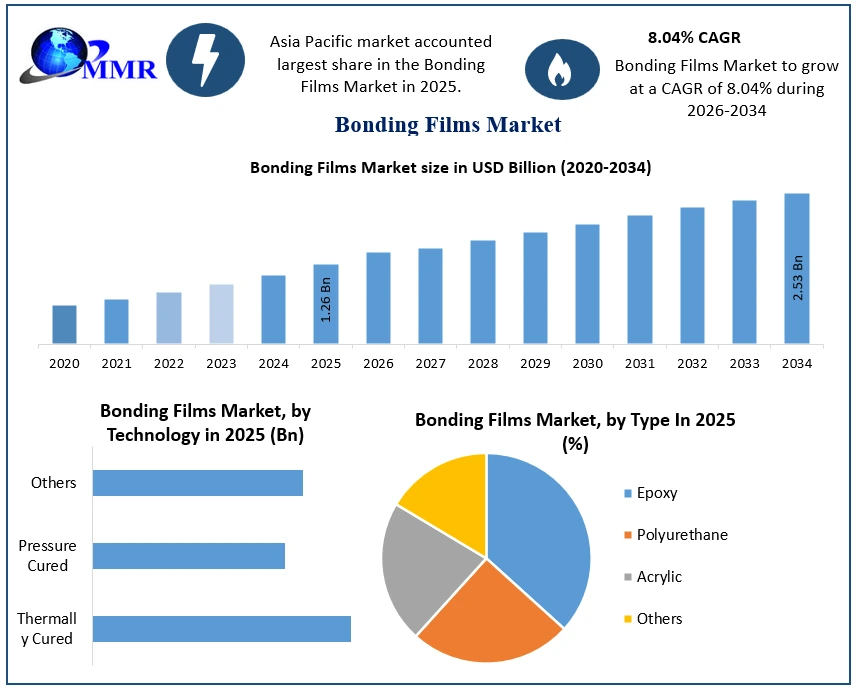
The shift toward advanced material packaging is structural. Industry players are moving away from mechanical fasteners and liquid resins to save weight and maximize space. The rise of 5G infrastructure, internet-of-things (IoT) nodes, and advanced driver assistance systems (ADAS) requires robust adhesive systems that perform reliably under high operating temperatures. Bonding films supply the high-strength adhesion and thermal protection needed to meet these demanding operational profiles.
Key Trends Driving Growth
Three key technical trends are currently reshaping the global bonding films sector. First, the miniaturization of hardware has made sub-10µm ultra-thin films necessary for advanced chip packaging, micro-LED displays, and AI accelerators. These films provide precise thermal dissipation and structural adhesion inside high-density packages without adding thickness. This transition improves spatial efficiency and prevents thermal runaway in high-performance computing hardware.
Second, strict international environmental regulations are driving the rapid adoption of bio-based bonding films. Traditional petroleum-derived epoxies are being replaced by bio-based formulations that reduce raw petroleum consumption by up to 90% while maintaining equivalent mechanical properties. This allows OEMs in the automotive and electronics sectors to reduce scope 3 emissions without sacrificing bond integrity or heat resistance.
Third, the industry is adopting smart self-healing and conductive films. Electrically conductive adhesives (ECAs) are replacing metal solders in high-frequency millimeter-wave (mmWave) 5G equipment. These films absorb mechanical shock and prevent micro-cracking under thermal stress. In EV battery packs, flame-retardant bonding films are now standard, preventing thermal runaway propagation between neighboring cells.
Get a free sample
Segment Insights
Dominant Segment (Electrical & Electronics): This sector holds the largest market share due to high production volumes of mobile phones, advanced processors, and wearable tech. Films are critical in PCB fabrication, OLED assembly, and 3D chip stacking, where liquid adhesives would cause contamination.
Fastest-Growing Segment (Transportation & EV Infrastructure): Driven by global emission reduction targets, this segment is growing rapidly. Battery manufacturers use structural bonding films to secure cells, reduce pack weight, and guarantee electrical insulation.
Feedstock & Materials Segment: Epoxy-based and polyimide films dominate due to their thermal stability. However, acrylic and bio-based alternatives are gaining share in consumer-facing packaging applications due to their lower cost and faster curing times.
Regional Growth Story
Asia-Pacific led the market in 2025, driven by major electronics manufacturing hubs in China, Taiwan, South Korea, and Japan. The region benefits from lower raw material costs, high concentration of semiconductor foundries, and integrated supply chains. Large-scale state investments in electric vehicles and domestic chip production in China and India continue to attract foreign chemical producers looking to build local capacity.
In contrast, North America and Europe are experiencing steady, high-value growth focused on aerospace, military, and premium automotive applications. Stringent environmental rules from the EPA and REACH restrict solvent-borne liquid adhesives, steering European and American manufacturers toward zero-VOC bonding films. These regions are also prioritizing domestic supply chain resilience for semiconductors and EV components, prompting new investments in specialized regional film production facilities.
Competitive Landscape
The global market remains highly consolidated, led by Henkel AG & Co. KGaA and DuPont de Nemours, Inc. These chemical giants maintain their market positions through heavy R&D investment and direct partnerships with major OEMs like Apple, TSMC, and Tesla. This tight integration allows them to co-develop custom adhesive films that match next-generation product design cycles.
Lesser-known specialty players like Toray Industries and Hitachi Chemical are capturing market share by targeting specific high-growth niches. By focusing on areas like bio-based polymers or anisotropic conductive films (ACF) for flexible displays, these companies avoid direct price competition with commodity adhesive manufacturers. Their focus on specialized niches gives them strong pricing power and protects their margins from rising petrochemical feedstock costs.
Recent Developments
March 2024: Henkel AG & Co. KGaA launched Loctite ABLESTIK NCA 2000, specifically engineered for high-performance AI chip packaging.
February 2024: DuPont de Nemours released its Interra HK 2945 film, designed to meet the electrical requirements of advanced 5G semiconductor packaging.
January 2024: 3M Company introduced a highly flame-retardant structural bonding film designed to improve safety in high-voltage EV battery assemblies.
April 2024: Toray Industries unveiled a bio-based bonding film that replaces 30% of its petroleum feedstock with plant-derived materials.
May 2024: Hitachi Chemical expanded its manufacturing capacity for anisotropic conductive films (ACF) to meet rising demand for foldable OLED displays.
Strategic Implications
For chemical executives and corporate investors, the shift from liquid adhesives to bonding films signals a permanent change in market structure. Companies that rely on standard, low-margin adhesive formulations are vulnerable to margin compression. The high technical requirements of sub-10µm electronics assembly and high-voltage EV battery systems are creating high barriers to entry, concentrating market power among a few advanced material producers.
To build supply chain resilience, procurement officers must secure long-term supply agreements for specialty film feedstocks, such as high-purity polyimides and specialty epoxies. Geopolitical tensions and localized capacity constraints in Asia-Pacific could lead to supply bottlenecks for key raw materials. Developing regional, closed-loop recycling programs for film trim and production waste will become a key competitive advantage as carbon-accounting regulations become more common.
Future Outlook
The global bonding films sector is moving toward a more specialized, low-carbon future. As manufacturers continue to miniaturize electronic devices and scale up EV manufacturing, the demand for thin, high-performance bonding films will continue to outpace traditional liquid adhesives. Winning chemical suppliers will be those who can scale production of bio-based, high-thermal-conductivity films while keeping costs competitive for mass-market manufacturing.
Analyst Perspective
“The shift toward advanced packaging in semiconductors and structural lightweighting in electric vehicles has transformed bonding films from a specialty component into a core strategic material. Chemical manufacturers must transition their portfolios from traditional liquid adhesives to high-performance, low-emission film solutions to remain competitive in the global supply chain.”
— Ankita Kagwade, Lead Analyst, Chemicals & Materials, Maximize Market Research
About Maximize Market Research
Maximize Market Research Pvt. Ltd. (MMR) is a global market research and consulting company that provides reliable, data-focused, and practical business insights. The firm serves a wide range of industries, including healthcare, pharmaceuticals, technology, automotive, electronics, chemicals, personal care, and consumer goods. Through market forecasts, competitive analysis, strategic consulting, and industry impact assessments, MMR helps organizations understand changing market conditions, identify growth opportunities, and make informed business decisions for long-term success.
2nd Floor, Navale IT Park Phase 3
Pune Banglore Highway, Narhe
Pune, Maharashtra 411041, India
+91 9607365656