Key Highlights
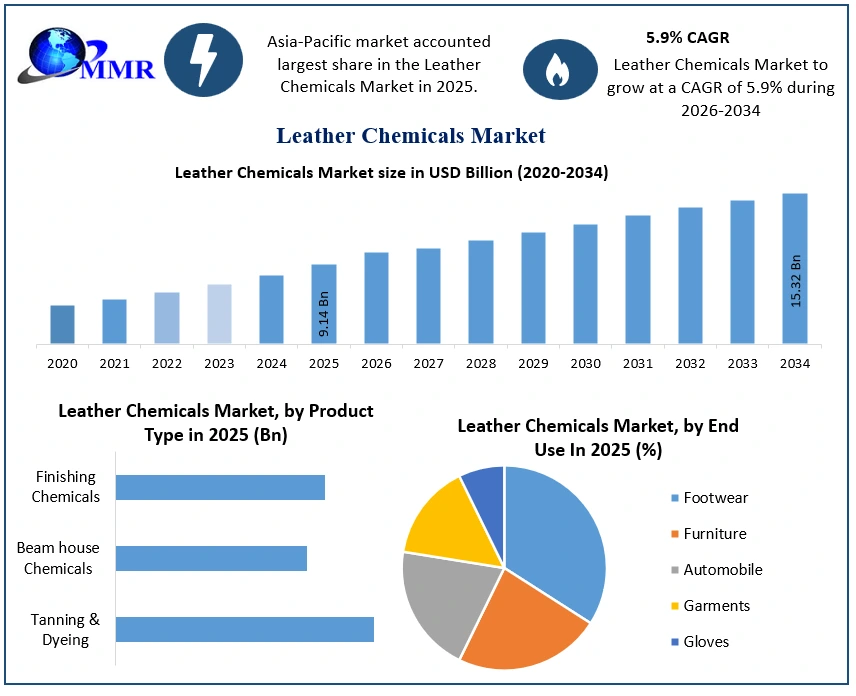
Global Valuation: Market size reached USD 9.14 Billion in 2025 and is projected to scale to USD 15.32 Billion by 2034, reflecting a 5.9% CAGR during the 2026–2034 period.
Footwear Dominance: The footwear application segment accounts for a massive 80% share of the global leather chemicals market.
Segment Engine: Tanning and dyeing chemicals dominate the product landscape, driven by high consumption in emerging economies such as China, India, and Brazil.
Sustainability Recertification: TFL Ledertechnik GmbH achieved ZDHC MRSL V3.1 Level 3 recertification, proving the industry’s push toward verified zero hazardous discharge.
Corporate Restructuring: Stahl Holdings finalized the carve-out of its wet-end leather chemicals business into an independent entity, Muno, to focus on high-margin specialty coatings.
Geopolitical Pricing Friction: TFL Group initiated global freight and product surcharges in March 2026, showcasing how regional instability immediately impacts distribution costs.
Why This Matters Now
Volatile raw material pricing, geopolitical conflicts, and intensifying environmental scrutiny are forcing a fundamental restructuring of the leather chemicals supply chain. Regulatory frameworks such as REACH are no longer distant compliance targets; they are active operational constraints reshaping product portfolios.
For procurement leaders and chemical manufacturers, the window for adopting non-hazardous, low-bisphenol, and bio-based alternatives is closing. Companies failing to transition away from traditional chrome-heavy and high-VOC chemistries face immediate exclusion from premium footwear and automotive supply chains.
Market Overview
The global Leather Chemicals Market stood at USD 9.14 Billion in 2025 and is on track to hit USD 15.32 Billion by 2034. This expansion, representing a 5.9% CAGR between 2026 and 2034, is driven by the rise in disposable incomes, changing lifestyles, and escalating demand for leather products.
Abundant raw material availability supports this growth, but manufacturers are squeezed between supply chain disruptions and stringent regulatory policies. The market is transitioning from commodity-driven volume sales to high-value specialty chemical formulations designed to minimize environmental impact.
Key Trends Driving Growth
Rapidly expanding downstream footwear and automotive sectors represent the primary catalysts for market volume growth. Consumers are increasingly seeking premium interior cabin aesthetics in vehicles, making automotive leather a highly competitive secondary segment. Additionally, surging consumer interest in leather jackets and outerwear is fueling growth in the garment segment.
However, the industry faces strict regulatory hurdles, particularly from Europe’s Registration, Evaluation, Authorisation and Restriction of Chemicals (REACH) framework. Compliance with these guidelines requires heavy investments in research and development to replace restricted substances with compliant specialty alternatives.
Segment Insights
Tanning and Dyeing (Dominant Segment): This product group holds the major share of the market. Robust demand in developing economies—specifically India, Brazil, and China—fuels the need for tanning agents, as these nations remain central processing hubs for raw hides.
Footwear (Fastest-Growing Segment): Dominating downstream application with an 80% market share, footwear production dictates global chemical procurement volumes. Manufacturers are rapidly shifting to low-bisphenol tanning and eco-friendly finishing agents to meet retail brand mandates.
Automobile & Garments: The automotive sector occupies the second-largest position, requiring highly durable specialty coatings. This is followed closely by the garment segment, which is experiencing a revival driven by trending apparel and fashion leather outerwear.
Regional Growth Story
The Asia Pacific region held the largest market share in 2025. Rising living standards, higher disposable income, and industrial capacity in China and India have concentrated major manufacturing facilities in this region. Recognizing this shift, leading multinational chemical producers are actively expanding their production capacity within APAC to remain close to downstream hide-processing plants.
North America stands as the second-largest region, holding a 20% market share. Demand here is heavily supported by premium automotive interiors and luxury consumer goods. In Europe, chemical manufacturers are heavily focused on high-tech, compliant formulations, positioning countries like Germany as centers for bio-based chemical innovation.
Competitive Landscape
Consolidation and strategic carve-outs are redrawing the competitive lines among the market’s major players. Companies are separating high-volume, lower-margin wet-end operations from premium specialty coatings to unlock corporate value and improve resource allocation.
At the same time, logistics volatility is testing the pricing power of market leaders. In response to rising geopolitical conflicts in the Gulf region, major players have demonstrated their ability to pass costs down the supply chain by implementing temporary surcharges. This indicates that chemical manufacturers with specialized, hard-to-replace portfolios maintain significant pricing power over raw tanners.
Recent Developments
March 2025: TFL Group appointed André Lanning as Group CEO to drive long-term global growth and strengthen its specialty leather chemicals market position.
May 2025: TFL Ledertechnik GmbH attained the ZDHC MRSL V3.1 Level 3 recertification, confirming chemical safety and zero hazardous discharge compliance.
January 2026: Stahl Holdings completed the carve-out of its wet-end leather chemicals business into “Muno,” an independent corporate entity. This enables Stahl to focus exclusively on high-margin specialty coatings for flexible materials.
March 2026: TFL Group introduced temporary surcharges on global freight and product lines to offset logistical expenses caused by geopolitical conflicts in the Gulf.
April 2026: TFL Group named Sandra Schneider as Chief Operating Officer (COO) to optimize internal supply chain performance and technical formulations.
April 2026: Royal Smit & Zoon published its annual sustainability update, highlighting market expansion of low-bisphenol portfolios and bio-based tanning alternatives.
Strategic Implications
The carve-out of Stahl’s wet-end business into Muno signals a broader industry trend. It highlights that commodity-scale hide processing and high-performance finishing chemistry require distinct corporate strategies, operational structures, and capital expenditure models.
Furthermore, the rapid industry adoption of certifications like ZDHC MRSL Level 3 shows that sustainability is no longer a marketing tool but a minimum requirement for market entry. Leading chemical companies are investing heavily in bio-based tanning alternatives to reduce petroleum dependency, establishing a fully circular leather value chain before regional laws mandate it.
Future Outlook
As the market moves toward USD 15.32 Billion by 2034, the competitive divide will widen between commodity chemical suppliers and specialty formulation innovators. The future belongs to chemical manufacturers that can seamlessly integrate circular, bio-based feedstocks into their existing product lines without sacrificing performance or driving up processing costs.
Analyst Perspective
“The leather chemicals industry is undergoing a structural realignment where regulatory compliance and supply chain agility have become the primary drivers of profitability. Companies that proactively redesign their portfolios around low-bisphenol chemistry and zero-hazardous-discharge standards are capturing premium margins, while those relying on legacy chemistries face intensifying margin squeeze and regulatory exclusion.”
— Ankita Kagwade, Lead Analyst, Maximize Market Research
About Maximize Market Research
Maximize Market Research Pvt. Ltd. (MMR) is a global market research and consulting company that provides reliable, data-focused, and practical business insights. The firm serves a wide range of industries, including healthcare, pharmaceuticals, technology, automotive, electronics, chemicals, personal care, and consumer goods. Through market forecasts, competitive analysis, strategic consulting, and industry impact assessments, MMR helps organizations understand changing market conditions, identify growth opportunities, and make informed business decisions for long-term success.
2nd Floor, Navale IT Park Phase 3
Pune Banglore Highway, Narhe
Pune, Maharashtra 411041, India
+91 9607365656
sales@maximizemarketresearch.com
