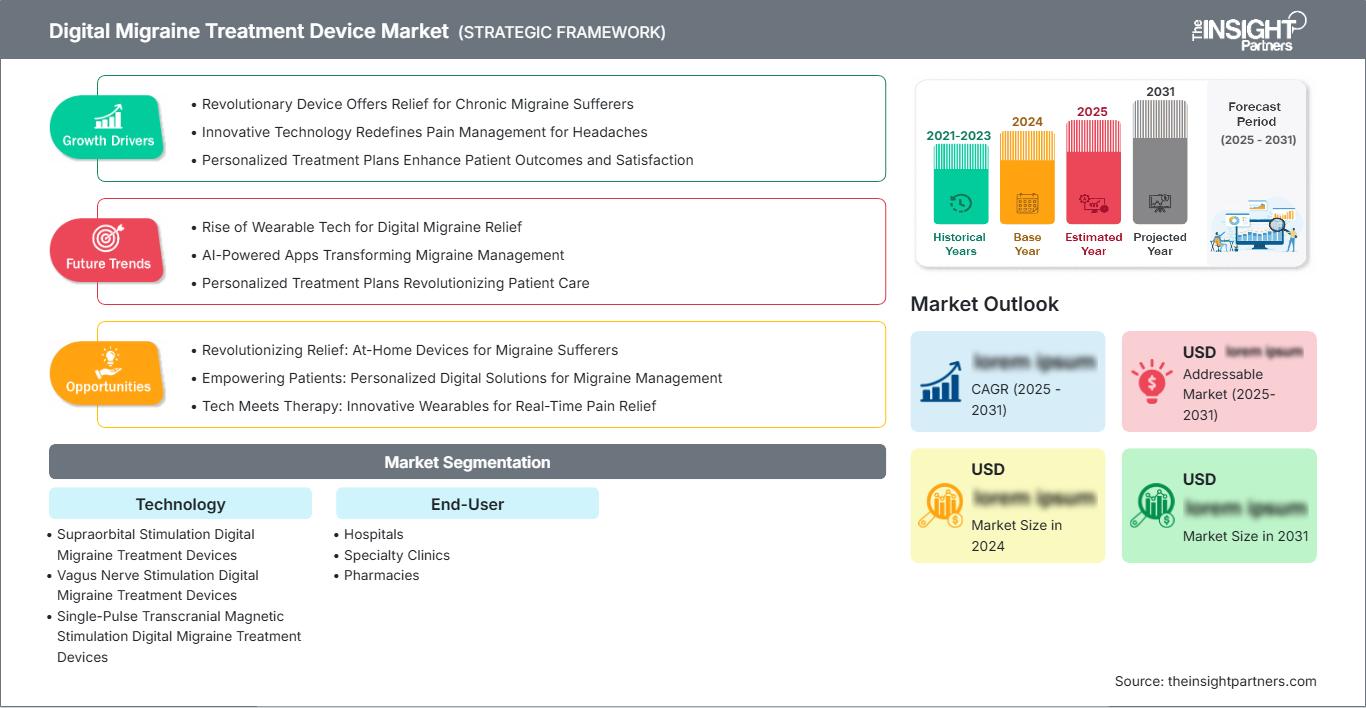
Migraine care is rapidly evolving as healthcare providers and patients seek effective non-drug treatment solutions. Advances in wearable neurostimulation technologies, digital therapeutics, and remote patient monitoring are transforming migraine management by improving treatment outcomes and enhancing patient convenience. Clinical evidence supporting these innovations continues to strengthen adoption across healthcare settings.
The Global Digital Migraine Treatment Device Market Trends indicate sustained expansion as neurological care increasingly incorporates connected medical technologies. According to The Insight Partners, the market was valued at US$ 504.0 million in 2025 and is projected to reach US$ 1,360.0 million by 2034, registering a CAGR of 11.66% during 2026 to 2034. Growing concerns regarding medication overuse headaches, increasing demand for personalized therapies, and favorable regulatory support for digital therapeutics continue to accelerate industry growth.
Get Sample PDF @ https://www.theinsightpartners.com/sample/TIPRE00013455
Rising Adoption of Wearable Neuromodulation Technologies
The growing preference for non-invasive migraine treatment devices is one of the primary factors driving industry expansion. Neuromodulation technologies provide targeted stimulation to specific nerves associated with migraine pain without relying on pharmaceutical intervention. These solutions appeal to patients seeking safer long-term management strategies while minimizing medication dependence.
Continuous improvements in wearable device design, smartphone connectivity, and patient monitoring capabilities have significantly enhanced treatment accessibility. Modern digital migraine treatment devices now offer personalized therapy programs, usage tracking, and real-time data collection, allowing healthcare professionals to monitor treatment effectiveness more efficiently. These technological advancements are strengthening physician confidence and encouraging broader clinical adoption.
Among available technologies, Vagus Nerve Stimulation (VNS) devices currently represent the largest segment due to strong clinical validation and increasing regulatory approvals. Meanwhile, Single-Pulse Transcranial Magnetic Stimulation (sTMS) devices are expected to witness the fastest growth owing to expanding evidence supporting personalized neurological intervention.
Regional Landscape Highlights
North America continues to lead the global industry, accounting for approximately 39% to 42% of total revenue in 2025. Strong reimbursement policies, advanced neurological care infrastructure, and widespread adoption of prescription digital therapeutics support continued regional leadership. The United States remains the largest contributor, benefiting from a substantial migraine patient population and active commercialization of innovative neurostimulation technologies.
Europe maintains a significant position with growing adoption across Germany, the United Kingdom, and France. Supportive digital health initiatives, favorable regulatory environments, and increasing awareness of non-pharmacological migraine therapies continue to strengthen regional demand.
Asia Pacific is projected to register the fastest growth during the forecast period. Rising healthcare expenditure, expanding neurological treatment infrastructure, increasing smartphone penetration, and improving access to advanced medical technologies are creating substantial opportunities across China, Japan, India, and South Korea.
Technology and End User Segmentation
The competitive landscape continues to diversify across multiple technology platforms designed to address varying migraine conditions and patient requirements.
Technology segments include:
- Supraorbital Stimulation Digital Migraine Treatment Devices
- Vagus Nerve Stimulation Digital Migraine Treatment Devices (VNS)
- Single-Pulse Transcranial Magnetic Stimulation Digital Migraine Treatment Devices (sTMS)
- Occipital Nerve Stimulation Digital Migraine Treatment Devices (ONS)
Hospitals remain the largest end users due to specialized neurology departments and multidisciplinary migraine treatment programs. Specialty clinics are rapidly increasing adoption as personalized headache management becomes more common. Pharmacies are also emerging as important distribution channels by supporting prescription fulfillment and patient education regarding wearable migraine treatment solutions.
Competitive Landscape and Strategic Developments
Competition continues to intensify as established neuromodulation companies and digital health innovators invest heavily in product development, regulatory approvals, and clinical research. Manufacturers are integrating artificial intelligence, remote monitoring, cloud connectivity, and predictive analytics to improve patient engagement and generate real-world clinical evidence.
Strategic collaborations between medical device manufacturers, healthcare providers, and digital health platform developers are accelerating commercialization efforts. Investment activity remains focused on technologies capable of delivering measurable clinical outcomes while supporting value-based healthcare initiatives.
Key Players
- Theranica Bio-Electronics Ltd.
- electroCore, Inc.
- Cefaly Technology SA
- Cirrus Healthcare Products Ltd.
- eNeura Inc.
- Prolivio Inc.
- Neuros Medical, Inc.
- Salvia BioElectronics B.V.
- Neurolief Ltd.
- Abbott Laboratories
Growth Drivers and Emerging Opportunities
Several long-term factors continue to support sustained industry expansion. Increasing migraine prevalence worldwide, rising awareness of medication-free therapies, and expanding reimbursement coverage are encouraging healthcare providers to incorporate digital migraine treatment devices into routine neurological practice.
Growing smartphone adoption and digital health integration are creating new opportunities for connected therapeutic platforms capable of combining treatment delivery with patient monitoring and outcome analytics. Manufacturers are also investing in real-world evidence generation to strengthen physician confidence and improve payer acceptance. As healthcare systems prioritize personalized care and long-term disease management, digital migraine treatment devices are expected to play an increasingly important role in comprehensive migraine treatment strategies.
Interested in Purchasing this Report? Click here @ https://www.theinsightpartners.com/buy/TIPRE00013455
Future Outlook
The outlook for the global digital migraine treatment device industry remains highly positive through 2034. Continued innovation in wearable neuromodulation, supportive regulatory frameworks, and expanding reimbursement policies will strengthen adoption across hospitals, specialty clinics, and pharmacy channels. Companies that successfully combine advanced neurostimulation technologies with digital health platforms, remote monitoring capabilities, and data-driven patient management solutions are expected to achieve a competitive advantage.
Related Report:
1) Procedure Trays Market Overview and Growth by 2031
2) Embolization Coils Market Size, Share, and Forecast 2025-2031
3) Aortic Valve Replacement Devices Market Growth and Recent Trends by 2030
About Us –
The Insight Partners provides comprehensive syndicated and tailored market research services in the healthcare, technology, and industrial domains. Renowned for delivering strategic intelligence and practical insights, the firm empowers businesses to remain competitive in ever-evolving global markets.
Contact Us:
Ankit Mathur | The Insight Partners
E-mail: ankit.mathur@theinsightpartners.com
Phone: +1-646-491-9876
Also Available in : Korean German Japanese French Chinese Italian Spanish
