Key Highlights
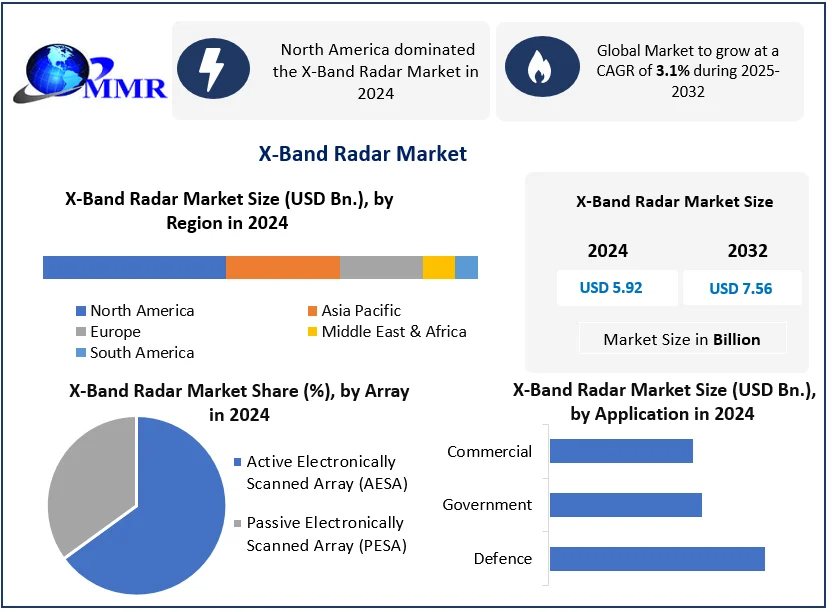
Steady Market Valuation: The global market reached USD 5.92 billion in 2024 and is on track to touch nearly USD 7.56 billion by 2032, driven by a stable compound annual growth rate (CAGR) of 3.1%.
Defense Sector Dominance: High-resolution defense applications account for the largest market share, which is projected to stand at approximately 65% by 2032.
Active Array Transitions: Mechanical radars are rapidly being replaced by Active Electronically Scanned Arrays (AESA) to achieve faster, multi-directional scanning.
Dual-Use Evolution: Beyond traditional military deployment, systems are increasingly utilized for extreme weather monitoring, disaster mitigation, and low-Earth-orbit satellite collision avoidance.
Geopolitical Regional Shifts: North America maintains market leadership, while Asia-Pacific is experiencing rapid growth due to national security commitments and infrastructure-monitoring needs.
Why This Matters Now
Defense contractors and military procurement agencies face an urgent operational turning point as modern threats transition toward hypersonic velocities, low-visibility stealth profiles, and congested electronic warfare environments. In an era where legacy detection systems fall short, high-resolution surveillance systems operating within the 8–12 GHz spectrum are no longer optional assets but strategic necessities.
The immediate business implication is clear: defense companies must align their research and development pipelines with active electronically scanned arrays (AESA) and artificial intelligence. Concurrently, commercial aviation, space operators, and meteorological agencies are seeking identical high-resolution technologies to secure transport corridors, protect space assets from orbital debris, and manage climate risks. Those who fail to adapt their production lines to modular, software-defined radar architectures risk being shut out of multi-billion-dollar allied defense and civil procurement cycles.
Market Overview
The global X-band Radar Market, which stood at a valuation of USD 5.92 billion in 2024, is projected to expand to USD 7.56 billion by 2032, representing a compound annual growth rate (CAGR) of 3.1%. Operating within the 8–12 GHz frequency range, these systems are prized for their extreme precision, narrow beamwidths, and real-time tracking capabilities.
This technological profile makes X-band systems ideal for tracking fast-moving targets, distinguishing between closely spaced objects, and mapping complex weather structures. The market scope covers three primary deployment modes: ground-based, mobile, and naval systems. Defense operations remain the primary economic engine of this industry, contributing a dominant 65% of total market revenue. However, growth is also supported by commercial aviation, satellite operations, and civil infrastructure monitoring.
Key Trends Driving Growth
A series of technological convergences and external demand factors are reshaping the market. Chief among these is the integration of artificial intelligence (AI) and machine learning directly into radar processors. This capability optimizes target recognition and filters out clutter, minimizing false alarms in complex urban or maritime environments.
In terms of hardware, the market is quickly moving away from older mechanical scanning mechanisms toward advanced phased-array and AESA configurations. AESA technology allows for instantaneous, multi-directional scanning, providing modern combat aircraft and naval vessels with superior situational awareness.
Simultaneously, dual-use applications are expanding. Civilian sectors are deploying X-band radars for precise meteorological forecasting, high-frequency maritime navigation, and air traffic management. Climate volatility has accelerated this trend, as seen in the U.S. National Weather Service’s 2023 deployment of advanced X-band systems to enhance midwestern tornado detection.
Japan similarly upgraded its meteorological radar network to monitor typhoons and severe downpours. Additionally, the space economy relies on these systems; in 2024, SpaceX Starlink integrated X-band radar technology to facilitate orbit-level debris detection and collision avoidance in low Earth orbit.
Segment Insights
Dominant Type (Mobile X-Band Radar): The mobile X-band radar segment dominated the market in 2024. This leadership is sustained by the widespread use of mobile systems in airborne surveillance, tactical military maneuvers, rapid early weather warning deployments, and perimeter security.
Dominant Application (Defense): The defense segment is expected to secure the largest share, accounting for nearly 65% of the market by 2032. This dominance is propelled by the continuous acquisition of X-band systems by global navies, military branches, and civil-government border security agencies.
Fastest-Growing Array (Active Electronically Scanned Array – AESA): Driven by modern electronic warfare requirements, the AESA segment is the fastest-growing array category, replacing passive arrays (PESA) and mechanical systems.
Emerging Segment (Sea-Based X-Band Radar): Large-scale maritime defense and tracking requirements are boosting investments in sea-based installations, particularly across North American and European defense procurement lines.
Regional Growth Story
North America led the global market in 2024 and is projected to maintain the largest market share through 2032. This position is supported by deep-seated defense budgets, aggressive homeland security initiatives, and ongoing acquisitions of sea-based X-band systems for missile defense.
The Asia-Pacific region represents the second-largest market. Regional demand is driven by the rapid adoption of portable, lightweight X-band radars used for critical infrastructure protection, remote facility surveillance, border security, and localized weather monitoring. Countries like Japan and India are actively building local manufacturing capability while expanding regional radar coverage to counter regional security threats and monitor extreme weather events.
Competitive Landscape
The global market is led by a consolidated tier of established aerospace and defense giants:
Northrop Grumman Corporation: Leads in multi-mission radar systems, prioritizing AI integration to streamline threat identification and automate operations.
Raytheon Technologies Corporation: Commands a strong presence in phased-array and naval radar solutions, focusing on modular, scalable designs that allow quick upgrades.
Lockheed Martin Corporation: Specializes in high-resolution, long-range tactical military radars designed for complex ground and air defense environments.
Thales Group: Dominates European and dual-use markets, engineering radar systems featuring heavy cyber security protections and electronic warfare resilience.
Mitsubishi Electric Corporation: Leads in compact, highly energy-efficient X-band systems optimized for maritime safety and advanced meteorological networks.
Recent Developments
Bharat Electronics Limited (BEL) Contract: On March 12, 2025, the Indian Ministry of Defence signed a ₹2,906 crore contract with BEL for 18 Low-Level Transportable Radars (Ashwini). These active electronically scanned phased-array X-band systems are designed to enhance the Indian Air Force’s early-warning capabilities.
BEL Naval Integration: On September 11, 2024, BEL secured a ₹850 crore order from Cochin Shipyard Limited to supply an indigenous Multi-Function X-Band Radar. This system is designed to provide defensive coverage for naval vessels.
Saab AB & ICEYE MoU: On March 18, 2025, Sweden’s Saab AB signed a Memorandum of Understanding with satellite SAR provider ICEYE. The agreement focuses on integrating space-based radar data directly into Saab’s command-and-control systems to improve real-time situational awareness.
Strategic Implications
The recent contract wins and technology partnerships signal a clear direction for the industry. BEL’s consecutive military orders illustrate a growing national push for defense indigenization, shifting reliance away from foreign military imports toward localized manufacturing hubs. This domestic production model ensures supply chain resilience and shields defense program pipelines from export restrictions.
Meanwhile, the partnership between Saab and ICEYE shows that modern security requires combining space-based assets with ground command networks. For suppliers and defense contractors, these moves highlight the necessity of designing open-architecture systems that can easily integrate third-party space data and software updates.
Future Outlook
Over the next decade, the market will continue to evolve from a hardware-centric model toward software-defined systems. High-resolution radar networks will become increasingly decentralized, relying on groups of smaller, mobile, and drone-mounted X-band sensors to cover wide geographic areas. Ultimately, the division between market leaders and laggards will depend entirely on their ability to integrate cognitive AI processing directly at the radar sensor level while mastering low-probability-of-intercept software algorithms.
Analyst Perspective
“The X-band radar market is moving away from static, single-purpose hardware toward highly agile, software-defined systems. As geopolitical challenges and climate risks increase simultaneously, the organizations that succeed will be those that can deliver multi-mission, dual-use platforms capable of switching from threat tracking to meteorological analysis instantly.”
— Rucha Deshpande, Lead Analyst at Maximize Market Research
About Maximize Market Research
Maximize Market Research Pvt. Ltd. (MMR) is a global market research and consulting company that provides reliable, data-focused, and practical business insights. The firm serves a wide range of industries, including healthcare, pharmaceuticals, technology, automotive, electronics, chemicals, personal care, and consumer goods. Through market forecasts, competitive analysis, strategic consulting, and industry impact assessments, MMR helps organizations understand changing market conditions, identify growth opportunities, and make informed business decisions for long-term success.
2nd Floor, Navale IT Park Phase 3
Pune Banglore Highway, Narhe
Pune, Maharashtra 411041, India
+91 9607365656
sales@maximizemarketresearch.com
