High Electron Mobility Transistor Market: Powering the Next Generation of High-Speed Electronics
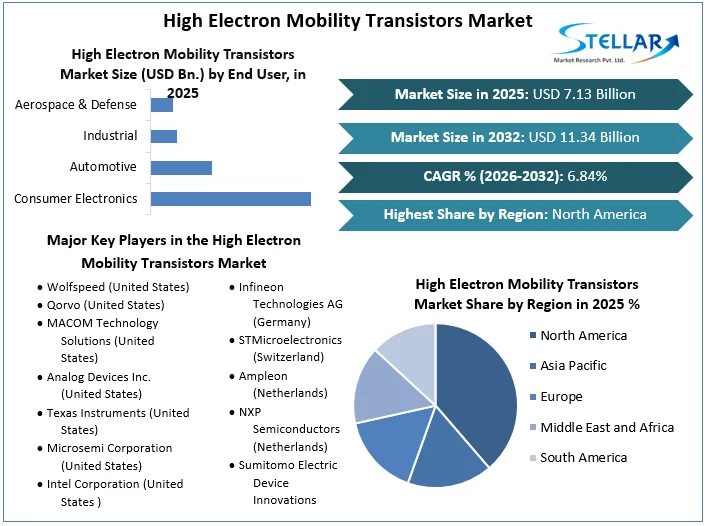
The semiconductor industry is rapidly evolving to meet the growing demand for faster, more efficient, and high-performance electronic devices. At the center of this transformation is the High Electron Mobility Transistor (HEMT) Market, driven by increasing adoption in 5G communications, electric vehicles (EVs), aerospace, defense, satellite communications, and consumer electronics. According to Stellar Market Research, the global High Electron Mobility Transistor Market was valued at USD 7.13 billion in 2025 and is projected to reach USD 11.34 billion by 2032, expanding at a CAGR of 6.84% during the forecast period.
What is a High Electron Mobility Transistor?
A High Electron Mobility Transistor (HEMT) is a field-effect transistor that uses a heterojunction made from semiconductor materials with different band gaps. This unique structure enables electrons to move with exceptionally high mobility, allowing HEMTs to deliver:
- High-frequency operation
- Low power loss
- Superior thermal performance
- High switching speed
- Excellent power efficiency
These characteristics make HEMTs ideal for applications such as radar systems, satellite communications, wireless infrastructure, renewable energy systems, and advanced automotive electronics.
Growing Demand for 5G and High-Speed Communication
One of the strongest growth drivers for the High Electron Mobility Transistor Market is the global deployment of 5G networks. Modern communication infrastructure requires semiconductor devices capable of handling higher frequencies, increased bandwidth, and lower latency.
HEMT technology offers outstanding radio frequency (RF) performance, making it the preferred choice for:
- 5G base stations
- Wireless communication equipment
- Microwave communication
- Satellite transmission
- High-frequency networking systems
As telecom operators continue expanding 5G coverage worldwide, demand for advanced HEMT devices is expected to rise significantly.
𝐃𝐨𝐰𝐧𝐥𝐨𝐚𝐝 𝐅𝐫𝐞𝐞 𝐏𝐃𝐅 𝐁𝐫𝐨𝐜𝐡𝐮𝐫𝐞: https://www.stellarmr.com/report/req_sample/high-electron-mobility-transistor-market/2776
Among various material types, Gallium Nitride (GaN) dominates the High Electron Mobility Transistor Market. GaN-based HEMTs provide several advantages over conventional silicon-based transistors, including:
- Higher power density
- Faster switching capability
- Better heat dissipation
- Lower energy consumption
- Improved operational efficiency
According to the report, the GaN segment accounted for nearly 48.6% of the market share in 2025, supported by growing adoption across telecommunications, electric vehicles, aerospace, and renewable energy applications.
Advancements in Semiconductor Manufacturing
Continuous improvements in semiconductor fabrication technologies are accelerating HEMT adoption. Advanced manufacturing methods such as Metal-Organic Chemical Vapor Deposition (MOCVD) and Molecular Beam Epitaxy (MBE) enable manufacturers to create highly precise heterostructures with improved electron mobility and lower power losses.
These innovations allow HEMTs to deliver superior performance while supporting the industry’s push toward smaller, faster, and more energy-efficient electronic devices.
Consumer Electronics Remain the Largest End User
Consumer electronics represent the largest end-user segment of the High Electron Mobility Transistor Market. Smartphones, laptops, gaming devices, wearables, and high-speed networking equipment increasingly require compact semiconductor components capable of delivering exceptional performance with minimal power consumption.
The report indicates that the consumer electronics segment accounted for approximately 28% of the market, while aerospace and defense are expected to witness the fastest growth during the forecast period due to increasing investments in radar systems, military communications, and satellite technologies.
Expanding Applications in Electric Vehicles and Aerospace
The rapid expansion of electric mobility is creating new opportunities for HEMT manufacturers. High Electron Mobility Transistors are increasingly used in:
- EV power converters
- Fast-charging infrastructure
- Battery management systems
- Power inverters
- Onboard charging systems
Similarly, aerospace and defense sectors rely on HEMTs for high-frequency radar, electronic warfare systems, satellite communications, and secure military networks where reliability and performance are critical.
Regional Market Outlook
North America currently leads the High Electron Mobility Transistor Market due to its well-established semiconductor industry, strong investment in research and development, and widespread adoption of advanced communication technologies.
Meanwhile, the Asia-Pacific region is expected to experience rapid growth, driven by expanding semiconductor manufacturing in China, Japan, South Korea, and India. Government initiatives supporting domestic chip production, renewable energy, and electric vehicles continue to fuel demand for HEMT technology across the region.
Competitive Landscape
The High Electron Mobility Transistor Market is highly competitive, with leading semiconductor companies focusing on innovation, strategic partnerships, and next-generation GaN technologies.
Recent industry developments include:
- SK Keyfoundry’s advancement of 650V GaN HEMT technology for radar and power electronics.
- Infineon Technologies’ collaboration with AWL-Electricity to develop advanced wireless power solutions using CoolGaN™ technology.
Manufacturers continue investing heavily in research to improve efficiency, thermal management, and high-frequency performance across diverse applications.
𝐃𝐨𝐰𝐧𝐥𝐨𝐚𝐝 𝐅𝐫𝐞𝐞 𝐏𝐃𝐅 𝐁𝐫𝐨𝐜𝐡𝐮𝐫𝐞: https://www.stellarmr.com/report/req_sample/high-electron-mobility-transistor-market/2776
Future Outlook
The future of the High Electron Mobility Transistor Market is closely tied to advancements in wireless communication, electric transportation, renewable energy, and defense modernization. As industries demand faster processing speeds, greater energy efficiency, and improved thermal performance, HEMTs will play a critical role in enabling next-generation electronic systems.
With continued innovation in GaN technology, expanding 5G infrastructure, increasing satellite deployments, and growing investments in semiconductor manufacturing, the market is expected to maintain steady growth throughout the forecast period.
