Key Highlights
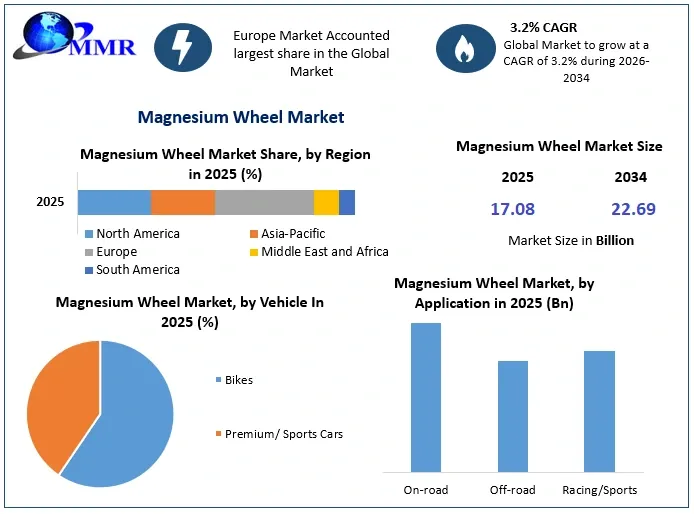
The global Magnesium Wheel Market size achieved a baseline valuation of USD 17.08 billion in 2025 and is projected to expand to USD 22.69 billion by 2034.
The industrial space sustains a consistent growth trajectory, advancing at a compounded annual growth rate (CAGR) of 3.2% during the forecast matrix spanning 2026 to 2034.
Cast manufacturing represents the dominant technology segment, capturing maximum market share due to its low production costs and efficient processing parameters.
The original equipment manufacturer (OEM) channel stands as the dominant end-use driver, dictating baseline components across premium and sports platforms.
Europe commands the leading regional market footprint, supported by concentrated luxury vehicle networks and direct state decarbonization protocols.
Why This Matters Now
Automotive OEMs, Tier-1 alloy suppliers, and mobility strategists face immediate, high-stakes engineering deadlines as regulatory mandates force systemic structural weight reductions across passenger and commercial fleets. Traditional steel and heavy aluminum architectures are increasingly restricted under tightening structural stress guidelines and fuel efficiency rules, such as regional weight restrictions like the California Vehicle Code capping gross wheel loads at 10,500 pounds. Component fabricators that delay moving production setups from legacy heavy metals toward advanced, highly durable magnesium alloys face immediate exclusion from upcoming high-efficiency platform architectures. Because every 100 pounds of total vehicle weight reduction triggers a measurable 2% decrease in fuel consumption, maximizing wheel efficiency yields immediate regulatory compliance benefits for volume producers.
Market Overview
The global magnesium wheel market covers the advanced structural engineering, chemical formulation, tool casting, and precision forging of high-strength, lightweight wheels designed for premium passenger platforms, sports vehicles, and high-performance bikes. Magnesium stands as a highly efficient alternative to traditional automotive steel, providing superior vibration dampening, increased heat dissipation, and reduced unsprung mass to optimize total vehicle responsiveness and cornering safety. The market operates under distinct processing segments, split between high-volume cast options and ultra-dense forged configurations. As green mobility initiatives expand worldwide, this specialized component category is migrating out of specialized motorsport applications into mainstream high-end vehicle production baselines.
Key Trends Driving Growth
Accelerating consumer spending and an intense global demand for high-performance passenger vehicles are generating consistent volume orders for specialized component upgrades. Buyers are increasingly seeking an elevated driving experience characterized by faster acceleration curves, shorter braking distances, and decreased road noise, which directly prompts automakers to deploy lightweight wheel solutions. This behavioral shift creates a stable, high-value procurement channel for alloy wheel producers worldwide.
Simultaneously, the rapid integration of magnesium components into upcoming hybrid and electric platforms acts as a major catalyst. Lightweighting remains a primary engineering concern inside electrified architectures to help offset massive battery pack weights and maximize overall driving range. Furthermore, rigid corporate average fuel economy targets and regional environmental metrics are forcing automakers to reconsider standard wheel metallurgy, making durable magnesium a highly practical choice for next-generation rolling chassis configurations.
Segment Insights
Cast Manufacturing [Dominant Segment]: This manufacturing type segment controls the absolute majority of global market volume. Automotive producers prioritize cast processing because it provides lower production costs, minimal tooling complexity, and easier manufacturing flows during high-volume wheel replication.
OEM [Dominant End-Use Segment]: Within the distribution structure, direct original equipment manufacturing placement represents the leading segment. High-end brands are embedding magnesium platforms directly into standard factory assembly lines to secure baseline premium performance claims.
Premium/Sports Cars [Dominant Vehicle Segment]: This vehicle type segment captures the maximum market share. The segment requires extreme mechanical strength alongside optimized rotating mass to satisfy the demanding speed and safety specifications of high-performance passenger lines.
Regional Growth Story
Europe commands the dominant position in the global magnesium wheel market landscape, functioning as the primary hub for premium vehicle technology validation and high-value sourcing. This regional leadership is supported by a concentrated presence of dominant luxury vehicle icons—including Volkswagen, Ferrari, and Mercedes-Benz—who are actively expanding their factory performance packages. The dense concentration of high-end automotive engineering facilities across Germany and neighboring manufacturing hubs allows regional suppliers to maintain supreme pricing power.
Conversely, North America occupies a powerful market position, driven by robust consumer passenger vehicle spending and stringent road weight regulations across major economic zones. The regional market structure benefits from high vehicle customization trends and heavy R&D spending by domestic Tier-1 suppliers. The Asia-Pacific territory is also emerging as an essential volume growth zone, fueled by expanding light vehicle production lines and upgrading metalworking infrastructure across China, Japan, and India.
Competitive Landscape
The competitive matrix of the global magnesium wheel market is highly active and consolidated around a select tier of dominant technological innovators who control advanced alloy formulation patents. Sourcing power belongs to component fabricators who can deliver large production batches that satisfy strict microscopic structural uniformity and impact-resistance parameters. Major players maintain their dominant market positions by executing continuous research expansions and locking down long-term supply agreements with elite vehicle brands, establishing high capital moats against new market entrants. Independent wheel brands and aftermarket customization houses are adjusting by focusing heavily on custom styling configurations and boutique forged programs to capture high-margin collector and enthusiast segments without triggering direct price conflicts with volume giants.
Recent Developments
Market leaders—including BBS, Enkei, and MKW Alloy—continue to expand their advanced metallurgy research operations to optimize the tensile strength of low-weight wheel architectures.
Specialized engineering firms like SMW Engineering and O.Z. Group have deployed automated casting controls to minimize internal porosity defects during high-volume production cycles.
Top-tier vehicle manufacturers—including Ferrari, Volkswagen, and Mercedes-Benz—have systematically broadened their factory options to integrate custom magnesium wheels onto mainstream premium lines.
Global logistics and trade flows have adjusted to support direct component deliveries from highly automated casting operations to premium vehicle assembly locations across Western Europe and North America.
Strategic Implications
For industrial design engineers and Tier-1 structural component providers, the clear industry shift toward micro-lightweighting requires an immediate focus on low-cost cast manufacturing optimization. Minimizing raw component production costs while maintaining excellent structural fatigue life allows suppliers to offer immediate value advantages to volume-conscious automotive brands.
Furthermore, to insulate corporate margins against volatile international magnesium pricing and sudden raw material access bottlenecks, wheel manufacturers must build highly diversified, multi-regional sourcing pipelines. Suppliers must also align their long-term manufacturing space with the rapid expansion of hybrid vehicle platforms, configuring automated machining cells to easily accommodate the distinct wheel offset configurations demanded by heavy battery-integrated chassis architectures.
Future Outlook
The ultimate line of separation in the global automotive structures space will isolate advanced alloy casting innovators who master low-cost production of ultra-lightweight magnesium wheels from legacy metal foundries stuck stamping heavy, low-efficiency steel components.
Analyst Perspective
“The global magnesium wheel market is navigating a complex evolutionary shift where core structural durability must align perfectly with aggressive vehicle weight-reduction targets,” states Dharati Raut, Research Analyst at Maximize Market Research. “As hybrid and premium vehicle architectures scale up globally, the engineering focus must lock onto low-cost cast manufacturing innovations and advanced alloy purity to win next-generation platform sourcing contracts.”
About Maximize Market Research
Maximize Market Research Pvt. Ltd. (MMR) is a global market research and consulting company that provides reliable, data-focused, and practical business insights. The firm serves a wide range of industries, including healthcare, pharmaceuticals, technology, automotive, electronics, chemicals, personal care, and consumer goods. Through market forecasts, competitive analysis, strategic consulting, and industry impact assessments, MMR helps organizations understand changing market conditions, identify growth opportunities, and make informed business decisions for long-term success.
2nd Floor, Navale IT Park Phase 3
Pune Banglore Highway, Narhe
Pune, Maharashtra 411041, India
+91 9607365656
sales@maximizemarketresearch.com
