Key Highlights
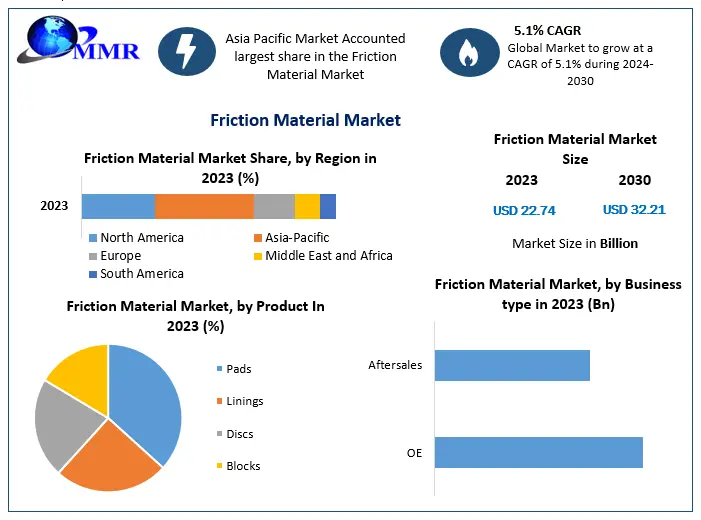
The global friction material market size achieved a baseline valuation of USD 22.74 billion in 2023 and is projected to scale to USD 32.21 billion by 2030.
The industrial space sustains a consistent growth trajectory, advancing at a compounded annual growth rate (CAGR) of 5.10% throughout the forecast period from 2024 to 2030.
Friction pads represent the dominant product configuration, capturing maximum market share due to superior low-dust abrasion properties and extreme high-temperature tolerance.
The automotive sector emerges as the fastest-growing end-user industry segment, driven directly by surging global production and sales across light passenger and commercial lines.
The Asia-Pacific region holds the highest geographic market footprint, propelled by massive industrial clusters and expanding logistics corridors across China and India.
Why This Matters Now
Automotive OEMs, Tier-1 braking suppliers, and transportation strategists face immediate operational urgency as expanding heavy-duty fleets and accelerating industrial transport networks squeeze the lifespans of legacy braking hardware. Standard mechanical components face severe degradation risks under intense operational duty cycles, requiring heavy vehicle networks to immediately allocate capital into next-generation compound mixtures that resist sudden thermal failures. Component fabricators that delay moving production setups from legacy dust-heavy substrates toward high-durability, non-abrasive matrix materials face immediate displacement by tier-1 brands locking down volume contracts. With the marketplace expanding systematically toward a USD 32.21 billion valuation by 2030, long-term procurement victories belong to organizations that prioritize component longevity under volatile operating conditions.
Market Overview
The global friction material market encompasses the precision engineering, chemical compounding, and high-pressure manufacturing of specialized wear-resistant components designed to manage kinetic energy transfer within mechanical braking and clutching systems. These highly engineered compounds are utilized across friction pads, linings, discs, and blocks to provide reliable decelerating capabilities while insulating primary metallic assemblies from extreme heat buildup. The sector serves as a fundamental safety baseline across the automotive, railway, and construction machinery industries, where component durability directly dictates overall vehicle uptime. As global shipping corridors multiply and demand for passenger safety rises, this specialized material science segment is scaling rapidly to satisfy rigorous multi-industry quality parameters.
Key Trends Driving Growth
Accelerating global vehicle production and rising logistics demand act as the primary engine for continuous friction material consumption. High-capacity commercial trucks and passenger vehicle fleets undergo extensive operational cycles that trigger high wear-and-tear rates across vehicle clutches and brakes, establishing a large, recession-proof demand pipeline for replacement components. This high-volume consumption pattern forces parts suppliers to continuously expand their manufacturing capacities to prevent regional supply bottlenecks.
Simultaneously, the widespread requirement for a new generation of high-resilience friction mixtures acts as a core catalyst for technological variation. Traditional industrial machinery and high-speed transit grids operate under severe load strains that demand advanced friction pads capable of surviving continuous high-temperature exposure without losing structural integrity. Because modern formulations are engineered to release less particulate dust during abrasion, their deployment allows transit operators to minimize environmental wear while satisfying rigid corporate safety criteria.
Segment Insights
Friction Pads [Dominant Product Segment]: This specialized component type commands the absolute majority of global market revenue. Friction pads serve as the structural baseline for modern disc braking systems, favored by tier-1 automotive suppliers because they are significantly less prone to releasing particulate dust during abrasion while maintaining steady halting power under high thermal strain.
Automotive Industry [Fastest-Growing End-User Segment]: Driven by rising multi-regional light and heavy vehicle sales, the automotive application matrix stands out as the fastest-increasing end-user segment. Automakers are consuming vast volumes of customized pads and linings to satisfy original equipment production schedules and support expanding international aftermarket distribution chains.
Regional Growth Story
The Asia-Pacific region commands the dominant position in the global friction material market landscape, holding the highest regional market share in 2023 and tracking to witness the highest localized growth through 2030. This market concentration is driven by rapid industrialization and extensive public infrastructure spending across primary manufacturing hubs like China and India. The dense presence of major automotive assembly plants, expanding railway projects, and active construction equipment networks provides regional component suppliers with immense economies of scale.
Concurrently, Western Europe, anchored by prominent automotive groups in Germany and France, maintains highly focused procurement patterns centered on high-performance braking discs and premium compound formulations. North America follows a parallel high-value path, driven by extensive commercial vehicle fleet tracking networks and intensive investment allocations by domestic tier-1 friction engineering specialists.
Competitive Landscape
The competitive matrix of the global friction material market is highly dynamic and consolidated around a select tier of dominant global component manufacturers and specialized chemical compounding specialists. Market power belongs to vendors that can deliver highly durable friction pads with extended wear cycles, allowing institutional fleet operators to minimize their long-term maintenance expenditure. Key industry players protect their market share by maintaining deep institutional integrations across both original equipment (OE) build channels and extensive global aftersales distribution networks, establishing high entry barriers for newer component suppliers. Independent material fabricators and niche parts suppliers are adjusting by forming tactical supply partnerships or focusing on specialized blocks for heavy construction machinery to avoid direct price conflicts with volume giants.
Recent Developments
Global manufacturing specialists—including Akebono Brake Industry, Federal-Mogul Holdings, and Nisshinbo Holdings—continue to expand their custom material development centers to maximize the thermal resilience of advanced automotive pads.
Leading component providers like Miba, Fras-Le, and Aisin Seiki have scaled up their automated pressing lines to achieve uniform density across high-volume braking discs.
Regional suppliers, including Valeo Friction Materials India and Yantai Hi-Pad Brake Technology, have systematically boosted their production outputs to satisfy surging vehicle assembly needs in emerging economies.
Industrial aftermarket providers—including Carlisle Brake & Friction, ABS Friction, Bendix Commercial Vehicle Systems, and Brembo—have expanded their aftersales delivery logistics to insulate international replacement channels against supply disruptions.
Strategic Implications
For industrial design engineers and Tier-1 material suppliers, the clear market movement toward high-temperature resistance requires an immediate operational focus on zero-defect pad manufacturing. Eliminating internal material variations during the automated pressing cycle allows suppliers to offer immediate safety advantages to volume-conscious automotive and industrial OEMs.
Furthermore, to hedge against shifting petrochemical and raw material costs, component fabricators must invest in low-scrap casting and extrusion processes that protect baseline operating margins. Suppliers must also align their long-term inventory networks with the fast-growing Asia-Pacific theater, ensuring that localized distribution nodes are fully positioned to feed the massive automotive and railway build expansions taking place in China and India.
Future Outlook
The ultimate line of separation in the global mechanical components space will isolate advanced material science innovators who successfully master dust-free, extreme-temperature friction formulations from legacy parts fabricators stuck stamping low-durability, high-wear braking elements.
Analyst Perspective
“The global friction material market is navigating a complex structural transition where core mechanical endurance must integrate with advanced low-dust chemical properties,” states Dharati Raut, Research Analyst at Maximize Market Research. “As global vehicle production counts scale up and industrial fleets demand longer component lifespans, the engineering focus must center completely on advanced friction pad durability and high-temperature tolerance to capture high-value supply agreements.”
About Maximize Market Research
Maximize Market Research Pvt. Ltd. (MMR) is a global market research and consulting company that provides reliable, data-focused, and practical business insights. The firm serves a wide range of industries, including healthcare, pharmaceuticals, technology, automotive, electronics, chemicals, personal care, and consumer goods. Through market forecasts, competitive analysis, strategic consulting, and industry impact assessments, MMR helps organizations understand changing market conditions, identify growth opportunities, and make informed business decisions for long-term success.
2nd Floor, Navale IT Park Phase 3
Pune Banglore Highway, Narhe
Pune, Maharashtra 411041, India
+91 9607365656
sales@maximizemarketresearch.com
