Key Highlights
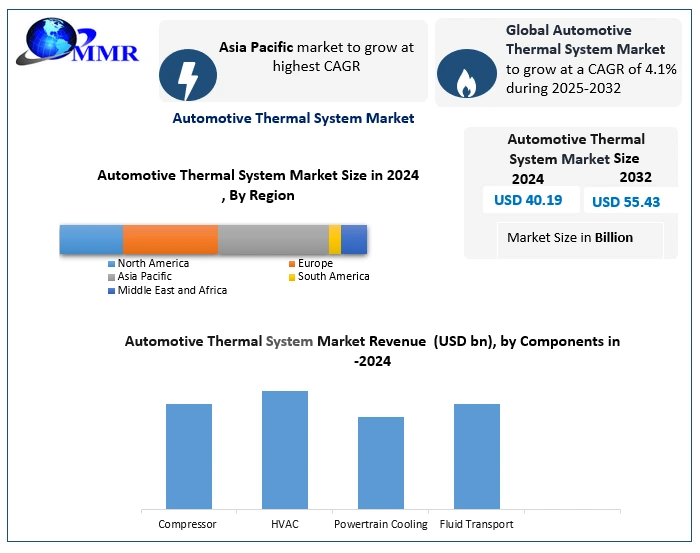
Market Valuation: The global automotive thermal system market was valued at USD 40.19 billion in 2024.
Growth Forecast: The market is projected to reach USD 55.43 billion by 2032, expanding at a CAGR of 4.1%.
Technological Shift: The transition from simple engine cooling to sophisticated, EV-integrated thermal management systems (TMS) is the primary industry pivot.
Efficiency Mandate: HVAC and battery cooling are now core determinants of electric vehicle (EV) range and charging performance.
Regional Leadership: Asia-Pacific remains the dominant global hub, supported by high manufacturing output in China, Japan, and India.
Why This Matters Now
The automotive industry is no longer merely cooling an engine; it is managing the thermal lifeblood of the entire vehicle. As OEMs accelerate the transition to electric powertrains, thermal systems have evolved from peripheral components into critical mission-control units that directly dictate battery longevity, cabin comfort, and ultra-fast charging capabilities.
Market Overview
Valued at USD 40.19 billion in 2024, the Automotive Thermal System Market is a foundational pillar of modern vehicle architecture. The sector is moving beyond basic HVAC (Heating, Ventilation, and Air Conditioning) to integrate complex thermal loops for battery packs, power electronics, and high-performance motors. This transformation is driven by the dual pressure of achieving greater vehicle range and meeting increasingly stringent global emissions regulations, making thermal optimization a strategic priority for every Tier-1 supplier and OEM.
Key Trends Driving Growth
The EV Thermal Revolution: Electric vehicles generate heat in entirely new ways, requiring advanced liquid cooling and thermal interface materials to maintain optimal performance. Innovations such as AI-driven heat pumps are replacing energy-hungry resistive heaters, directly extending the operational range of EVs by reducing the power drain on the battery.
Smart Thermal Integration: Modern thermal management is increasingly digitized. AI and IoT integration allow systems to predict heat patterns and optimize cooling in real-time, preventing component degradation and ensuring safety during the high-load cycles associated with ultra-fast charging. This intelligent approach enables vehicles to manage their internal climate and powertrain temperatures autonomously, boosting overall energy efficiency.
Segment Insights
Dominant Segment (Application): HVAC Systems. While evolving, HVAC remains the largest application segment, consistently driven by increasing consumer demand for premium in-cabin comfort across passenger and heavy-duty vehicles.
Fastest-Growing Segment: Battery Thermal Management Systems (BTMS). This segment is expanding rapidly as the proliferation of EVs demands precise temperature control to prevent battery degradation and ensure high-speed charging efficiency.
Regional Growth Story
The Asia-Pacific region continues to hold the dominant market share. This is fueled by the massive concentration of automotive manufacturing hubs and battery supply chains in China, Japan, and India. The region’s proactive government policies regarding clean mobility and the rapid scaling of local EV ecosystems have accelerated the adoption of next-generation thermal technologies.
In North America, market growth is bolstered by heavy investment in construction equipment and specialized heavy-duty vehicles, alongside the rapid shift toward electrified fleets. Europe maintains a high-growth trajectory, driven by some of the world’s most aggressive CO2 emission mandates, which compel automakers to deploy the most energy-efficient thermal components currently available.
Competitive Landscape
The market features intense rivalry among established incumbents like Denso Corporation, MAHLE GmbH, Valeo, Hanon Systems, and BorgWarner Inc. These companies are aggressively pivoting their R&D toward system-level integration.
This signals a shift in the supply chain where simple component sales are being replaced by “full-stack” thermal management partnerships. OEMs now prefer suppliers who can deliver turnkey systems—integrating heat exchangers, valves, pumps, and sensors into a single, cohesive unit. This trend gives these tier-1 leaders immense pricing power and creates high barriers to entry for smaller players, as OEMs prioritize the software-hardware integration capabilities of large-scale suppliers to ensure interoperability within their vehicle architectures.
Recent Developments
AI-Driven Heat Pumps: New designs, such as Denso’s Heat Pump 2.0, are drastically reducing energy waste in extreme climates, directly boosting EV range.
Ultra-Fast Charging Support: Advancements in liquid cooling, like BorgWarner’s Battery Thermal Jet technology, are enabling EV charging speeds that reach 80% capacity in under 12 minutes.
Lightweight Materials: Extensive adoption of high-efficiency, compact components made from lightweight composites to maximize energy density and vehicle efficiency.
Strategic Implications
For investors and OEMs, the bottleneck to mass-market EV adoption is moving from “range” to “charging and uptime.” Investment in thermal management is the most effective way to address both. Organizations that fail to innovate in active cooling and intelligent heat-recovery systems will find their vehicle platforms unable to meet the performance benchmarks set by more agile competitors.
Future Outlook
The thermal system market is approaching an inflection point where vehicle efficiency will be defined by the “intelligence” of the cooling loop. Future market leaders will be those who master the fusion of software-defined energy management with advanced thermal materials, while laggards will be left to compete on low-margin hardware that struggles to support the rapid-charge demands of next-generation mobility.
Analyst Perspective
“The automotive thermal system market is no longer a collection of pipes and fans, but the nervous system of the electric vehicle,” says Tejaswini Kakade, Analyst at Maximize Market Research. “As we advance toward 800V architectures and autonomous driving, the ability to dynamically manage heat in real-time will be the single most important factor in a manufacturer’s competitive standing.”
About Maximize Market Research
Maximize Market Research Pvt. Ltd. (MMR) is a global market research and consulting company that provides reliable, data-focused, and practical business insights. The firm serves a wide range of industries, including healthcare, pharmaceuticals, technology, automotive, electronics, chemicals, personal care, and consumer goods. Through market forecasts, competitive analysis, strategic consulting, and industry impact assessments, MMR helps organizations understand changing market conditions, identify growth opportunities, and make informed business decisions for long-term success.
2nd Floor, Navale IT Park Phase 3
Pune Banglore Highway, Narhe
Pune, Maharashtra 411041, India
+91 9607365656
sales@maximizemarketresearch.com
