Key Highlights
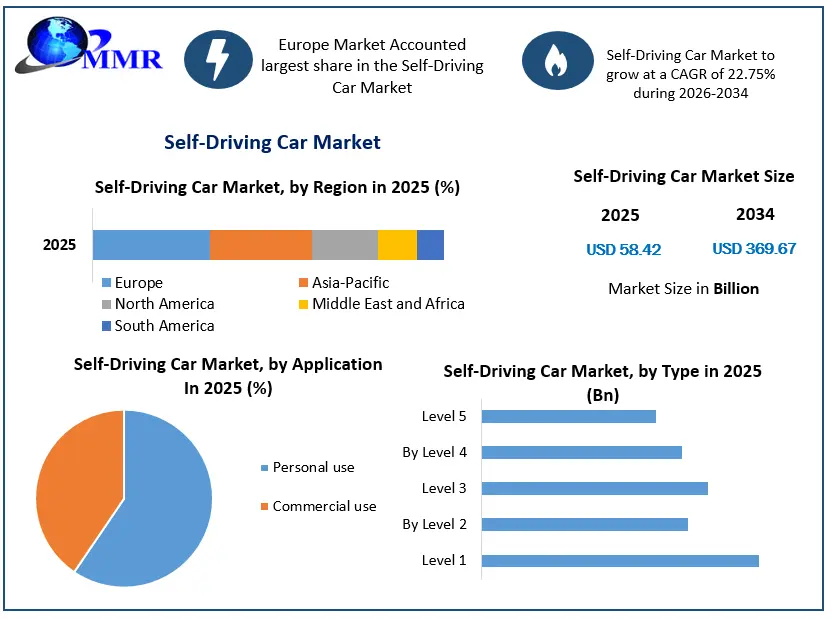
Market Valuation: The global self-driving car market was valued at USD 58.42 billion in 2025.
Growth Forecast: The market is projected to reach USD 369.67 billion by 2034, growing at a CAGR of 22.75%.
Technological Driver: Rapid progress in artificial intelligence, cloud computing, and blockchain is enabling the development of specialized, low-cost autonomous platforms.
Infrastructure Impact: Strategic investments in communication and road infrastructure are critical to enabling vehicle-to-everything (V2X) connectivity.
Safety Mandate: Reducing human error remains the primary driver for OEMs and governments, with autonomous combat and commercial trucks leading early deployment phases.
Why This Matters Now
The automotive industry has reached a point of no return where the vehicle is becoming a rolling data center, and the driver is increasingly becoming a passenger. For OEMs and Tier-1 suppliers, the integration of high-level autonomy is no longer just a research objective—it is a competitive necessity for survival in a market where software and sensor fusion define the value of the platform.
Market Overview
The Self-Driving Car Market is entering a pivotal expansion phase. Valued at USD 58.42 billion in 2025, the sector is leveraging a convergence of AI, LiDAR, and centralized computing to redefine mobility. By decoupling transportation from human operation, the industry is creating entirely new revenue streams, including Mobility-as-a-Service (MaaS) and automated logistics, which promise to disrupt traditional manufacturing and retail business models.
Key Trends Driving Growth
The Shift to Software-Defined Architectures: Modern autonomous systems are moving away from fragmented, hardware-heavy designs toward unified, software-defined platforms. This shift allows for continuous performance optimization through over-the-air (OTA) updates, enabling vehicles to improve their perception and decision-making capabilities without requiring physical hardware overhauls.
Commercialization of Level 4 Autonomy: Robotaxi fleets and autonomous logistics are the current frontier. By focusing on defined geofenced areas, manufacturers are overcoming the initial challenges of “general” autonomy, proving the safety and reliability of Level 4 systems in real-world urban and logistics environments. This targeted deployment is building the necessary public trust and regulatory readiness for broader adoption.
Segment Insights
Dominant Automation Segment: Semi-Autonomous Systems. These features, including adaptive cruise control and automated parking, currently dominate the market as they provide immediate safety benefits and consumer convenience.
Fastest-Growing Segment: Level 4 and Level 5 Autonomous Systems. Driven by aggressive investment in robotaxis and specialized logistics, fully autonomous technologies are seeing the highest growth rates as tech firms and OEMs scale up testing and deployment protocols.
Regional Growth Story
Europe currently holds the highest market share, benefiting from robust government funding and established autonomous testing programs that favor a safe, incremental roll-out. North America follows closely, supported by a dense ecosystem of tech giants and innovative start-ups in California, Texas, and Arizona that are setting global benchmarks for testing miles. The Asia-Pacific region is rapidly catching up, with China and Japan leading in the integration of smart city infrastructure and dedicated autonomous corridors.
Competitive Landscape
The market is characterized by a “co-opetition” model, where traditional automotive titans—like Stellantis, GM, and Toyota—collaborate with tech leaders like NVIDIA, Foxconn, and Uber. This structural shift signals that no single firm can solve the complexity of the full autonomous stack in isolation.
The strategy among market leaders is clear: secure the data-gathering advantage. By deploying fleets now, companies are training their neural networks on diverse, real-world edge cases. Suppliers that control the sensor-to-cloud pipeline, particularly in LiDAR and perception software, are gaining massive pricing power. OEMs who fail to secure these long-term partnerships risk becoming mere hardware assemblers in a supply chain where the real value—and the customer interface—lies in the software stack.
Recent Developments
Strategic Collaboration: Major OEMs are forging alliances with tech giants to develop and deploy Level 4 autonomous robotaxi fleets at scale.
Advanced Perception Systems: Increased integration of LiDAR and high-resolution camera sensors is significantly reducing traffic-related fatalities in test environments.
Regulatory Alignment: New testing protocols and government-backed infrastructure projects are streamlining the deployment of autonomous systems in dense urban settings.
Strategic Implications
For stakeholders, the implication is immediate: the value of the autonomous vehicle is found in its data connectivity. Investment strategies must pivot toward companies capable of scaling software-defined architectures. Fleet operators and logistics firms should prioritize platforms that offer interoperability with smart city infrastructure, as the “future of mobility” is fundamentally a connected, not just an autonomous, experience.
Future Outlook
The market is racing toward a future where “human-in-the-loop” driving will be a legacy requirement rather than an operational standard. Market leaders will be defined by their ability to orchestrate the complex ecosystem of sensors, connectivity, and AI-driven safety protocols, while those clinging to traditional, siloed manufacturing processes will find their influence rapidly eroding in the face of scalable, software-first autonomous solutions.
Analyst Perspective
“The self-driving car market is no longer a futuristic promise; it is an industrial imperative,” says Tejaswini Kakade, Analyst at Maximize Market Research. “As we transition from semi-autonomous convenience features to fully driverless commercial ecosystems, the winners will be those who can successfully integrate AI-driven perception with the rigorous safety standards required for public roads.”
About Maximize Market Research
Maximize Market Research Pvt. Ltd. (MMR) is a global market research and consulting company that provides reliable, data-focused, and practical business insights. The firm serves a wide range of industries, including healthcare, pharmaceuticals, technology, automotive, electronics, chemicals, personal care, and consumer goods. Through market forecasts, competitive analysis, strategic consulting, and industry impact assessments, MMR helps organizations understand changing market conditions, identify growth opportunities, and make informed business decisions for long-term success.
2nd Floor, Navale IT Park Phase 3
Pune Banglore Highway, Narhe
Pune, Maharashtra 411041, India
+91 9607365656
sales@maximizemarketresearch.com
