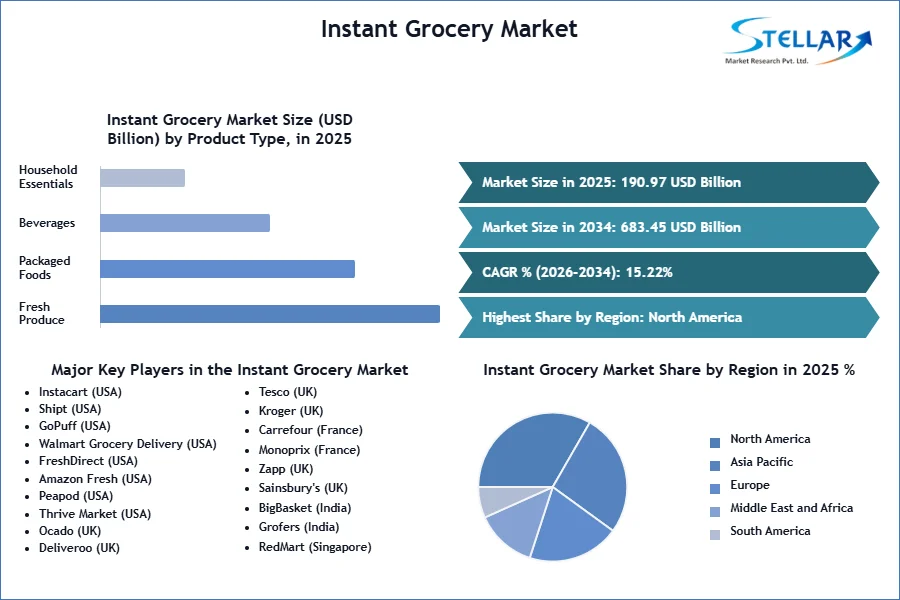
The Instant Grocery Market was valued at USD 190.97 billion in 2025 and is projected to reach nearly USD 683.45 billion by 2034, expanding at a CAGR of 15.22% from 2026 to 2032. The market is being transformed by dark stores, AI-driven logistics, and rising demand for ultra-fast grocery delivery solutions.
PUNE, India, July 15, 2026 —The Instant Grocery Market is entering a new phase of rapid transformation as consumers increasingly prioritize speed, convenience, and digital-first shopping experiences. According to a recent report by Stellar Market Research, the market is expected to witness significant growth during the forecast period, supported by expanding quick-commerce networks, rising smartphone penetration, advanced logistics technologies, and changing urban lifestyles.
𝐃𝐨𝐰𝐧𝐥𝐨𝐚𝐝 𝐅𝐫𝐞𝐞 𝐏𝐃𝐅 𝐁𝐫𝐨𝐜𝐡𝐮𝐫𝐞: https://www.stellarmr.com/report/req_sample/instant-grocery-market/2615
Market Opportunity Overview
The grocery retail sector is undergoing a major digital shift as traditional shopping models evolve toward instant fulfillment. Instant grocery services, powered by mobile applications, localized warehouses, and last-mile delivery networks, are redefining how consumers purchase everyday essentials.
The expansion of dark stores has become a major industry catalyst, allowing companies to maintain inventory closer to customers and complete deliveries within minutes. These micro-fulfillment centers are enabling quick-commerce platforms to improve order accuracy, reduce delivery times, and expand product availability across urban markets.
Consumer expectations have also changed significantly, with convenience becoming a key purchasing factor. Working professionals, urban households, and younger consumers are increasingly adopting instant grocery platforms for fresh produce, beverages, household essentials, personal care products, and packaged foods.
Technology integration is further strengthening market growth. Artificial intelligence-based demand forecasting, automated inventory management, route optimization, and data analytics are helping companies improve operational efficiency while reducing supply chain challenges.
Key Findings from the Report
Online grocery delivery platforms represent a major growth contributor due to increasing digital payments, mobile app adoption, and consumer preference for doorstep delivery.
Instant delivery models, including 10–30 minute delivery services, are gaining strong traction in densely populated urban regions.
North America and Europe remain significant markets due to advanced e-commerce infrastructure and high technology adoption.
Asia-Pacific is emerging as a high-growth region due to rapid urbanization, increasing internet penetration, and expanding quick-commerce startups.
AI-powered inventory management and route optimization are improving operational scalability and customer experience.
Investments in sustainable delivery methods, electric vehicles, and environmentally friendly packaging are creating new market opportunities.
Market Drivers and Restraints
Increasing Demand for Convenience-Based Shopping
The growing preference for fast and hassle-free shopping experiences is one of the strongest drivers of the Instant Grocery Market. Consumers are increasingly shifting from physical stores to digital platforms that provide immediate access to essential products.
Busy lifestyles, urban population growth, and increased adoption of smartphones are encouraging customers to use instant grocery applications for routine purchases.
Growth of Quick-Commerce Platforms
Quick-commerce companies are expanding their delivery networks through dark stores and hyperlocal fulfillment models. These platforms are investing heavily in logistics infrastructure, technology, and partnerships with local suppliers to improve delivery speed and product availability.
Artificial Intelligence and Automation Adoption
AI technologies are transforming grocery delivery operations by enabling real-time inventory tracking, predictive demand analysis, and optimized delivery routes. These solutions help companies minimize product shortages, reduce waste, and improve customer satisfaction.
High Operational Costs
One of the major challenges facing the Instant Grocery Market is the cost associated with maintaining dark stores, delivery fleets, warehouse operations, and last-mile logistics. Maintaining ultra-fast delivery capabilities requires continuous investment in infrastructure.
Profitability and Sustainability Challenges
Many instant grocery companies face challenges in achieving profitability due to competitive pricing strategies, customer acquisition costs, and environmental concerns related to rapid delivery operations.
Technology, Regulation, and Sustainability Trends
Technology remains at the center of instant grocery market development. Companies are increasingly adopting artificial intelligence, machine learning, cloud-based platforms, and automated fulfillment systems to improve operational performance.
Digital payment solutions and personalized recommendation engines are enhancing customer engagement by offering targeted promotions and customized shopping experiences.
Sustainability is also becoming an important focus area. Companies are investing in electric delivery vehicles, optimized delivery routes, reusable packaging, and waste reduction strategies to reduce environmental impact.
Regulatory frameworks related to food safety, delivery standards, labor policies, and digital commerce are influencing market operations. Businesses are increasingly focusing on compliance while scaling their delivery networks.
Regional Insights
North America
North America remains one of the leading regions in the Instant Grocery Market due to high online shopping adoption, strong digital infrastructure, and increasing demand for convenience-based services. The region continues to witness investments in quick-commerce platforms and automated fulfillment technologies.
Europe
Europe is experiencing steady growth as consumers increasingly adopt online grocery services. Strong logistics infrastructure, sustainability initiatives, and demand for efficient delivery models are supporting market expansion.
Asia-Pacific
Asia-Pacific is emerging as a major growth opportunity due to rapid urbanization, expanding middle-class populations, and increasing smartphone usage. Countries such as India, China, Japan, and Southeast Asian markets are witnessing strong adoption of instant grocery platforms.
The region’s growing digital ecosystem and increasing investments in quick-commerce startups are expected to accelerate future market growth.
Recent Industry Developments
Blinkit (2025): Expanded its quick-commerce network by increasing dark store coverage across major Indian cities, strengthening its ultra-fast grocery delivery capabilities.
Zepto (2025): Continued expansion of fulfillment centers and technology investments to improve delivery speed, inventory management, and customer experience.
Swiggy Instamart (2025): Increased focus on expanding instant grocery operations and strengthening partnerships with brands and local suppliers.
DoorDash (2025): Enhanced grocery delivery capabilities through technology upgrades and expanded partnerships with retailers to improve digital grocery access.
Gopuff (2025): Continued investment in micro-fulfillment infrastructure and operational optimization to strengthen its convenience commerce model.
Competitive Landscape
The Instant Grocery Market is highly competitive, with companies focusing on delivery speed, geographic expansion, technology integration, and customer retention strategies.
Major players include Blinkit, Zepto, Getir, Gorillas, Zapp, DoorDash, Gopuff, Swiggy Instamart, and other regional quick-commerce providers.
Market leaders are investing in dark store expansion, artificial intelligence solutions, automated warehouses, and strategic partnerships to improve operational efficiency. Companies are also focusing on loyalty programs, subscription models, and personalized shopping experiences to strengthen customer relationships.
𝐃𝐨𝐰𝐧𝐥𝐨𝐚𝐝 𝐅𝐫𝐞𝐞 𝐏𝐃𝐅 𝐁𝐫𝐨𝐜𝐡𝐮𝐫𝐞: https://www.stellarmr.com/report/req_sample/instant-grocery-market/2615
Analyst Commentary
“The Instant Grocery Market is moving beyond convenience delivery into a technology-driven retail ecosystem. The next stage of growth will depend on operational efficiency, sustainable logistics, and the ability of companies to balance delivery speed with profitability,” said a Senior Research Analyst at Stellar Market Research.
Future Outlook
The Instant Grocery Market is expected to experience strong expansion as digital commerce continues reshaping consumer purchasing behavior. Future growth will be influenced by advancements in artificial intelligence, automation, sustainable delivery systems, and expansion into emerging urban markets.
Companies that successfully optimize supply chains, improve customer experience, and develop profitable quick-commerce models will gain a competitive advantage. As consumer expectations continue moving toward faster and more personalized services, instant grocery platforms are expected to become an important component of the global retail ecosystem.
About Stellar Market Research
Stellar Market Research is a global market research and business consulting firm providing comprehensive industry analysis, market intelligence, and strategic consulting solutions. The company delivers reliable research reports covering technology, consumer goods, healthcare, energy, industrial sectors, and emerging markets. Through data-driven insights, competitive analysis, and customized research solutions, Stellar Market Research supports businesses, investors, and organizations in identifying opportunities and making informed decisions. The company focuses on delivering actionable market intelligence that helps clients understand industry trends, evaluate growth potential, and develop effective business strategies.
Media Contact
Stellar Market Research
Website: Stellar Market Research – Global Research Reports & Consulting
Email: sales@stellarmr.com
