Key Highlights
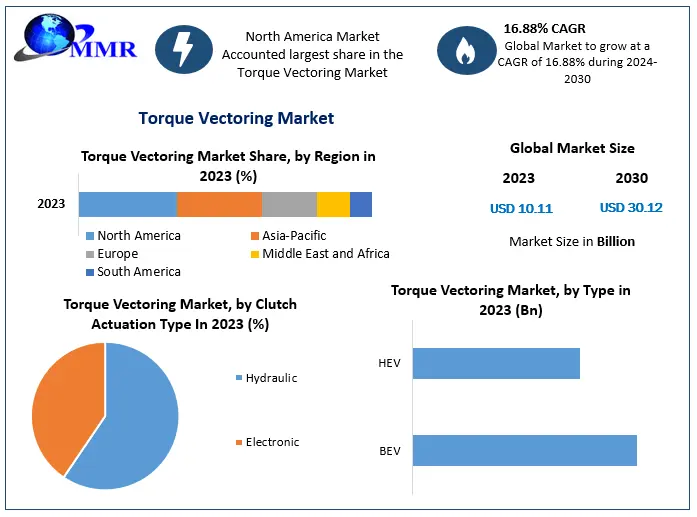
- Market valued at USD 10.11 Billion in 2023.
- Expected to reach nearly USD 30.12 Billion by 2030.
- Forecast CAGR: 16.88% (2024–2030).
- Electric vehicles continue expanding demand for advanced torque distribution systems.
- ADAS adoption strengthens the business case for intelligent vehicle dynamics.
- Growing demand for AWD and high-performance vehicles supports wider deployment.
- Automotive manufacturers increasingly integrate electronic control with drivetrain technologies.
Why This Matters Now
Automakers no longer compete only on horsepower or battery range. They increasingly compete on how intelligently vehicles convert power into control. That shift places torque vectoring at the center of future vehicle architecture.
The business implications extend well beyond handling. Better torque distribution improves safety, enhances energy efficiency in electric vehicles, strengthens ADAS performance, and enables differentiated driving experiences that premium brands can monetize. As electrification accelerates, OEMs and Tier-1 suppliers that master vehicle dynamics software gain stronger pricing power and technological differentiation.
Market Overview
The Torque Vectoring Market was valued at USD 10.11 Billion in 2023 and is expected to reach nearly USD 30.12 Billion by 2030, expanding at a 16.88% CAGR during the forecast period. According to Maximize Market Research, rising adoption of advanced driver assistance systems, increasing demand for all-wheel-drive vehicles, and rapid growth of electric and hybrid vehicles continue to reshape market demand.
Torque vectoring technology distributes torque between wheels according to steering angle, road conditions, traction levels, and vehicle speed. The result is improved cornering, better traction, greater stability, and enhanced vehicle control across diverse driving environments.
This capability is becoming increasingly valuable as vehicle software assumes greater responsibility for safety, autonomous functions, and performance optimization. Rather than serving only performance vehicles, torque vectoring is gradually becoming part of broader intelligent mobility strategies.
Key Trends Driving Growth
Electric vehicle adoption remains the strongest structural catalyst. Unlike conventional drivetrains, electric motors enable precise electronic control of individual wheel torque, making torque vectoring both more effective and easier to integrate. As global EV production expands, manufacturers gain new opportunities to deliver software-defined driving performance without relying solely on mechanical systems.
ADAS deployment further increases demand. Stability control, traction management, emergency maneuvering, and predictive safety systems all benefit from faster torque allocation. This creates additional value for OEMs seeking higher safety ratings and regulatory compliance.
Powertrain architectures are also evolving. Mechanical, hydraulic, electronic, and electric torque vectoring solutions continue to coexist, but software-driven control systems increasingly dominate development priorities. The transition favors suppliers with expertise in electronics, sensors, and control algorithms rather than purely mechanical engineering.
Consumer expectations are changing as well. Buyers increasingly expect premium driving characteristics across SUVs, crossovers, and electrified vehicles, encouraging manufacturers to expand torque vectoring beyond luxury performance segments.
Segment Insights
- Dominant Segment: Not specified in the supplied MMR report. Omitted in accordance with source requirements.
- Fastest-Growing Segment: Not specified in the supplied MMR report. Omitted in accordance with source requirements.
- Electric, mechanical, hydraulic, and electronic torque vectoring technologies serve multiple vehicle categories, including passenger cars, commercial vehicles, and off-road vehicles.
- Growing deployment across AWD and electrified vehicle platforms continues to expand application opportunities.
Regional Growth Story
China continues benefiting from aggressive electric vehicle policies, extensive manufacturing capacity, and sustained consumer adoption. The country’s leadership in EV production naturally strengthens demand for advanced vehicle dynamics technologies integrated into electric platforms.
Europe maintains strong momentum as increasingly stringent emission regulations encourage automakers to accelerate electrification. Premium European manufacturers also continue differentiating through driving dynamics, creating favorable conditions for torque vectoring deployment.
The United States is steadily expanding adoption as electric vehicle market share grows and automakers introduce increasingly software-centric vehicle platforms. Safety technologies and performance-oriented SUVs further support implementation.
Japan and South Korea remain important innovation centers through advanced automotive electronics and global OEM manufacturing capabilities. India is emerging as a longer-term opportunity as electric mobility investments expand and vehicle safety expectations increase.
Across automotive manufacturing hubs, investment priorities increasingly combine electrification, intelligent control systems, and software-defined vehicle architectures.
Competitive Landscape
Competition increasingly revolves around software capability rather than hardware alone.
OEMs seek integrated vehicle control platforms capable of coordinating torque distribution, braking, steering, and stability systems simultaneously. This favors suppliers able to combine electronic control units, sensors, software algorithms, and drivetrain expertise into unified solutions.
Tier-1 suppliers also face growing pressure to support multiple propulsion systems—including internal combustion, hybrid, and battery-electric vehicles—using scalable architectures. Platform flexibility reduces development costs while enabling manufacturers to deploy similar technologies across broader product portfolios.
As electrification progresses, competitive advantage shifts toward companies capable of delivering integrated vehicle dynamics rather than standalone mechanical components.
Recent Developments
- Rising adoption of electric and hybrid vehicles continues expanding demand for advanced torque vectoring technologies.
- Integration of torque vectoring with ADAS and broader vehicle safety systems is increasing across automotive platforms.
- Automotive manufacturers continue investing in technologies that improve vehicle handling, stability, traction, and overall driving performance.
- Growth of all-wheel-drive vehicle platforms supports broader deployment opportunities across passenger and specialty vehicle segments.
Strategic Implications
Several structural shifts deserve executive attention.
First, software increasingly determines vehicle differentiation. Torque vectoring becomes another software-enabled capability that enhances both safety and customer experience.
Second, semiconductor availability becomes increasingly important. Advanced torque vectoring depends on sensors, electronic controllers, computing capability, and real-time software execution. This strengthens the strategic importance of resilient semiconductor supply chains.
Third, electrification changes supplier economics. Electric drivetrains simplify implementation while creating opportunities for entirely new vehicle control strategies that were previously impractical with conventional mechanical systems.
Finally, regulatory pressure continues supporting investment. Better stability, traction, and safety performance align with increasingly demanding vehicle safety expectations across major automotive markets.
Future Outlook
Torque vectoring is steadily evolving from a premium performance feature into a foundational technology for software-defined mobility. As electric vehicles, ADAS, connected platforms, and autonomous driving capabilities mature together, intelligent torque management will become increasingly integrated into overall vehicle control architecture.
Manufacturers that combine drivetrain engineering with advanced software, electronics, and scalable vehicle platforms will capture greater competitive advantage, while those relying solely on conventional mechanical differentiation risk losing market relevance.
The future leaders will not simply build faster vehicles—they will build vehicles that make every watt, every sensor, and every wheel work together intelligently.
Analyst Perspective
“Growing adoption of electric vehicles, advanced driver assistance systems, and intelligent drivetrain technologies is accelerating demand for torque vectoring solutions as automotive manufacturers prioritize safety, stability, and vehicle performance across next-generation mobility platforms.” — Tejaswini Kakade, Analyst
About Maximize Market Research
Maximize Market Research Pvt. Ltd. (MMR) is a global market research and consulting company that provides reliable, data-focused, and practical business insights. The firm serves a wide range of industries, including healthcare, pharmaceuticals, technology, automotive, electronics, chemicals, personal care, and consumer goods. Through market forecasts, competitive analysis, strategic consulting, and industry impact assessments, MMR helps organizations understand changing market conditions, identify growth opportunities, and make informed business decisions for long-term success.
2nd Floor, Navale IT Park Phase 3
Pune Banglore Highway, Narhe
Pune, Maharashtra 411041, India
+91 9607365656
sales@maximizemarketresearch.com
