Key Highlights
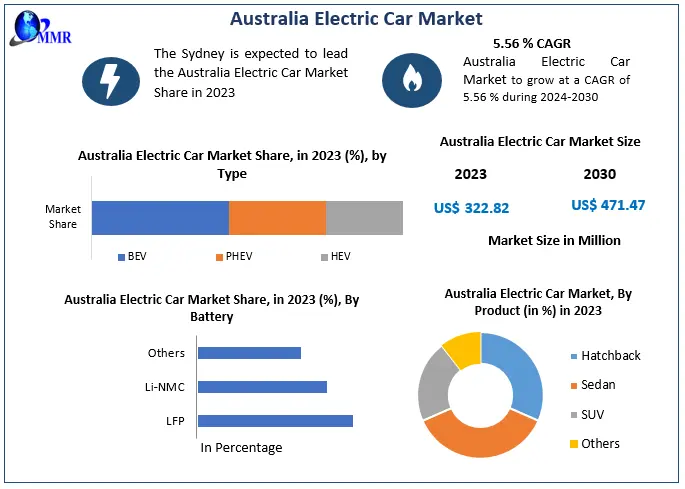
- The Australia Electric Car Market was valued at USD 322.82 Million in 2023, reflecting accelerating consumer and industry adoption of electric mobility.
- The market is expected to reach USD 471.47 Million by 2030, encouraging sustained investment in EV production, charging infrastructure, and digital mobility ecosystems.
- The market is projected to grow at a 5.56% CAGR from 2024 to 2030, supporting long-term opportunities for OEMs, suppliers, fleet operators, and infrastructure developers.
- Charging network expansion and government decarbonization initiatives continue strengthening market confidence.
- Connected vehicle technologies, battery innovation, and software-defined mobility are reshaping Australia’s automotive landscape.
Why This Matters Now
Australia’s automotive industry is entering a decisive transition from conventional internal combustion vehicles toward connected, electrified transportation. For automakers, battery suppliers, charging infrastructure providers, fleet operators, and investors, the market is shifting from early adoption to long-term commercialization.
The Australia Electric Car Market was valued at USD 322.82 Million in 2023. That market value demonstrates growing commercial momentum for electric passenger vehicles and encourages OEMs to strengthen vehicle availability, expand dealer networks, and invest in localized mobility ecosystems. The market is expected to reach USD 471.47 Million by 2030, growing at a 5.56% CAGR from 2024 to 2030, signaling sustained investment opportunities across manufacturing, infrastructure, digital services, and fleet electrification.
Market Overview
Electric vehicles are becoming a strategic priority across Australia’s transportation sector. Consumer awareness, sustainability objectives, regulatory support, and advances in battery technology are reshaping purchasing decisions while encouraging greater investment throughout the automotive value chain.
Unlike earlier phases of EV adoption that focused primarily on environmental benefits, today’s market is increasingly driven by total ownership value, digital connectivity, vehicle performance, and long-term operating efficiency. Buyers expect electric vehicles to function as connected mobility platforms rather than simply replacing conventional powertrains.
Manufacturers are responding by expanding electric vehicle portfolios while strengthening software integration, intelligent energy management, advanced safety systems, and connected services. This broader transformation is redefining competition across Australia’s automotive market.
The supporting ecosystem is evolving simultaneously. Charging infrastructure providers, fleet operators, energy companies, software developers, and mobility service providers are becoming essential participants in Australia’s transition toward electrified transportation.
Key Trends Driving Growth
The strongest catalyst remains accelerating electrification across passenger mobility. Consumers increasingly consider battery electric vehicles as practical alternatives to conventional automobiles, encouraging manufacturers to expand product availability and improve affordability.
Charging infrastructure expansion continues reducing one of the industry’s most significant adoption barriers. Public charging investments, workplace charging solutions, and residential charging capabilities improve consumer confidence while supporting higher vehicle utilization.
Battery technology remains central to market competitiveness. Improvements in battery performance, energy density, durability, and charging capability enable manufacturers to improve driving experience while reducing ownership concerns.
Software-defined vehicle development is reshaping customer expectations. Modern electric vehicles increasingly rely on integrated software platforms supporting over-the-air updates, intelligent energy optimization, predictive maintenance, and connected mobility services throughout the vehicle lifecycle.
Fleet electrification is becoming another important growth driver. Commercial operators increasingly evaluate electric vehicles for corporate sustainability objectives, operational efficiency, and long-term fleet modernization strategies.
Supply-chain resilience also remains strategically important. Semiconductor availability, battery materials, power electronics, and advanced manufacturing capabilities continue influencing production planning and product availability across Australia’s automotive market.
Segment Insights
- Dominant Segment: Information not available in the supplied source.
- Fastest-Growing Segment: Information not available in the supplied source.
- Battery electric vehicles continue driving innovation across passenger mobility.
- Connected vehicle technologies are becoming increasingly important purchasing criteria.
- Manufacturers continue emphasizing battery efficiency, digital integration, intelligent safety systems, and software-enabled functionality.
Regional Growth Story
Australia’s electric vehicle transition reflects broader developments occurring across major global automotive markets.
The United States continues advancing battery manufacturing, charging infrastructure expansion, and software-defined vehicle development, influencing technology adoption across international markets.
Germany remains a leader in premium electric vehicle engineering while accelerating investments in battery technologies, connected mobility, and advanced manufacturing capabilities.
China continues strengthening global leadership across electric vehicle manufacturing, battery production, and supply-chain integration. Manufacturing scale and technological investment continue shaping international competitive dynamics.
Japan and South Korea remain important centers for battery innovation, power electronics, advanced materials, and intelligent vehicle development. Their engineering capabilities continue supporting global electrification.
Australia benefits from these international developments while simultaneously expanding domestic charging infrastructure, strengthening consumer adoption, and creating opportunities for automotive retailers, charging providers, and mobility service companies.
Regional competitiveness increasingly depends on charging accessibility, policy consistency, digital infrastructure, and ecosystem collaboration rather than vehicle availability alone.
Competitive Landscape
Competition within Australia’s electric vehicle market extends beyond vehicle manufacturing. Companies increasingly compete through integrated mobility ecosystems that combine hardware, software, charging solutions, digital services, and customer experience.
OEM strategies increasingly prioritize complete ownership ecosystems rather than standalone vehicle sales. Manufacturers capable of integrating charging partnerships, connected vehicle services, predictive maintenance, and software upgrades strengthen long-term customer relationships.
Tier-1 suppliers are also expanding their strategic importance. Battery systems, power electronics, advanced sensors, intelligent software, thermal management technologies, and electronic architectures are becoming essential differentiators across electric vehicle platforms.
Technology leadership increasingly depends on battery innovation, digital connectivity, autonomous-ready vehicle architectures, cybersecurity, and over-the-air software capabilities rather than conventional automotive engineering alone.
Manufacturing competitiveness continues shifting toward resilient battery supply chains, semiconductor availability, intelligent production systems, and flexible manufacturing platforms capable of supporting evolving consumer demand.
Pricing power increasingly reflects ecosystem value. Companies delivering superior charging access, software functionality, digital services, and ownership convenience strengthen competitive positioning despite increasing market competition.
Recent Developments
- Charging infrastructure investments continue expanding across Australia.
- OEMs are increasing availability of battery electric vehicle models.
- Software-defined vehicle technologies are becoming standard competitive features.
- Fleet electrification initiatives continue gaining momentum.
- Battery technology development remains central to long-term industry investment.
Strategic Implications
Australia’s electric vehicle market illustrates a broader transformation from vehicle ownership toward digitally connected mobility ecosystems. Success increasingly depends on ecosystem integration rather than product availability alone.
OEMs must simultaneously strengthen vehicle technology, software platforms, charging partnerships, and customer experience. Suppliers benefit from expanding demand for batteries, semiconductors, power electronics, sensors, and intelligent software platforms.
Fleet operators increasingly evaluate electric vehicles based on lifecycle operating efficiency, sustainability objectives, digital fleet management, and charging accessibility rather than initial acquisition cost.
For investors, competitive advantage increasingly depends on companies capable of integrating electrification, software intelligence, infrastructure partnerships, and resilient supply chains into scalable business models.
Future Outlook
The Australia Electric Car Market is entering a period where electrification, intelligent software, connected mobility, and charging infrastructure collectively redefine automotive competition. The market’s growth from USD 322.82 Million in 2023 to an expected USD 471.47 Million by 2030, supported by a 5.56% CAGR, demonstrates sustained commercial confidence in Australia’s electric mobility transition.
The next competitive leaders will not simply manufacture electric vehicles—they will build integrated mobility ecosystems that combine battery innovation, intelligent software, charging accessibility, and digital customer experiences, while companies treating electrification as only a powertrain replacement will steadily lose strategic relevance.
Analyst Perspective
“The Australia Electric Car Market reflects a broader transformation in how mobility is designed, delivered, and experienced. Organizations that combine electrification, digital connectivity, charging ecosystem development, and customer-centric innovation will be best positioned to capture long-term value as Australia’s automotive industry continues its transition toward sustainable mobility.” — Tejaswini Kakade, Analyst
About Maximize Market Research
Maximize Market Research Pvt. Ltd. (MMR) is a global market research and consulting company that provides reliable, data-focused, and practical business insights. The firm serves a wide range of industries, including healthcare, pharmaceuticals, technology, automotive, electronics, chemicals, personal care, and consumer goods. Through market forecasts, competitive analysis, strategic consulting, and industry impact assessments, MMR helps organizations understand changing market conditions, identify growth opportunities, and make informed business decisions for long-term success.
2nd Floor, Navale IT Park Phase 3
Pune Banglore Highway, Narhe
Pune, Maharashtra 411041, India
+91 9607365656
sales@maximizemarketresearch.com
