Key Highlights
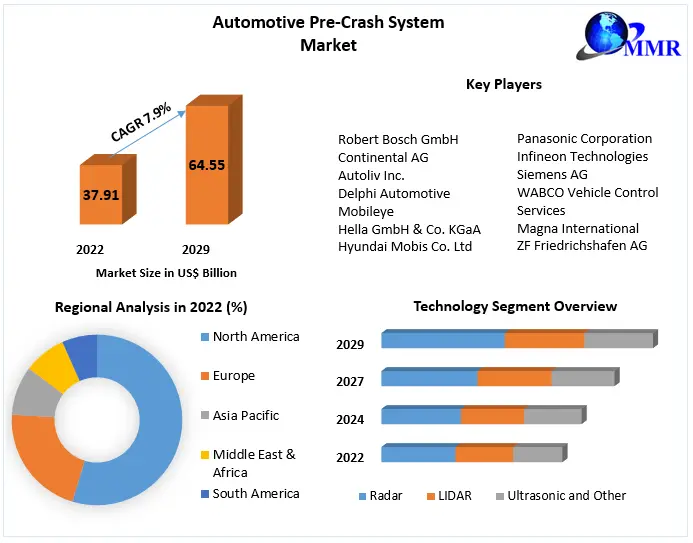
- Global market expected to grow from US$37.91 billion in 2022 to US$64.55 billion by 2029.
- Market projected to expand at a 7.9% CAGR during the forecast period.
- Asia Pacific held the largest market share in 2022.
- Adaptive Cruise Control and Blind Spot Detection remain the leading system categories.
- Passenger vehicles account for the largest deployment of pre-crash technologies.
- Radar, LiDAR, cameras, and ultrasonic sensors continue to improve collision detection accuracy.
- Government safety regulations are increasing standard installation of advanced driver assistance systems.
- Autonomous vehicle development is strengthening long-term demand for collision mitigation technologies.
Why This Matters Now
Vehicle safety has become a strategic differentiator rather than a premium feature. Governments are tightening safety regulations, while consumers increasingly expect advanced driver assistance systems as standard equipment. Automakers are responding by integrating collision prevention technologies across more vehicle segments. This shift expands opportunities for sensor manufacturers, semiconductor companies, automotive electronics suppliers, and software developers while improving road safety worldwide.
Market Overview
The Automotive Pre-Crash System Market includes electronic safety systems designed to detect potential collisions and either warn drivers or automatically intervene before an accident occurs. These systems combine radar, cameras, LiDAR, ultrasonic sensors, electronic control units, and intelligent software to reduce crash severity or prevent accidents altogether.
Demand continues to rise as vehicle manufacturers prioritize active safety technologies. Consumers increasingly value safety ratings when purchasing vehicles, encouraging manufacturers to install advanced driver assistance systems across entry-level and mid-range models.
Supply-side growth is supported by continuous innovation in automotive electronics, semiconductor technology, sensor manufacturing, and embedded software. Improvements in production efficiency are lowering system costs while increasing performance, enabling wider adoption across global vehicle platforms.
Several macroeconomic factors reinforce market expansion. Rising road traffic, increasing passenger vehicle ownership, growing awareness of accident prevention, and stricter government regulations continue to strengthen industry demand. According to WHO estimates referenced in the report, approximately 1.35 million people lose their lives annually in road accidents, with nearly 95% of accidents linked to human error. This highlights the growing importance of technologies capable of reducing driver mistakes and improving vehicle safety.
Key Trends Driving Growth
Sensor Fusion Improves Vehicle Intelligence
Automotive manufacturers are integrating radar, LiDAR, cameras, and ultrasonic sensors into unified detection platforms. Sensor fusion significantly improves obstacle recognition under rain, fog, darkness, and complex traffic conditions.
Business impact: Suppliers delivering integrated hardware and software platforms gain stronger OEM partnerships while reducing dependence on individual component sales.
Government Safety Regulations Drive Standard Adoption
Road safety regulations continue to evolve across major automotive markets. Manufacturers increasingly install pre-crash systems as standard equipment rather than optional upgrades.
Business impact: Regulatory compliance expands addressable markets for automotive electronics suppliers and supports stable long-term demand.
Autonomous Vehicle Development Expands Market Potential
Autonomous driving technologies rely on accurate collision detection and automated braking capabilities. Pre-crash systems have become foundational technologies supporting higher levels of vehicle automation.
Business impact: Companies investing in advanced sensing technologies secure stronger positions within next-generation mobility ecosystems.
Hardware and Software Integration Enhances Performance
Advances in artificial intelligence, embedded software, and electronic control units are improving system accuracy while reducing false alerts and enhancing performance in adverse weather.
Business impact: Competitive differentiation increasingly depends on intelligent software integration rather than hardware specifications alone.
Global Automotive Production Supports Scale
Growing vehicle production across emerging economies enables larger manufacturing volumes for sensors and safety components.
Business impact: Higher production volumes improve economies of scale and reduce overall system costs, supporting wider market penetration.
Explore detailed analysis, insights, and growth opportunities
Segment Insights
Dominant Segment: Adaptive Cruise Control and Blind Spot Detection
Adaptive Cruise Control and Blind Spot Detection hold the largest share of the Automotive Pre-Crash System Market. These technologies directly address common collision scenarios, including highway driving, lane changes, and congested urban traffic.
Automakers increasingly bundle these features into advanced driver assistance packages, making them accessible beyond luxury vehicle segments.
Business impact: Suppliers specializing in radar modules, cameras, electronic control units, and software algorithms benefit from increasing production contracts across multiple vehicle platforms.
Fastest-Growing Segment: Driver Monitoring System
Driver Monitoring Systems are emerging as one of the fastest-growing segments due to increasing attention on distracted driving, fatigue detection, and driver behavior monitoring.
Governments and automotive manufacturers recognize driver monitoring as an essential complement to automated driving technologies.
Business impact: Camera manufacturers, AI developers, and automotive software companies gain new revenue opportunities as driver monitoring becomes more widely integrated into future vehicle architectures.
Additional Key Sub-Segments
By Component
- DC Motor
- Cameras
- Sensors
- Electronic Control Unit (ECU)
- Other Components
Sensors and cameras remain the most strategically important components because they directly determine environmental awareness and system response accuracy. ECUs continue gaining importance as vehicle software becomes increasingly sophisticated.
By Technology
- Radar
- LiDAR
- Ultrasonic and Other Technologies
Radar maintains broad adoption due to its cost efficiency and reliability. LiDAR adoption is increasing as autonomous vehicle development advances and sensing accuracy becomes more critical.
By Vehicle Type
- Passenger Vehicle
- Light Commercial Vehicle
- Medium Commercial Vehicle
- Heavy Commercial Vehicle
- Other Vehicles
Passenger vehicles dominate market demand because of their higher production volumes and growing consumer demand for active safety technologies. Commercial vehicle adoption continues to increase as fleet operators focus on reducing accident-related operating costs.
Regional Growth Story
Asia Pacific
Asia Pacific remains the largest regional market, supported by its leadership in global passenger vehicle production. Approximately 68% of worldwide passenger vehicles are produced within the region, creating significant demand for advanced safety systems.
Rapid industrialization, expanding middle-class vehicle ownership, and increasing adoption of Electronic Stability Control and Lane Departure Warning technologies reinforce regional growth.
Europe
Europe continues leading automotive safety innovation through advanced engineering capabilities and strong investment in ADAS development. Stringent vehicle safety regulations encourage widespread adoption of collision mitigation technologies.
The region also attracts continuous investment from automotive technology companies developing next-generation safety platforms.
North America
North America maintains strong demand through sustained investment in automotive research, advanced electronics, and autonomous driving technologies.
High consumer acceptance of premium safety features supports steady deployment of pre-crash systems across passenger and commercial vehicles.
Middle East & Africa and South America
These regions represent emerging growth markets as governments strengthen road safety initiatives and manufacturers introduce advanced driver assistance technologies across broader vehicle categories.
Competitive Landscape
The Automotive Pre-Crash System Market remains highly consolidated, with global automotive technology suppliers competing through innovation, integrated product portfolios, and long-standing relationships with original equipment manufacturers.
Robert Bosch GmbH, Continental AG, Autoliv Inc., Delphi Automotive, Mobileye, Hella GmbH & Co. KGaA, Hyundai Mobis Co. Ltd., Panasonic Corporation, Infineon Technologies, Siemens AG, WABCO Vehicle Control Services, Magna International, and ZF Friedrichshafen AG are strengthening their market positions through continued investment in advanced driver assistance systems, sensor technologies, automotive electronics, and intelligent vehicle software.
Competition is increasingly shifting toward complete safety ecosystems that integrate sensing, data processing, automated braking, and driver assistance functions into unified vehicle platforms. Companies capable of delivering end-to-end solutions are expected to secure stronger partnerships with global automakers and benefit from expanding autonomous mobility programs.
Recent Developments
- Automotive manufacturers are expanding pre-crash systems as standard equipment to improve vehicle safety.
- Hardware and software integration continues to improve system performance in adverse weather conditions.
- Radar, camera, LiDAR, and ultrasonic sensor technologies remain the primary focus of product development.
- Increasing autonomous vehicle development is driving greater adoption of collision mitigation technologies.
- Government road safety initiatives continue encouraging broader deployment of advanced driver assistance systems.
Future Outlook
Manufacturers that combine intelligent sensor fusion, advanced software integration, and regulatory-compliant safety platforms will capture the strongest competitive advantage as collision avoidance technologies become standard across global vehicle production.
Analyst Perspective – Rucha Deshpande
The Automotive Pre-Crash System Market is transitioning from an optional safety technology to a core vehicle requirement as regulators, consumers, and automakers prioritize accident prevention. The projected rise from US$37.91 billion in 2022 to US$64.55 billion by 2029 reflects a structural shift toward advanced driver assistance systems (ADAS) becoming standard across passenger and commercial vehicles.
About Maximize Market Research
Maximize Market Research Pvt. Ltd. (MMR) is a global market research and consulting company that provides reliable, data-focused, and practical business insights. The firm serves a wide range of industries, including healthcare, pharmaceuticals, technology, automotive, electronics, chemicals, personal care, and consumer goods. Through market forecasts, competitive analysis, strategic consulting, and industry impact assessments, MMR helps organizations understand changing market conditions, identify growth opportunities, and make informed business decisions for long-term success.
Contact Us :
2nd Floor, Navale IT Park Phase 3
Pune Banglore Highway, Narhe
Pune, Maharashtra 411041, India
+91 9607365656
sales@maximizemarketresearch.com
