Key Highlights
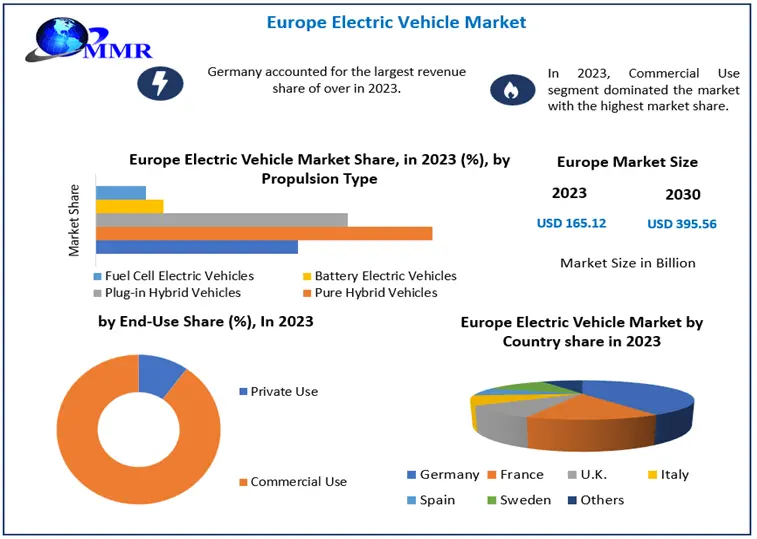
- Europe Electric Vehicle Market valued at USD 165.12 billion in 2023.
- Market projected to reach USD 395.56 billion by 2030.
- Expected CAGR of 13.29% during 2024–2030.
- Germany remained the largest EV market in Europe.
- Commercial-use electric vehicles are expected to dominate future demand.
- The 100 kW–250 kW power output segment is projected to witness the fastest growth.
- Government incentives continue supporting EV purchases and charging infrastructure.
- Battery electric vehicles continue gaining market share across Europe.
Why This Matters Now
Europe’s transition toward zero-emission transportation has entered a large-scale commercialization phase. Governments are strengthening emissions regulations, expanding charging infrastructure, and supporting domestic battery manufacturing while automakers accelerate investments in electric mobility. These developments are reshaping automotive supply chains and creating long-term opportunities for vehicle manufacturers, battery producers, charging infrastructure providers, and technology companies.
Market Overview
The Europe Electric Vehicle Market comprises battery electric vehicles (BEVs), hybrid electric vehicles (HEVs), plug-in hybrid electric vehicles (PHEVs), and fuel cell electric vehicles (FCEVs) designed to reduce greenhouse gas emissions and dependence on fossil fuels.
Demand continues to accelerate as governments implement stricter emission regulations, provide purchase incentives, and invest heavily in charging infrastructure. Rising consumer awareness regarding sustainability and lower vehicle operating costs is further strengthening EV adoption across passenger and commercial transportation.
Supply-side growth is supported by significant investments in battery manufacturing, vehicle production, software development, and charging technologies. European manufacturers continue expanding product portfolios while increasing localized battery production to reduce dependence on imported components.
China continues to dominate the global EV battery supply chain, creating strategic challenges for Europe despite increasing regional investments in battery manufacturing facilities. At the same time, public and private investments in charging infrastructure continue reducing range anxiety and improving consumer confidence.
Key Trends Driving Growth
Government Incentives Continue Driving EV Adoption
European governments continue introducing tax incentives, purchase subsidies, and charging infrastructure grants to accelerate electric mobility.
Countries including the Netherlands, Greece, Finland, Germany, and Italy continue expanding financial support for both EV purchases and charging installations.
Business impact: Incentive programs improve vehicle affordability while accelerating EV adoption across residential and commercial markets.
Charging Infrastructure Expands Rapidly
Governments continue investing heavily in public charging networks to support growing EV fleets.
Italy plans to install more than 21,000 charging stations by 2026, strengthening accessibility across urban and intercity transportation corridors.
Business impact: Expanded charging networks reduce range anxiety while supporting higher EV penetration rates.
Battery Technology Continues Advancing
Automotive manufacturers continue improving battery performance through higher energy density, faster charging capability, and lower production costs.
Business impact: Improved battery technologies increase vehicle competitiveness while supporting wider consumer adoption.
Commercial Fleet Electrification Accelerates
Electric buses, delivery vans, and commercial trucks are experiencing rapid adoption due to fuel cost savings and stricter emission regulations.
Business impact: Fleet electrification creates significant opportunities for vehicle manufacturers, battery suppliers, and charging infrastructure companies.
Explore detailed analysis, insights, and growth opportunities
Supply Chain Localization Gains Importance
European governments and manufacturers continue investing in domestic battery production to strengthen supply chain resilience.
Business impact: Local battery manufacturing reduces import dependence while supporting long-term industrial competitiveness.
Segment Insights
Dominant Segment: Commercial Use
Commercial-use electric vehicles are expected to dominate market growth throughout the forecast period.
Increasing fuel prices, emission regulations, and rapid adoption of electric buses, delivery vans, and freight vehicles continue strengthening commercial demand.
Fleet operators increasingly prioritize electric vehicles because of lower operating costs and regulatory compliance.
Business impact: Manufacturers focusing on commercial EV platforms benefit from stable fleet replacement cycles and government-supported procurement programs.
Fastest-Growing Segment: 100 kW–250 kW Power Output
The 100 kW–250 kW segment is expected to register the highest CAGR during the forecast period.
Growth is driven by increasing production of electric buses, commercial vans, pickup trucks, and medium-duty freight vehicles requiring higher power outputs.
Business impact: Battery manufacturers and powertrain suppliers gain opportunities through growing demand for high-performance commercial electric vehicles.
Additional Key Sub-Segments
By Propulsion Type
- Hybrid Vehicles
- Pure Hybrid Vehicles
- Plug-in Hybrid Vehicles
- Battery Electric Vehicles
- Fuel Cell Electric Vehicles
Battery Electric Vehicles continue capturing the largest share of new registrations as governments prioritize zero-emission transportation.
Hybrid vehicles remain important transitional technologies in markets where charging infrastructure is still developing.
By End Use
- Private Use
- Commercial Use
Private vehicle adoption remains strong due to increasing model availability and purchase incentives, while commercial applications continue generating faster long-term growth.
Regional Growth Story
Germany
Germany remains Europe’s largest electric vehicle market, supported by strong domestic automotive manufacturing and extensive government incentives.
The country aims to place 15 million electric vehicles on its roads by 2030 while continuing to expand charging infrastructure and battery production.
Sweden
Sweden is expected to record the fastest market growth during the forecast period.
Strong government support, early adoption of electric mobility, and consumer preference for sustainable transportation continue accelerating EV sales.
France, Italy, Spain and United Kingdom
These countries continue investing heavily in charging infrastructure, public transportation electrification, and consumer incentive programs.
Manufacturers are expanding production capacity while introducing new battery-electric and hybrid vehicle models.
Competitive Landscape
The Europe Electric Vehicle Market remains highly competitive, with established global automakers competing alongside emerging electric mobility companies through product innovation, battery technology, software integration, and manufacturing expansion.
Tesla, Renault, Hyundai Motor Company, Volkswagen AG, Kia Corporation, Mercedes-Benz, Ford, BYD Company Ltd., Solaris Bus & Coach, Volvo, Ebusco, Daimler, Zero Motorcycles Inc., Niu International, Evoke Electric Motorcycles (HK) Ltd., Horwin Global, Harley-Davidson Inc., VanMoof, Cowboy, Giant Bicycles, myStromer AG, and Yamaha Motor continue strengthening market positions through investments in battery technologies, charging ecosystems, software-defined vehicles, and expanded EV product portfolios.
Competition is increasingly shifting toward battery efficiency, charging speed, software capabilities, and localized manufacturing. Companies capable of securing reliable battery supply chains while delivering affordable, long-range electric vehicles will strengthen their leadership across the European market.
Recent Developments
- January 2023: Italy announced plans to install more than 21,000 EV charging stations by 2026 through the Ministry of the Environment and Energy Security (MASE).
- February 2023: Renault announced plans to invest €20 billion in electric vehicles and software by 2030.
- Renault plans to introduce 30 new electric vehicle models by 2025, including Renault, Dacia, and Alpine brands.
- European governments continue expanding financial incentives for EV purchases and residential charging infrastructure.
- Battery electric vehicle registrations across the EU recorded strong growth during 2023, reinforcing accelerating market adoption.
Analyst Perspective – Rucha Deshpande
The Europe Electric Vehicle Market has moved beyond early adoption and is entering a phase of industrial transformation where battery manufacturing, charging infrastructure, and software ecosystems will determine long-term competitiveness. While government incentives continue to stimulate demand, future market leadership will increasingly depend on localized battery supply chains, scalable manufacturing, and technological differentiation. Europe’s dependence on Asian battery production remains a strategic challenge, prompting significant investments in regional battery gigafactories and supply chain diversification.
Germany will continue leading production and innovation, while Sweden and other Nordic countries will remain important benchmarks for EV adoption and policy implementation. Commercial electric vehicles—including buses, delivery vans, and freight trucks—are expected to generate the strongest growth opportunities as businesses pursue lower operating costs and compliance with stringent emission standards. Manufacturers capable of combining battery efficiency, fast-charging technologies, and software-driven vehicle platforms will be best positioned to secure long-term leadership in Europe’s rapidly evolving electric mobility landscape.
Future Outlook
Automakers and technology providers that localize battery production, expand charging ecosystems, and deliver affordable long-range electric vehicles will secure the strongest competitive advantage as Europe accelerates toward a fully electrified transportation ecosystem.
About Maximize Market Research
Maximize Market Research Pvt. Ltd. (MMR) is a global market research and consulting company that provides reliable, data-focused, and practical business insights. The firm serves a wide range of industries, including healthcare, pharmaceuticals, technology, automotive, electronics, chemicals, personal care, and consumer goods. Through market forecasts, competitive analysis, strategic consulting, and industry impact assessments, MMR helps organizations understand changing market conditions, identify growth opportunities, and make informed business decisions for long-term success.
Contact Us :
2nd Floor, Navale IT Park Phase 3
Pune Banglore Highway, Narhe
Pune, Maharashtra 411041, India
+91 9607365656
sales@maximizemarketresearch.com
