Key Highlights
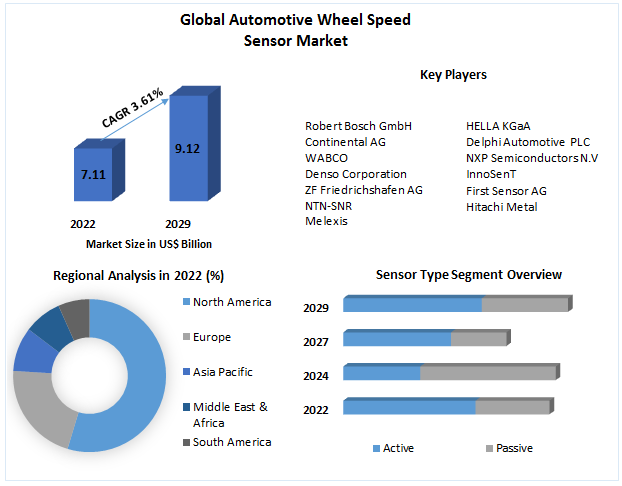
Market Valuation: The market is set to expand from US$ 7.11 Bn in 2022 to US$ 9.12 Bn by 2029.
Compound Growth: A steady CAGR of 3.61% reflects the mature yet essential nature of wheel speed sensor technology in modern vehicle architectures.
Safety Imperative: Increased government mandates for Electronic Stability Control (ESC) and Anti-lock Braking Systems (ABS) ensure sustained demand across all light and heavy-duty vehicle segments.
Technological Convergence: Wheel speed sensors now serve as foundational inputs for sophisticated ADAS platforms and traction control systems in electric vehicle (EV) drivetrains.
Why This Matters Now
Automotive OEMs and Tier-1 suppliers face an urgent inflection point: wheel speed sensors are no longer mere utility components; they are the primary data anchors for autonomous decision-making. As vehicle architectures shift toward software-defined mobility, any latency or failure in speed-sensing data compromises the entire ADAS stack. Stakeholders who fail to integrate high-fidelity, diagnostic-capable sensors now will find themselves unable to meet the stringent safety requirements of 2029, effectively locking them out of future-proofed vehicle platforms.
Market Overview
The Automotive Wheel Speed Sensor Market operates at the intersection of mechanical reliability and electronic precision. With a valuation of US$ 7.11 billion in 2022, the sector demonstrates the resilience of core safety infrastructure. The anticipated climb to US$ 9.12 billion by 2029 highlights a predictable, albeit competitive, growth curve. This market is driven by the global imperative to eliminate traffic fatalities and the transition toward connected, autonomous, and electrified fleets.
Key Trends Driving Growth
The primary engine of growth is the evolution of safety legislation. Regional authorities continue to raise the bar for vehicle stability, forcing the mass-market adoption of ABS and ESC across developing automotive manufacturing hubs. Furthermore, the push for electrification requires specialized sensor calibration. EVs, characterized by high instant torque, demand more responsive traction control and speed sensing to manage regenerative braking efficiency.
Segment Insights
Dominant Segment (ABS/ESC Integration): Anti-lock Braking Systems (ABS) combined with Electronic Stability Control remain the primary drivers of volume. These systems are non-negotiable in global markets, providing the largest revenue stream for sensor manufacturers.
Fastest-Growing Segment (ADAS-Ready Sensors): Sensors capable of providing high-resolution, low-latency data for ADAS and autonomous driving interfaces are experiencing the highest growth rates. These components integrate with vehicle telemetry systems to inform collision avoidance and adaptive cruise control.
Regional Growth Story
Growth is tethered to automotive production output. Manufacturing hubs in Asia-Pacific, notably China and India, are scaling up as domestic demand for safer, higher-spec vehicles rises. In North America and Europe, growth is characterized by the replacement market and the integration of advanced diagnostic sensors into existing vehicle platforms to support increasingly complex autonomous testing and production.
Competitive Landscape
The competitive environment is shifting from hardware-focused production to strategic partnerships with software firms. Tier-1 suppliers are consolidating their portfolios, favoring vendors who offer “smart” sensors—those with built-in diagnostic capabilities that flag maintenance needs before a failure occurs. This capability is creating a moat for established leaders, as OEMs prioritize supply chain reliability and diagnostic integration over mere price competition.
Recent Developments
Strategic Capacity Expansion: Major suppliers are retooling lines to accommodate higher-precision sensors required for EV regenerative braking systems.
Cross-Industry Partnerships: Collaborative efforts between sensor OEMs and software providers are surging to ensure data compatibility with centralized vehicle domain controllers.
Investment in Diagnostic Sensing: Funding is shifting toward sensors that provide real-time performance health, directly addressing the fleet-operator need for lower total cost of ownership (TCO).
Strategic Implications
For the OEM, the strategy is clear: transition from purchasing discrete components to sourcing integrated data ecosystems. For suppliers, the path to survival lies in data-rich output. A sensor that only reports speed is a commodity; a sensor that reports speed, diagnostic health, and environmental data for the vehicle’s central nervous system is a premium asset. Pricing power will inevitably consolidate with firms that can guarantee zero-defect manufacturing at scale.
Future Outlook
The market for wheel speed sensors is migrating toward a future where hardware is the vehicle’s nervous system, and the winners will be those who can provide the highest resolution data with the lowest latency. Companies that view these sensors as mere commodities will face obsolescence, while those integrating them into the core software-defined vehicle platform will dominate the next decade of mobility.
Analyst Perspective
“The move toward US$ 9.12 billion reflects a fundamental truth about modern transportation: safety and automation are non-negotiable costs of entry for the next generation of OEMs,” notes analyst Tejaswini Kakade. “The market is not just selling sensors; it is selling the reliable data architecture that allows vehicles to see and react in real-time.”
About Maximize Market Research
Maximize Market Research Pvt. Ltd. (MMR) is a global market research and consulting company that provides reliable, data-focused, and practical business insights. The firm serves a wide range of industries, including healthcare, pharmaceuticals, technology, automotive, electronics, chemicals, personal care, and consumer goods. Through market forecasts, competitive analysis, strategic consulting, and industry impact assessments, MMR helps organizations understand changing market conditions, identify growth opportunities, and make informed business decisions for long-term success.
2nd Floor, Navale IT Park Phase 3
Pune Banglore Highway, Narhe
Pune, Maharashtra 411041, India
+91 9607365656
sales@maximizemarketresearch.com
