Key Highlights
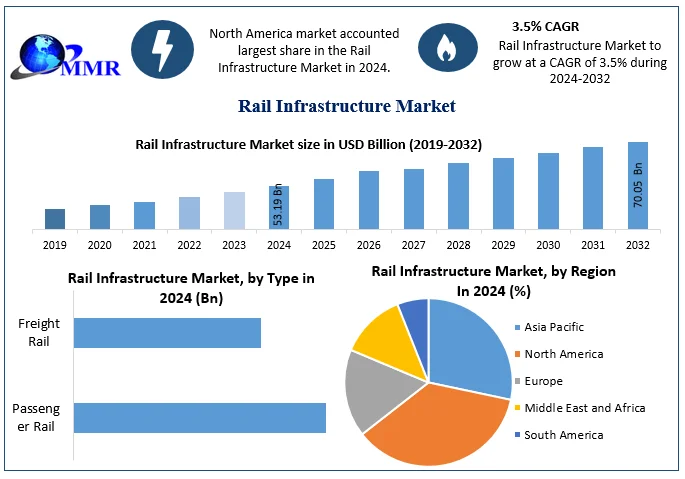
- Market valued at USD 53.19 billion in 2024.
- Expected to reach USD 70.05 billion by 2032.
- Forecast CAGR stands at 3.5% from 2025 to 2032.
- North America accounted for approximately 40% of global market revenue in 2024.
- Asia Pacific held nearly 28% market share and remains the fastest investment destination.
- Rail network infrastructure dominated the market by infrastructure type.
- Government investments and rail electrification continue supporting long-term demand.
- Urbanization and freight transportation expansion are increasing rail capacity requirements.
- Sustainable transportation policies are accelerating railway modernization worldwide.
Why This Matters Now
Governments are treating rail infrastructure as a strategic asset for economic growth, energy security, and carbon reduction. Aging transportation networks require extensive modernization, while expanding urban populations demand faster, cleaner, and higher-capacity transit systems. Investment is shifting toward electrified rail corridors, intelligent transportation systems, and maintenance programs that improve operational efficiency while reducing long-term infrastructure costs.
Market Overview
The Rail Infrastructure Market includes investments in rail networks, new track construction, maintenance activities, passenger rail systems, freight corridors, and supporting transportation infrastructure. Railways remain one of the most efficient modes of moving both passengers and heavy freight over long distances while reducing congestion and emissions.
Global demand is primarily driven by increasing transportation requirements resulting from urbanization, industrial expansion, and international trade. Governments continue allocating significant budgets toward railway modernization to improve mobility, strengthen supply chains, and support economic development.
The market also benefits from rising investments by both public authorities and private operators. Aging rail assets across developed economies require replacement and maintenance, while emerging countries continue expanding entirely new railway networks to support industrialization and population growth.
At the same time, sustainability goals are reshaping infrastructure planning. Electrified rail systems and mass rapid transit projects are increasingly replacing carbon-intensive transport alternatives, creating long-term demand for railway infrastructure investment.
However, rising fuel prices, resource constraints, and high infrastructure development costs remain important challenges affecting project economics and implementation timelines.
Key Trends Driving Growth
Rail Electrification Becomes a Strategic Priority
Countries worldwide continue replacing diesel-powered rail systems with electrified networks to reduce emissions, improve operational efficiency, and support national climate commitments. Electrification projects are expanding opportunities across track infrastructure, signaling, and power distribution systems.
Intelligent Transportation Systems Improve Network Performance
Digital technologies are transforming railway operations through traffic management, communication systems, predictive maintenance, and operational automation. Intelligent transportation systems improve safety, increase network capacity, and reduce operational disruptions.
Urban Rail Expansion Accelerates
Rapid urbanization is driving investments in metro systems, suburban rail, and rapid transit corridors. Cities are expanding rail capacity to reduce road congestion while supporting sustainable urban mobility strategies.
Infrastructure Modernization Drives Capital Spending
Many railway systems in North America and Europe require modernization after decades of operation. Governments continue prioritizing maintenance programs, track renewal, and network upgrades to improve reliability and reduce lifecycle costs.
Global Trade Supports Freight Rail Investments
Growth in bulk commodity transportation, automotive logistics, and industrial freight continues supporting investments in heavy-haul rail infrastructure. Efficient freight corridors remain essential for improving supply chain resilience and lowering transportation costs.
Explore detailed analysis, insights, and growth opportunities
Segment Insights
Dominant Segment: Rail Network Infrastructure
Rail network infrastructure accounted for the largest market share in 2024.
Growing urban populations and increasing freight transportation volumes continue driving investment in railway networks. Governments are expanding rail capacity while upgrading existing corridors to accommodate higher passenger volumes and increased movement of coal, automobiles, industrial materials, and other bulk commodities.
Regular maintenance investments also support long-term network reliability, reducing operational disruptions and improving transportation efficiency.
Business impact: Engineering companies, infrastructure contractors, and rail equipment suppliers benefit from recurring government-funded maintenance and expansion projects that provide stable long-term revenue visibility.
Fastest-Growing Segment: Maintenance Investment
Maintenance investment is expected to record strong growth throughout the forecast period.
Rail operators increasingly recognize that proactive maintenance reduces long-term operating costs while improving network safety and service reliability. Aging rail systems require continuous investment in tracks, signaling equipment, bridges, and supporting infrastructure.
Business impact: Companies specializing in inspection technologies, maintenance engineering, digital monitoring, and track rehabilitation are expected to benefit from sustained infrastructure renewal programs.
Additional Key Sub-segments
Passenger Rail
Passenger rail continues expanding as governments encourage public transportation to reduce road congestion, improve mobility, and lower greenhouse gas emissions.
Freight Rail
Freight rail remains essential for transporting heavy industrial goods, agricultural products, and bulk commodities over long distances with greater efficiency than road transport.
Long-Distance Rail
Long-distance rail supports national connectivity and cross-border trade while strengthening logistics infrastructure.
Public Rail Ownership
Public sector ownership remains dominant as governments continue financing major infrastructure projects that require significant long-term capital investment.
Regional Growth Story
North America
North America led the global market with approximately 40% market share in 2024.
The region continues investing heavily in rapid transit systems, railway modernization, locomotive upgrades, and freight corridor improvements. Aging infrastructure replacement programs and increasing passenger mobility requirements continue supporting capital expenditure across both public and private railway operators.
Europe
Europe remains one of the most advanced railway markets, supported by strict environmental regulations and ambitious carbon reduction targets.
Governments continue promoting renewable energy integration, electrified rail systems, and next-generation propulsion technologies. These initiatives are encouraging sustained investment in railway modernization and smart transportation infrastructure.
Asia Pacific
Asia Pacific represented approximately 28% of global demand in 2024 and offers the strongest long-term growth opportunities.
Rapid industrialization, urban population growth, and expanding railway networks across China, India, Japan, and South Korea continue attracting significant public and private investment. International OEMs are strengthening their regional presence to support large-scale infrastructure development and growing passenger demand.
Middle East, Africa and South America
Infrastructure expansion across emerging economies continues creating new investment opportunities as governments improve transportation connectivity, strengthen logistics networks, and diversify economic development through modern rail systems.
Competitive Landscape
The Rail Infrastructure Market is characterized by a combination of global transportation technology providers, rolling stock manufacturers, railway operators, and infrastructure specialists competing across public infrastructure contracts and long-term modernization programs.
Market leadership increasingly depends on engineering capability, integrated transportation solutions, digital railway technologies, and experience delivering large-scale government infrastructure projects. Companies with comprehensive portfolios covering signaling, rolling stock, rail systems, maintenance, and electrification are strengthening their competitive positions as customers increasingly seek end-to-end project execution.
The industry’s competitive environment also reflects growing collaboration between infrastructure developers, technology providers, and railway operators to improve network efficiency, safety, and lifecycle performance.
Key players include:
- Bombardier Transportation
- Alstom
- Siemens
- Kawasaki Heavy Industries
- Norfolk Southern Corp
- Stadler Rail
- Hyundai Rotem Company
- GE Company
- Union Pacific Railroad Company
- BNSF Railway Company
- CSR Corporation Limited
- National Railroad Passenger Corporation
- Kawasaki Heavy Industries Ltd.
- GE Transportation
- Bombardier Inc.
- Alstom SA
- Siemens AG
Recent Developments
- Governments increased investments in rail network expansion and modernization projects.
- Rail operators accelerated maintenance programs to improve network reliability and operational efficiency.
- Intelligent transportation technologies gained wider deployment to enhance traffic management and railway safety.
- Multiple countries expanded rail electrification initiatives to support green transportation objectives.
- Public and private sector investments continued supporting new railway infrastructure development in emerging economies.
Analyst Perspective — Rucha Deshpande
Rail infrastructure is evolving from a transportation asset into a strategic pillar of economic resilience and decarbonization. Organizations capable of delivering integrated rail networks, digital infrastructure, electrification expertise, and long-term maintenance solutions will capture the greatest value as governments accelerate sustainable mobility investments worldwide.
Future Outlook
The strongest competitive advantage will belong to infrastructure providers that combine electrification, digital railway technologies, and lifecycle maintenance capabilities as governments prioritize resilient, low-carbon transportation networks.
About Maximize Market Research
Maximize Market Research Pvt. Ltd. (MMR) is a global market research and consulting company that provides reliable, data-focused, and practical business insights. The firm serves a wide range of industries, including healthcare, pharmaceuticals, technology, automotive, electronics, chemicals, personal care, and consumer goods. Through market forecasts, competitive analysis, strategic consulting, and industry impact assessments, MMR helps organizations understand changing market conditions, identify growth opportunities, and make informed business decisions for long-term success.
Contact Us :
2nd Floor, Navale IT Park Phase 3
Pune Banglore Highway, Narhe
Pune, Maharashtra 411041, India
+91 9607365656
sales@maximizemarketresearch.com
