Key Highlights
Market Dynamics: Japan’s electric vehicle (EV) motor market is undergoing a rapid evolution as domestic automakers shift away from traditional internal combustion engines (ICE) toward electrified powertrains.
Technological Shift: Research and development are intensely focused on high-efficiency, lightweight, and compact motor designs to optimize vehicle range and performance.
Key Growth Drivers: Stricter emission standards, government subsidies for clean energy vehicles, and a strategic national push for decarbonization by 2050 are accelerating the market.
Competitive Landscape: The market is dominated by global Tier-1 suppliers and established Japanese automotive giants, who are leveraging their manufacturing prowess to lead in drivetrain innovation.
Strategic Opportunity: The trend toward “pint-sized” runabouts and minicars—a staple of the Japanese domestic market—is providing a unique niche for cost-effective, high-efficiency motor development.
Why This Matters Now
The Japanese automotive sector, long the global benchmark for combustion efficiency, is currently executing its most significant pivot in a century. For Tier-1 suppliers, investors, and OEM strategists, the electric vehicle motor is no longer just a component; it is the heartbeat of the future vehicle, determining everything from range and energy consumption to market competitiveness.
Market Overview
The Japan’s Electric Vehicle Motor Market is the primary engine behind the nation’s broader “green mobility” transformation. While the country has historically prioritized hybrid electric vehicles (HEVs) to bridge the transition, the current mandate for net-zero emissions by 2050 is driving a structural shift toward full electrification. Electric motors, which extract power from battery packs to drive the drivetrain, are at the center of this technological metamorphosis, with Japanese manufacturers competing to deliver the most efficient AC and DC solutions for an increasingly demanding consumer base.
Key Trends Driving Growth
The Minicar Opportunity: Unlike Western markets focused on large-scale SUVs and sedans, Japan’s unique automotive landscape remains dominated by “minicars” or kei-cars. This preference has forced a domestic strategy that differs from global players like Tesla or Volkswagen. Japanese manufacturers are steering toward cheaper, compact, and efficient electric runabouts, creating a massive, untapped demand for motors optimized for smaller platforms and lower cost-of-ownership models.
Energy Efficiency and Smart Design: The integration of smart technologies and advanced material science is enhancing motor functionality. Today’s motor designs are being refined for energy density, ensuring that every watt of electricity is translated into motion with minimal thermal loss. This focus on efficiency is critical for overcoming range anxiety and enhancing the overall customer experience of electrified transit.
Segment Insights
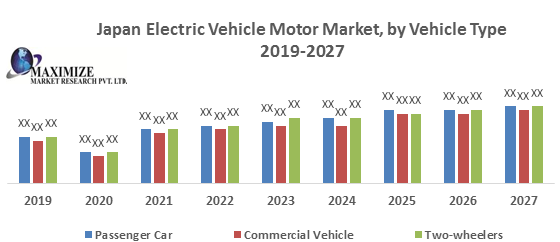
Dominant Segment: Passenger Cars. Given Japan’s deep-rooted automotive manufacturing history, passenger cars account for the largest revenue share, supported by the strong presence of brands like Toyota, Nissan, and Honda.
Fastest-Growing Segment: Commercial Electric Vehicles. The push to electrify delivery and transportation services, driven by the increasing need for eco-friendly logistics in dense urban environments, is positioning the commercial vehicle motor segment as the fastest-growing area.
Regional Growth Story
The Tokyo metropolitan area continues to lead the national market. High population density and aggressive urban decarbonization policies make EVs a logical choice for Japanese consumers. As infrastructure projects for charging and power management scale up, Tokyo is acting as the primary testbed for electric mobility integration. Rural Japan, meanwhile, is gradually catching up as the central government increases financial support for charging stations and clean energy initiatives in the provinces.
Competitive Landscape
The competitive landscape is a high-stakes arena where traditional automotive giants—such as Denso, Mitsubishi Electric, and Toshiba—are vying for leadership alongside new entrants. This competition signals that the industry is moving from an era of “mechanical dominance” to “electrification dominance.”
Companies that are successfully diversifying their product portfolios, such as moving from traditional HVAC or industrial motors into precision-engineered EV traction motors, are capturing significant market share. The focus on R&D investment is intense, with current developments signaling that the future market leaders will be those who can provide fully integrated drivetrain systems—combining the motor, inverter, and gearbox into a single, high-efficiency unit.
Recent Developments
New EV Lineups: Major OEMs like Nissan are expanding their electric portfolios, with recent model launches specifically tailored to leverage advanced, lightweight motor architectures.
Collaborative R&D: Increased partnerships between automotive manufacturers and electronics conglomerates are accelerating the development of the next generation of traction motors.
Policy-Driven Investment: Supplementary government budgets earmarked for electric mobility R&D are fueling factory expansions and manufacturing capacity upgrades for domestic motor production.
Strategic Implications
For stakeholders, the primary takeaway is that the “wait-and-see” approach to electrification is no longer viable. The winners in the Japanese EV motor market will be those who can optimize their motor designs for the unique Japanese preference for compact vehicles while simultaneously scaling for the global export market. As battery supply chains fluctuate, motor efficiency will become the defining factor for OEM competitive advantage and pricing power.
Future Outlook
The Japanese EV motor market is entering an inflection point where the sheer scale of R&D investment will begin to yield dominant, high-efficiency technologies. Future market leaders will be those who master the integration of software and hardware—enabling motors to communicate seamlessly with vehicle control systems—while laggards who fail to innovate beyond legacy motor designs will find their margins under pressure from more agile, tech-focused entrants.
Analyst Perspective
“Japan’s approach to the EV motor market is a masterclass in strategic niche management,” says Tejaswini Kakade, Analyst at Maximize Market Research. “By focusing on high-efficiency, compact power units that suit the domestic demand for minicars, Japan is building a technological foundation that is not only robust for its own streets but highly scalable for the global shift toward electrified urban mobility.”
About Maximize Market Research
Maximize Market Research Pvt. Ltd. (MMR) is a global market research and consulting company that provides reliable, data-focused, and practical business insights. The firm serves a wide range of industries, including healthcare, pharmaceuticals, technology, automotive, electronics, chemicals, personal care, and consumer goods. Through market forecasts, competitive analysis, strategic consulting, and industry impact assessments, MMR helps organizations understand changing market conditions, identify growth opportunities, and make informed business decisions for long-term success.
2nd Floor, Navale IT Park Phase 3
Pune Banglore Highway, Narhe
Pune, Maharashtra 411041, India
+91 9607365656
sales@maximizemarketresearch.com
