Key Highlights
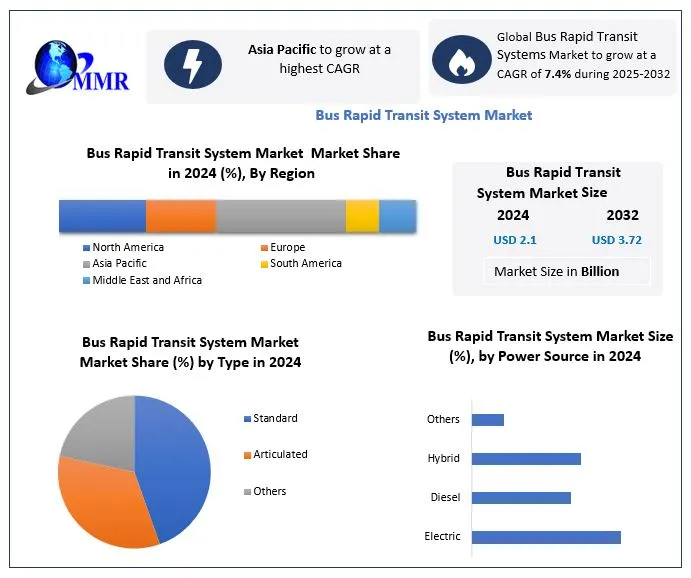
Market Scale: Valued at US$ 2.1 billion in 2024, projected to grow at a CAGR of 7.4% to reach US$ 3.72 billion by 2032.
Dominant Segment: Urban Areas, accounting for over 65% of the total market share in 2024.
Fastest-Growing Segment: Electric-powered BRT fleets, driven by global emission regulations and battery technology advancements.
Regional Leader: Asia Pacific, led by China, India, and Indonesia, with a regional valuation of US$ 10.8 billion (total regional infrastructure investment context).
Strategic Shift: Transition from traditional diesel powertrains to electric and hybrid platforms to meet climate mandates and reduce operational expenditure.
Why This Matters Now
Global urban centers are reaching a saturation point where rail-based mass transit is too slow to deploy and too expensive to maintain. Bus Rapid Transit (BRT) systems have emerged as the primary strategic lever for city planners and fleet operators to alleviate congestion while meeting aggressive carbon reduction targets. This market shift represents a fundamental realignment of the automotive manufacturing sector, moving away from private vehicle sales toward high-capacity, electrified public mobility platforms.
Market Overview
The Bus Rapid Transit System Market is no longer a collection of simple bus routes but a high-tech infrastructure requirement for modern cities. By operating in dedicated lanes, these systems provide a cost-effective alternative to subway networks. The industry is currently transitioning from fossil-fuel dominance to electric and hybrid architectures. With a forecast reaching US$ 3.72 billion by 2032, the sector is attracting heavy investment from both municipal governments and major commercial vehicle OEMs.
Key Trends Driving Growth
Electrification is the single most significant transformation in the BRT landscape. Operators are replacing diesel-guzzling fleets with electric buses to slash operational fuel costs and comply with stringent international emission standards. Furthermore, the integration of Intelligent Transportation Systems (ITS)—including real-time tracking, IoT sensors, and contactless ticketing—is turning transit routes into data-rich networks. This digitization allows cities to optimize fleet management and improve throughput, directly impacting the return on investment for transit authorities.
Segment Insights
Dominant Segment: Urban Areas dominated the market in 2024 with a 65% share, fueled by the urgent need for high-capacity solutions in dense municipalities to combat traffic and pollution.
Fastest-Growing Segment: Electric BRT buses now lead the power source segment, as improvements in battery density and charging speed render them more viable and cost-effective than diesel or hybrid options for fixed-route applications.
Regional Growth Story
Asia Pacific remains the global epicenter of BRT development, commanding a market valuation of US$ 10.8 billion. Rapid urbanization in China, India, and Indonesia creates a structural need for transit corridors that can be deployed quickly and at a lower cost than rail. India’s Smart Cities Mission and China’s green mobility policies are not merely environmental initiatives; they are economic imperatives that leverage local manufacturing hubs. The presence of high-volume producers like Tata Motors, Ashok Leyland, and BYD in this region provides a competitive advantage in pricing and supply chain integration.
Competitive Landscape
The competitive map is defined by OEMs that can provide both the physical vehicle and the supporting digital infrastructure. Tata Motors is leveraging the FAME II scheme in India to deliver large-scale electric and hybrid fleets, positioning itself as a core provider for smart city corridors. Ashok Leyland is focusing on product diversification, integrating advanced passenger safety features into its electric and CNG models to secure municipal contracts.
BYD Auto stands as a global titan in the electric segment, exporting thousands of units to Asia, South America, and Europe. Its success signals a broader trend: the dominance of OEMs that prioritize battery innovation and autonomous readiness over pure mechanical engineering. The market is shifting toward a “service-plus-product” model, where manufacturers must partner with governments to ensure infrastructure, charging capacity, and software integration are managed as a single cohesive unit.
Recent Developments
Tata Motors (February 2024): Unveiled a new fleet of electric and CNG BRT buses specifically for Indian metro projects under the Smart City initiative.
Volvo Buses (May 2024): Delivered high-capacity hybrid BRT buses to Stockholm to accelerate the city’s transition to a 100% green fleet by 2030.
VDL Bus & Coach (February 2025): Supplied winter-ready, articulated electric buses to Helsinki, emphasizing the reliability of electric platforms in extreme climates.
MAN Truck & Bus (December 2024): Partnered with Warsaw and Budapest on electrification projects, demonstrating the role of the EU Green Deal in funding urban infrastructure.
Yutong Bus (August 2024): Secured a contract for 150 electric BRT buses in Nigeria, marking a significant expansion into the African market.
Strategic Implications
The reliance on massive upfront investment remains the primary barrier to entry. However, the move toward public-private partnerships (PPPs) is unlocking projects that were previously stalled by budgetary constraints. For Tier-1 suppliers and technology partners, the opportunity lies in the “aftermarket” of electrification—charging infrastructure, battery management software, and over-the-air update capabilities. Companies that fail to provide a complete “bus-plus-software” package will likely see their margins eroded by competitors offering comprehensive fleet management solutions.
Future Outlook
The BRT market will evolve into a software-defined ecosystem where vehicle uptime is a metric determined by predictive maintenance and real-time connectivity. As battery costs continue to decline, the diesel powertrain will be pushed into total obsolescence in urban transit sectors. Market leaders will be those who control the entire transit stack—from high-density battery manufacturing to the software that manages flow and ticketing—while laggards will remain stuck in a traditional hardware-selling model that lacks the scalability required by modern megacities.
Analyst Perspective
“The BRT market has moved past the experimental phase and is now a central pillar of urban industrial policy,” notes Tejaswini Kakade, Analyst at Maximize Market Research. “OEMs are no longer just selling buses; they are selling the capacity to move millions of people without the carbon footprint. The firms that win in this space will be those that integrate deep-tech electrification with the local regulatory frameworks of emerging urban markets.”
About Maximize Market Research
Maximize Market Research Pvt. Ltd. (MMR) is a global market research and consulting company that provides reliable, data-focused, and practical business insights. The firm serves a wide range of industries, including healthcare, pharmaceuticals, technology, automotive, electronics, chemicals, personal care, and consumer goods. Through market forecasts, competitive analysis, strategic consulting, and industry impact assessments, MMR helps organizations understand changing market conditions, identify growth opportunities, and make informed business decisions for long-term success.
2nd Floor, Navale IT Park Phase 3
Pune Banglore Highway, Narhe
Pune, Maharashtra 411041, India
+91 9607365656
sales@maximizemarketresearch.com
