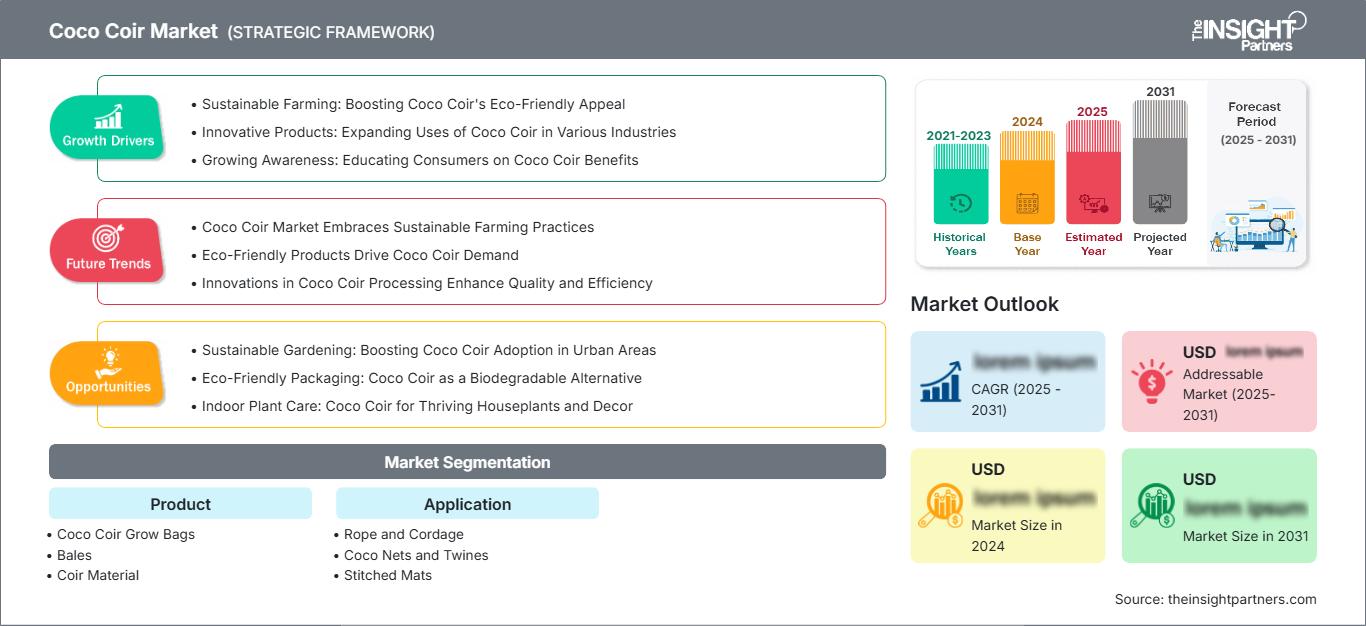
Coconut husks used to be waste. Now they are a growing medium that greenhouses fight to secure. The Coco Coir Market was valued at US$ 750.38 Million in 2025 and is projected to reach US$ 1,544.75 Million by 2034, growing at a CAGR of 8.35% during 2026–2034. This natural fiber has moved from a byproduct of coconut processing to a core input for modern horticulture, and demand keeps climbing as growers search for sustainable alternatives to peat.
What Is Coco Coir?
Coco coir is a natural fiber extracted from the husk of coconuts. It is processed into grow bags, bales, mats, and loose substrate for agricultural and horticultural use. Its ability to retain water while allowing good aeration makes it a favored growing medium worldwide.
Request a Sample Copy of the Report: https://www.theinsightpartners.com/sample/TIPRE00016512
Market Drivers
Peat scarcity is reshaping the growing media industry. Peatlands take centuries to form, and harvesting them releases stored carbon while destroying wetland ecosystems. Regulators in Europe are restricting peat extraction, and growers are shifting to coco coir as the most viable renewable substitute. This regulatory push alone is driving steady demand growth across commercial horticulture.
Controlled-environment agriculture is expanding fast, and coco coir sits at the center of it. Greenhouse operations and vertical farms need a lightweight, consistent growing medium that supports precise irrigation. Coco coir holds water efficiently while draining excess, which suits hydroponic and semi-hydroponic systems perfectly. As indoor farming investment grows worldwide, so does substrate demand.
Cannabis cultivation has become an unexpected growth driver. Legal cultivation is expanding across North America and parts of Europe, and growers favor coco coir for its consistency and disease resistance compared with soil-based methods. This crop alone has pulled significant new demand into the market over the past several years.
What keeps coco coir ahead of synthetic alternatives? Cost and renewability. Coconut husks are abundant, particularly across South and Southeast Asia, and processing them into usable substrate costs less than manufacturing synthetic growing media. That economic advantage, paired with genuine sustainability credentials, keeps coco coir attractive even as input costs across agriculture rise.
Segmentation Overview
Segments Covered
By Product: Coco Coir Grow Bags lead demand, widely used in commercial greenhouse and hydroponic operations. Bales serve bulk agricultural buyers who process substrate on-site. Coir Material covers raw processed fiber sold to manufacturers. Open Tops and Blends and Loose Substrate serve nursery and retail gardening markets. Others includes specialty formulated products for niche crops.
By Application: Rope and Cordage remains a traditional use, particularly in regions with strong artisanal coir industries. Coco Nets and Twines serve erosion control and agricultural support applications. Stitched Mats are used for landscaping and erosion prevention. Coconut Meals and Husk applications serve animal feed and mulch markets. Others includes packaging and industrial fiber uses.
Key Market Players
- Allwin Coir
- Bali Coco Fiber
- Benlion Coir Industries
- Coco Green Pvt. Ltd.
- Consarc Pvt. Ltd.
- Lanka Coco Products
- Lima Group
- Pelemix Ltd.
- Pilipinas Ecofiber Corporation
- Universal Coco Indonesia
These companies compete on fiber quality, processing consistency, and export logistics. Several are investing in washing and buffering technology to reduce salt content, a key quality factor for horticultural buyers. Partnerships with greenhouse operators and agricultural distributors are becoming more common as competition intensifies.
Sustainability and Innovation Trends
Water and energy use in processing are drawing more attention. Coir producers are adopting closed-loop washing systems that recycle water used to remove excess salts from raw fiber. This cut both costs and environmental impact, an increasingly important factor for buyers in regions with strict sustainability requirements.
Compressed and lightweight packaging formats are also gaining traction. Shipping raw coir is expensive due to its bulk, so producers are investing in high-density compression technology that reduces shipping volume without damaging fiber quality. This innovation is helping exporters reach farther markets more cost-effectively.
Buy Premium Report: https://www.theinsightpartners.com/buy/TIPRE00016512
Regional Outlook
Asia Pacific dominates both production and consumption. India and Sri Lanka are the world’s largest coco coir exporters, backed by abundant coconut cultivation and established processing infrastructure. Domestic horticulture demand is also rising steadily across the region.
Europe is a major import market, driven by peat-reduction regulations and a strong commercial horticulture sector. Growers across the Netherlands, Germany, and Spain increasingly rely on imported coco coir substrate for greenhouse production.
North America is growing quickly, fueled by cannabis cultivation and expanding controlled-environment agriculture. The region imports most of its coco coir supply, primarily from Asia Pacific producers.
South and Central America remains a smaller market today, though rising commercial agriculture investment is gradually increasing local demand.
Related Reports:
Water-Soluble Fertilizers Market
About The Insight Partners
The Insight Partners is among the leading market research and consulting firms in the world. We take pride in delivering exclusive reports along with sophisticated strategic and tactical insights into the industry. Reports are generated through a combination of primary and secondary research, solely aimed at giving our clientele a knowledge-based insight into the market and domain. This is done to assist clients in making wiser business decisions. A holistic perspective in every study undertaken forms an integral part of our research methodology and makes the report unique and reliable.
Contact Us:
If you have any queries about this report or if you would like further information, please contact us:
Phone: +1-646-491-9876
E-mail: sales@theinsightpartners.com
Also Available in: Korean | German | Japanese | French | Chinese | Italian | Spanish
