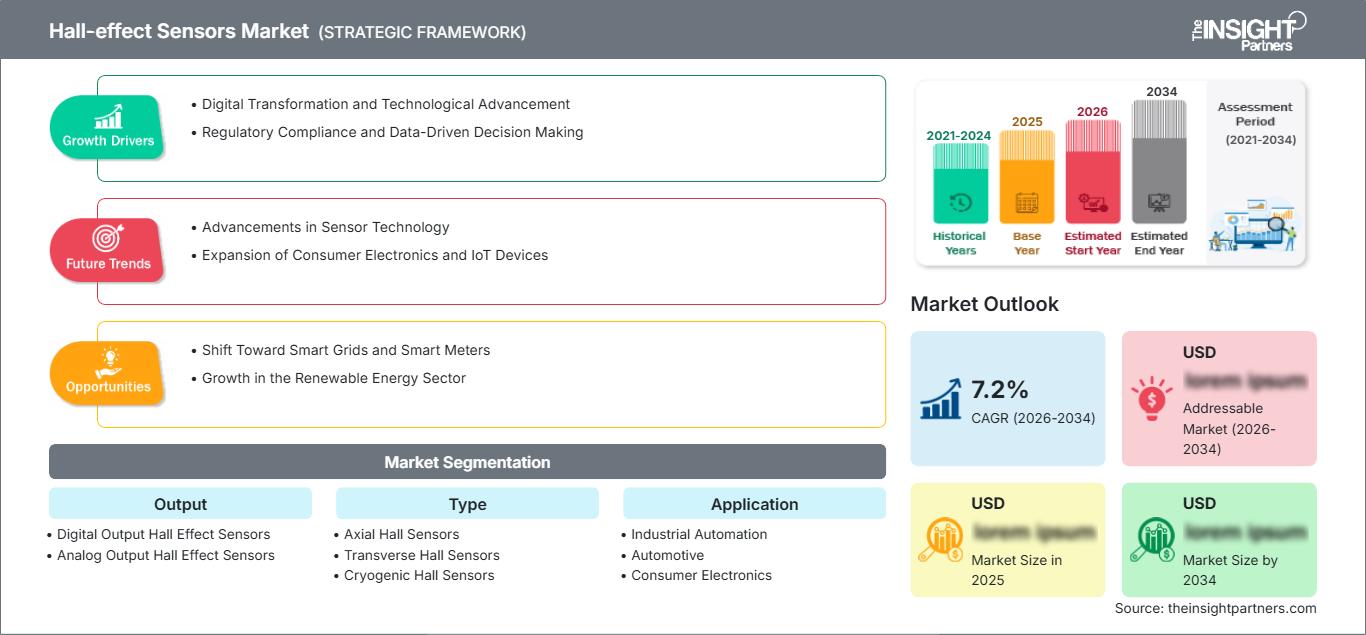
The Hall-effect Sensors Market continues to evolve as industries worldwide increasingly rely on advanced magnetic sensing technologies for precision, reliability, and energy efficiency. From electric vehicles and industrial automation to consumer electronics and healthcare devices, Hall-effect sensors have become essential components that enable accurate position, speed, current, and proximity detection. Their non-contact sensing capability, compact size, long operational life, and durability make them a preferred solution across multiple end-use industries.
Get a sample PDF of the Report: https://www.theinsightpartners.com/sample/TIPRE00015715
Growing investments in electrification, Industry 4.0 initiatives, smart manufacturing, and connected electronic devices are creating strong opportunities for the Hall-effect Sensors Market. Manufacturers are focusing on developing highly integrated sensors with improved sensitivity, lower power consumption, and enhanced temperature stability to meet evolving application requirements. As automotive electronics become increasingly sophisticated and industrial systems demand higher precision, the role of Hall-effect sensors is expanding rapidly across both developed and emerging economies. The market is also benefiting from continuous semiconductor innovations and the increasing adoption of intelligent sensing technologies.
Hall-effect Sensors Market Highlights by 2031
- Market Size: Expected to witness significant expansion by 2031
- Market Share: Automotive segment continues to dominate global demand
- Market Trends: Increasing integration in electric vehicles, robotics, and smart electronics
- Market Analysis: Strong investments in industrial automation and intelligent sensing technologies
- Market Forecast: Positive long-term outlook driven by digital transformation and semiconductor innovation
Industry Overview
The Hall-effect Sensors Market is experiencing sustained growth as industries prioritize accuracy, reliability, and contactless sensing technologies. Hall-effect sensors operate by detecting changes in magnetic fields and converting them into electrical signals, enabling precise monitoring of movement, current flow, rotational speed, and object positioning.
Automotive manufacturers increasingly integrate these sensors into electric power steering, braking systems, transmission controls, battery management systems, motor positioning, and advanced driver assistance systems (ADAS). Similarly, industrial automation applications rely on Hall-effect sensors for motor control, robotics, conveyor systems, and predictive maintenance.
Consumer electronics manufacturers continue incorporating Hall-effect sensors into smartphones, laptops, tablets, gaming accessories, wearable devices, and smart home products to improve user experience while reducing mechanical wear. These expanding application areas continue strengthening the long-term outlook of the Hall-effect Sensors Market.
Updated Market News
Recent developments highlight the industry’s continued focus on innovation. TDK introduced its Micronas HAL 13xy family of dual-output 3D Hall-effect switch sensors designed for highly accurate motor speed and direction sensing in automotive and industrial applications. The new solution offers greater flexibility in sensor placement while supporting safety-oriented automotive designs.
Manufacturers are also investing in next-generation magnetic sensing technologies featuring improved electromagnetic compatibility, wider operating temperature ranges, and enhanced reliability for electric mobility and industrial automation. Research efforts continue toward higher sensitivity, compact integration, and improved energy efficiency to support increasingly complex electronic systems.
Key Growth Drivers
Several factors continue driving the Hall-effect Sensors Market across global industries.
The rapid expansion of electric vehicles is significantly increasing demand for reliable magnetic sensing solutions used in battery systems, motor control, and power electronics.
Industrial automation and smart factories are creating new opportunities as manufacturers deploy intelligent sensors for precision monitoring, predictive maintenance, and robotic automation.
Consumer electronics continue adopting Hall-effect sensors for improved functionality in smartphones, gaming devices, laptops, wearable electronics, and IoT products.
Renewable energy installations also contribute to market expansion through advanced motor control and power monitoring applications.
Additionally, healthcare equipment manufacturers increasingly utilize Hall-effect sensors in medical devices requiring accurate, contactless motion detection and monitoring capabilities.
Global and Regional Analysis
North America remains one of the leading regions for the Hall-effect Sensors Market, supported by strong automotive innovation, semiconductor research, industrial automation, and widespread adoption of electric mobility technologies. The United States continues investing heavily in smart manufacturing and advanced electronic systems, encouraging increased sensor deployment.
Europe maintains a strong position due to stringent automotive safety regulations, sustainable mobility initiatives, and the presence of leading automotive manufacturers. Countries including Germany, France, and the United Kingdom continue emphasizing industrial modernization and electric vehicle production.
Asia-Pacific represents the fastest-growing regional market, driven by expanding electronics manufacturing, semiconductor production, electric vehicle adoption, and industrial automation across China, Japan, South Korea, and India. Government initiatives supporting digital manufacturing and smart infrastructure further strengthen regional demand.
Latin America and the Middle East & Africa are gradually increasing adoption as industrial development, infrastructure modernization, renewable energy investments, and automotive production continue expanding.
Emerging Trends
Several important trends are shaping the future of the Hall-effect Sensors Market.
Manufacturers are developing highly integrated multi-axis Hall-effect sensors capable of delivering enhanced measurement accuracy.
Miniaturization continues enabling deployment in compact consumer electronics and wearable technologies.
Artificial intelligence and Industrial Internet of Things (IIoT) integration are increasing the importance of real-time sensing and predictive maintenance.
Energy-efficient semiconductor technologies are supporting lower power consumption while maintaining high performance.
Automotive manufacturers continue demanding sensors capable of operating under extreme temperatures and harsh environmental conditions.
These advancements continue expanding the application scope of Hall-effect sensing technology across numerous industries.
Key Players
- Infineon Technologies AG
- Allegro MicroSystems
- TDK Corporation
- Melexis NV
- Honeywell International Inc.
- Texas Instruments Incorporated
- STMicroelectronics
- NXP Semiconductors
- Analog Devices Inc.
- ROHM Semiconductor
- Diodes Incorporated
- Toshiba Electronic Devices & Storage Corporation
Competitive Landscape
Leading companies operating in the Hall-effect Sensors Market continue emphasizing research and development, product innovation, strategic collaborations, manufacturing expansion, and advanced semiconductor integration. Businesses are investing in intelligent sensor platforms capable of supporting electric mobility, industrial robotics, renewable energy systems, and connected consumer electronics. Product differentiation increasingly focuses on sensitivity, durability, energy efficiency, and compact design.
Get the Premium Research Report @ https://www.theinsightpartners.com/buy/TIPRE00015715
Future Outlook
The future of the Hall-effect Sensors Market remains highly promising as industries continue embracing electrification, automation, artificial intelligence, and smart connected devices. Increasing investments in electric vehicles, industrial robotics, renewable energy infrastructure, advanced medical equipment, and intelligent consumer electronics will continue expanding application opportunities. Continuous advancements in semiconductor technology, miniaturization, and high-performance magnetic sensing solutions are expected to strengthen industry competitiveness and accelerate innovation through 2031. As manufacturers focus on delivering reliable, energy-efficient, and intelligent sensing solutions, the Hall-effect Sensors Market is well positioned for sustained long-term growth across global industries.
Related Reports –
Home Energy Management System Market Regional Share, Trend, and Growth Opportunity
Vision Transformers Market Regional Share, Trend, and Growth Opportunity
Differential-Pressure Mass Flow Controller Market Regional Share, Trend, and Growth Opportunity
About The Insight Partners
The Insight Partners is a leading market research and consulting firm delivering actionable insights through in-depth industry analysis and strategic intelligence. The firm supports clients across various industries in making informed business decisions by providing comprehensive market forecasts, competitive assessments, and growth opportunities.
Contact Us:
If you have any queries about this report or if you would like further information, please contact us:
Contact Person: Ankit Mathur
E-mail: sales@theinsightpartners.com
Phone: +1-646-491-9876
Also Available in :
Korean | German | Japanese | French | Chinese | Italian | Spanish
