The IoT Analytics Market is witnessing rapid expansion as organizations increasingly leverage connected devices and advanced data analytics to improve decision-making, operational efficiency, and automation. IoT analytics combines Internet of Things (IoT) data collection with artificial intelligence, machine learning, and advanced analytics to generate actionable insights from massive volumes of connected data.
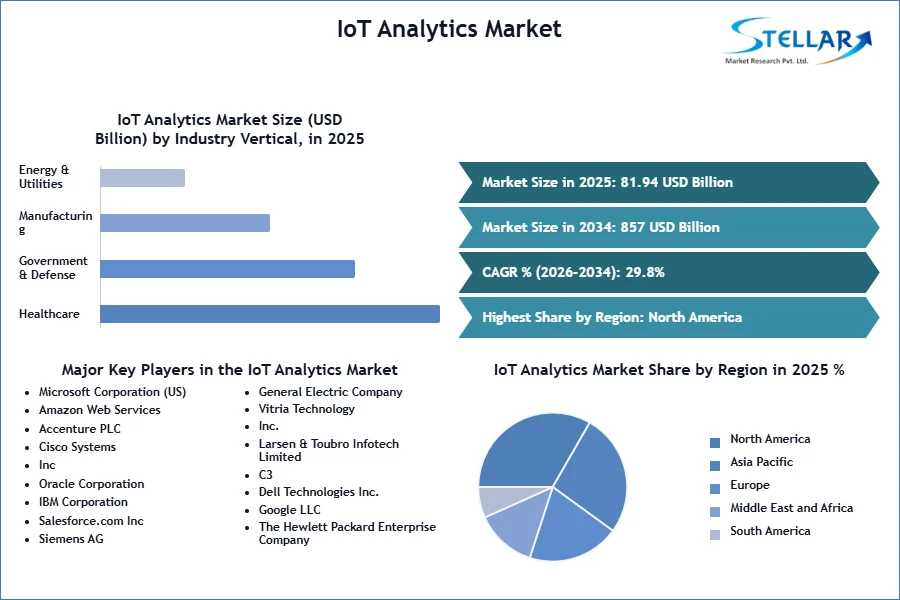
IoT Analytics Market size was valued at USD 81.94 Billion in 2025 and the total Market revenue is expected to grow at 29.8% through 2026 to 2034, reaching nearly USD 857 Billion.
With the growing adoption of smart cities, industrial automation, connected healthcare, and intelligent manufacturing, IoT analytics is becoming a critical technology for businesses across industries.
A Market Driven by Connected Data and Real-Time Insights
A defining trend in the IoT analytics market is the increasing demand for real-time data processing and predictive intelligence. Businesses are moving beyond traditional monitoring systems and adopting analytics platforms that can identify patterns, predict failures, and optimize operations.
IoT analytics enables organizations to transform raw sensor data into valuable business insights, supporting faster and more accurate decisions.
Key Market Insights
- IoT analytics enables real-time monitoring and decision-making.
- Artificial intelligence and machine learning enhance analytics capabilities.
- Industrial IoT is a major application segment.
- Cloud-based analytics platforms are gaining adoption.
- Smart cities and connected infrastructure drive demand.
- Healthcare, manufacturing, and transportation sectors are key users.
- North America leads technology adoption.
- Asia-Pacific is experiencing rapid growth.
𝐃𝐨𝐰𝐧𝐥𝐨𝐚𝐝 𝐅𝐫𝐞𝐞 𝐏𝐃𝐅 𝐁𝐫𝐨𝐜𝐡𝐮𝐫𝐞: https://www.stellarmr.com/report/req_sample/IoT-Analytics-Market/520
Market Drivers Accelerating Growth
1. Increasing Adoption of IoT Devices
The growing number of connected devices is generating massive volumes of data, increasing the need for advanced analytics solutions.
2. Growth of Industrial IoT and Smart Manufacturing
Manufacturers are using IoT analytics to improve productivity, monitor equipment performance, and reduce downtime.
3. Rising Demand for Predictive Analytics
Organizations are adopting predictive models to forecast trends, optimize resources, and improve operational efficiency.
Market Challenges and Restraints
1. Data Security and Privacy Concerns
The increasing volume of connected data creates cybersecurity challenges and requires strong protection measures.
2. Complex Data Management
Managing large-scale IoT data from multiple sources can be challenging for organizations.
Technology and Innovation Trends
Innovation in the IoT analytics market is driven by advancements in artificial intelligence, edge computing, cloud platforms, and machine learning technologies.
Edge analytics is gaining importance as businesses require faster processing of IoT data closer to the source. This reduces latency and improves real-time decision-making.
AI-powered analytics platforms are enabling predictive maintenance, anomaly detection, and automated decision-making. Cloud-based IoT analytics solutions provide scalability and flexibility for enterprises managing large connected ecosystems.
Digital twins are also emerging as an important technology trend, allowing organizations to create virtual models of physical assets for monitoring and optimization.
The integration of 5G networks with IoT analytics is further improving connectivity, enabling faster data transmission and supporting advanced applications.
Visual Snapshot: IoT Analytics Ecosystem
Regional Insights: North America Leads, Asia-Pacific Expands
North America dominates the IoT analytics market due to strong adoption of advanced technologies, developed digital infrastructure, and significant investments in industrial automation.
Europe is witnessing strong growth driven by smart manufacturing initiatives, sustainability goals, and connected infrastructure development.
Asia-Pacific is expected to experience rapid expansion due to increasing digitalization, smart city projects, and industrial growth in countries such as China, Japan, South Korea, and India.
Emerging economies are adopting IoT analytics to improve efficiency across agriculture, healthcare, transportation, and manufacturing sectors.
Recent Industry Developments
- Microsoft (2025): Expanded IoT cloud and analytics capabilities for enterprise applications.
- IBM (2024): Enhanced AI-driven IoT analytics solutions.
- Siemens (2025): Advanced industrial IoT analytics platforms.
- Cisco (2024): Improved connected infrastructure and analytics solutions.
- Oracle (2025): Expanded cloud-based IoT data management services.
Competitive Landscape
The IoT analytics market is highly competitive, with technology providers, cloud companies, and industrial automation firms developing advanced solutions. Companies are focusing on AI integration, cloud capabilities, cybersecurity, and industry-specific analytics platforms to strengthen their market position.
Strategic partnerships between IoT providers, software companies, and industry players are accelerating innovation and adoption.
Analyst Perspective
A senior market analyst notes:
“IoT analytics is becoming a foundation for digital transformation by enabling organizations to unlock value from connected data. AI-driven insights and real-time analytics will shape the future of intelligent operations.”
Future Outlook
The IoT Analytics Market is expected to witness strong growth in the coming years, supported by increasing IoT adoption, advancements in AI, and rising demand for automation.
The expansion of smart cities, connected industries, and intelligent infrastructure will continue creating new opportunities for IoT analytics providers.
As organizations increasingly depend on data-driven strategies, IoT analytics will play a crucial role in improving efficiency, reducing costs, and enabling smarter decision-making across industries.
Overall, the market presents significant opportunities for technology providers, enterprises, and investors aiming to capitalize on the growing demand for connected intelligence.
