The Fast-Food Market continues to expand as consumers seek quick, affordable, and convenient meal options in increasingly fast-paced lifestyles. From traditional quick-service restaurants (QSRs) to modern delivery-first brands, the industry has evolved into a dynamic ecosystem shaped by technology, urbanization, and shifting food preferences.
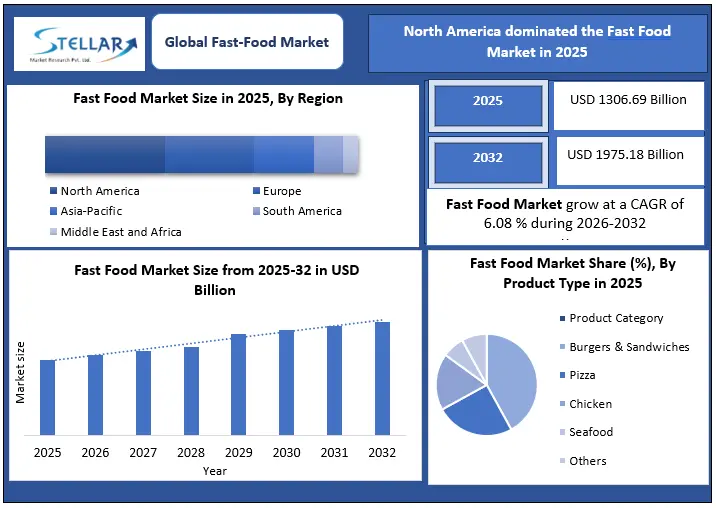
Global Fast-Food Market is projected to grow from USD 1,306.69 billion in 2025 to USD 1,975.18 billion by 2032, registering a CAGR of 6.08% during the forecast period.
With rising demand for on-the-go meals, digital ordering, and diverse menu options, the fast-food market remains one of the most resilient and rapidly evolving sectors in the global food industry.
A Market Driven by Convenience and Lifestyle Changes
A defining trend in the fast-food market is the growing demand for convenience-driven dining experiences. Busy schedules, urban living, and increased workforce participation are encouraging consumers to opt for quick meals that require minimal preparation time.
The industry is also adapting to changing dietary preferences by offering healthier, plant-based, and customizable menu options.
Key Market Insights
- Quick-service restaurants dominate the market.
- Digital ordering and delivery services are expanding rapidly.
- Burgers, pizzas, and fried chicken remain popular categories.
- Health-conscious and plant-based options are growing.
- Millennials and Gen Z are key consumer segments.
- Franchise models drive global expansion.
- Asia-Pacific is the fastest-growing region.
𝐃𝐨𝐰𝐧𝐥𝐨𝐚𝐝 𝐅𝐫𝐞𝐞 𝐏𝐃𝐅 𝐁𝐫𝐨𝐜𝐡𝐮𝐫𝐞: https://www.stellarmr.com/report/req_sample/Fast-Food-Market/526
Market Drivers Accelerating Growth
1. Increasing Urbanization and Busy Lifestyles
Consumers are prioritizing convenience, leading to higher demand for fast-food options.
2. Growth of Food Delivery Platforms
Online ordering and delivery apps are transforming the way consumers access fast food.
3. Expansion of Franchise and QSR Chains
Global brands are rapidly expanding through franchise models and international markets.
Market Challenges and Restraints
1. Health Concerns and Changing Dietary Habits
Rising awareness about nutrition and obesity is influencing consumer choices.
2. Intense Market Competition
The presence of numerous global and local players creates strong competition.
Technology and Innovation Trends
Innovation in the fast-food market is driven by advancements in digital ordering systems, automation, artificial intelligence, and delivery logistics. Mobile apps, self-service kiosks, and contactless payments are enhancing customer convenience and efficiency.
AI-powered recommendation systems are enabling personalized menu suggestions, while data analytics is helping companies optimize operations and inventory management.
Cloud kitchens and delivery-only models are gaining popularity, reducing operational costs and expanding reach. Automation technologies, including robotic cooking and smart kitchen equipment, are improving consistency and speed.
Sustainability is also becoming a focus area, with brands adopting eco-friendly packaging and reducing food waste.
Visual Snapshot: Fast-Food Industry Trends
Regional Insights: North America Leads, Asia-Pacific Expands
North America dominates the fast-food market due to strong brand presence, high consumer spending, and advanced digital infrastructure.
Europe represents a mature market with increasing focus on healthier and sustainable food options.
Asia-Pacific is the fastest-growing region, driven by rapid urbanization, expanding middle-class populations, and increasing adoption of Western food trends in countries such as China, India, and Southeast Asia.
Emerging markets are witnessing significant growth as global QSR brands expand their presence.
Recent Industry Developments
- McDonald’s (2025): Expanded digital ordering and delivery capabilities globally.
- KFC (2024): Introduced new menu innovations and plant-based options.
- Subway (2025): Focused on healthier and customizable offerings.
- Domino’s Pizza (2024): Enhanced delivery technology and online platforms.
- Burger King (2025): Strengthened plant-based product portfolio.
Competitive Landscape
The fast-food market is highly competitive, with global QSR chains, regional brands, and emerging cloud kitchens competing for market share. Companies are focusing on menu innovation, digital transformation, customer experience, and sustainability to differentiate themselves.
Strategic partnerships with delivery platforms and investments in technology are shaping the competitive landscape.
Analyst Perspective
A senior market analyst notes:
“The fast-food market is evolving rapidly with the integration of technology and changing consumer preferences. Convenience, personalization, and sustainability will define the future of the industry.”
Future Outlook
The Fast-Food Market is expected to witness strong growth in the coming years, driven by increasing demand for convenience, digital ordering, and innovative menu offerings.
The expansion of delivery services, cloud kitchens, and AI-driven customer engagement will further enhance market potential. Companies that balance taste, health, and sustainability will be best positioned for long-term success.
As consumer lifestyles continue to evolve, the fast-food industry will remain a key player in the global food ecosystem, offering significant opportunities for brands, investors, and entrepreneurs.
