Key Highlights
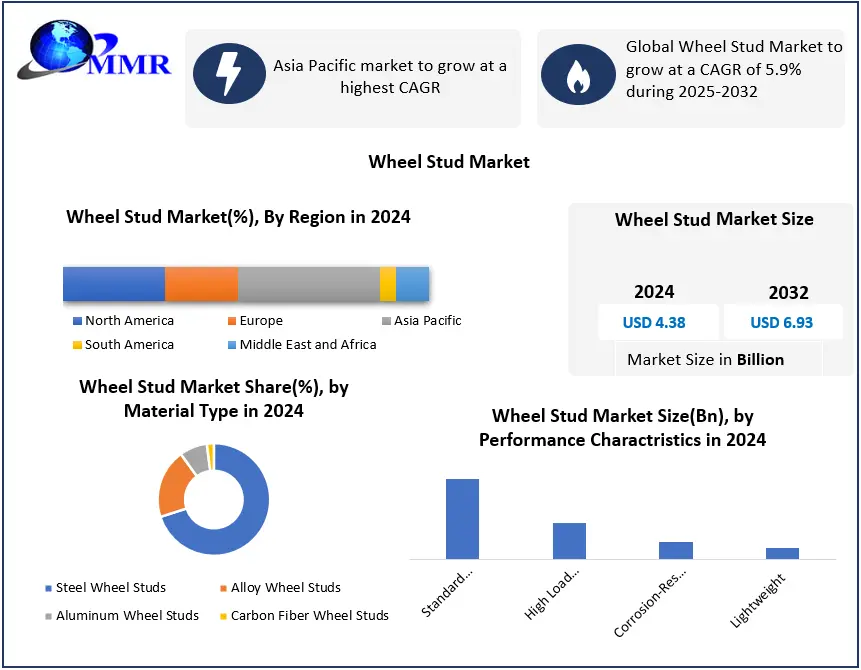
Global Wheel Stud Market size was valued at USD 4.38 billion in 2024, showing that wheel fastening hardware already represents a sizeable, specialized niche across light and heavy vehicles.
Total Wheel Stud Market revenue is expected to grow by 5.9% from 2025 to 2032, reaching nearly USD 6.93 billion, signaling steady expansion tied to vehicle production, weight growth and safety compliance.
Wheel studs are described as essential components used to secure automobile wheels, providing stability and strength to withstand pressure and vibration during driving, which makes them central to safety outcomes.
The market includes screw‑in, press‑in and welded‑in studs, indicating diverse engineering solutions across passenger cars, performance vehicles and heavy‑duty applications.
Growth expectations reflect rising EV and SUV weights, stronger regulatory focus on wheel integrity, and extended vehicle lifespans in global fleets.
Why This Matters Now
OEMs are adding weight to vehicles through batteries, bigger bodies and more equipment, while regulators and fleets demand higher safety and longer uptime. Wheel studs carry that extra load every kilometer; failure can mean catastrophic accidents, downtime and liability.
At the same time, electrification and fleet modernization require rethinking basic hardware. A market expected to climb from USD 4.38 billion to nearly USD 6.93 billion by 2032 at 5.9% CAGR shows that wheel studs are evolving from commodity fasteners into critical elements of chassis, safety and fleet strategies.
Market Overview
MMR positions the Global Wheel Stud Market around the design, production and distribution of studs used to attach wheels to hubs across passenger vehicles, commercial trucks, buses and specialized equipment. Studs must withstand cyclical loads, shocks and vibration while maintaining clamp force over long periods.
The forecast growth from USD 4.38 billion in 2024 to almost USD 6.93 billion by 2032, at 5.9% annual growth, implies demand driven largely by global vehicle output and rising content per vehicle. As heavier EVs and high‑payload commercial vehicles proliferate, wheel hardware must adapt to new load profiles, encouraging higher‑grade materials and refined designs.
For executives and investors, this means wheel studs are part of the hidden infrastructure of mobility. They influence safety reputations, warranty costs and fleet uptime, especially in markets with harsh roads or climates. Strategic sourcing and design decisions at this level can quietly protect or erode brand and operator economics.
Key Trends Driving Growth
1. Vehicle Weight and Electrification – What Changed?
Industry analysis describes wheel studs as essential for stability and strength in the face of pressure and vibration. As EVs add hundreds of kilograms of battery mass, and SUVs grow larger, the forces on wheel assemblies increase, stressing fasteners more than in previous generations.
This weight trend pushes OEMs and suppliers to re‑examine stud design: length, thread quality, materials and coatings must match higher loads and different dynamic behavior. Suppliers that can certify performance under heavier EV and crossover platforms gain advantage in winning new contracts.
2. Safety Regulation and Fleet Risk Management – Why Now?
Accidents linked to wheel detachment are highly visible and regulatory agencies in key markets have tightened guidance around wheel maintenance, torque and component quality. Wheel studs, as the mechanical link securing wheels, sit at the core of this compliance challenge.
Fleet operators, especially in logistics and bus networks, treat wheel hardware as a risk‑management priority. They demand studs that offer predictable life, corrosion resistance and clear replacement protocols. This drives aftermarket demand and encourages OEMs to specify higher‑tier hardware to lower lifecycle risk.
3. Product Mix: Screw‑In, Press‑In and Welded‑In – Who Benefits?
Research identifies screw‑in studs—standard and extended length—as commonly used in automotive and racing industries, with press‑in and welded‑in variants also in the mix. This diversity reflects different engineering philosophies and performance needs.
Suppliers specializing in screw‑in studs can address performance and customization markets, while press‑in and welded‑in stud suppliers often target OEM assembly efficiency and heavy‑duty durability. Each segment offers distinct margins and customer relationships, giving multi‑segment players broader resilience.
4. Aftermarket and Vehicle Longevity – What Happens Next?
Vehicle lifespans are extending, and fleets push assets to run longer. Wheel studs experience wear, corrosion and thread fatigue, driving replacement demand in the aftermarket.
As mobility models like ride‑hail and last‑mile delivery compress maintenance cycles, aftermarket studs that match OEM standards become critical to safety and uptime. Brands that build trust in replacement hardware can capture recurring revenue and strengthen distributor relationships.
Request a Free Sample Copy or View Report Summary: https://www.maximizemarketresearch.com/request-sample/146937/
Segment Insights
Dominant Segment: Automotive applications—passenger cars and commercial vehicles—are the dominant demand base for wheel studs, given their constant use across global vehicle fleets and central role described in market reports.
Fastest‑Growing Segment: Screw‑in wheel studs, including standard and extended length versions, are highlighted in research as key growth segments, driven by automotive and racing industries; however, MMR’s summary does not explicitly name a single fastest‑growing category, so specific rankings cannot be stated.
By type, screw‑in, press‑in and welded‑in studs serve different use cases: screw‑in for flexibility and replacement, press‑in for production efficiency, welded‑in for permanence and robustness.
By end‑use, segments include OEM fitment and aftermarket replacement, with OEM volume tied to vehicle production and aftermarket volume tied to fleet maintenance and aging vehicle stock.
This segmentation matters because it shows where strategic focus should lie: OEM contracts secure predictable long‑term volumes, while aftermarket channels capture margin and recurring business with fleets and consumers.
Regional Growth Story
Global reports describe demand across North America, Europe, Asia Pacific and other regions, with growth closely following vehicle production corridors. In North America, heavy truck and high‑mileage fleets drive robust wheel stud usage and replacement.
Europe’s mix of passenger cars, vans and regulated commercial fleets creates steady stud demand, reinforced by safety and maintenance standards. Germany and surrounding markets, with strong OEM presence, draw significant manufacturing and engineering activity for fasteners.
Asia Pacific, led by China, India, Japan and South Korea, contributes through high vehicle production and growing fleets. As these markets deploy more EVs, buses and logistics trucks, local stud manufacturers face both volume and performance demands, influencing regional investment in steel, machining and coating capabilities.
For stakeholders, this regional pattern means wheel stud strategies must align with local fleet composition, climate and regulatory practices, not just global averages.
Competitive Landscape
Industry research points to multiple global and regional wheel stud manufacturers competing on material quality, precision machining, corrosion resistance and pricing. Some are integrated fastener specialists serving wider automotive hardware needs, while others focus specifically on wheel systems.
Strategically, manufacturers that prove performance under heavy loads, severe climates and long duty cycles gain reputation advantages that translate into OEM and fleet contracts. Their engineering capabilities—fatigue testing, metallurgical control, coating technology—become differentiators beyond simple cost comparisons.
As electrification and high‑spec commercial vehicles spread, wheel studs for larger wheels and higher torque requirements will gain share. Suppliers that move early into EV‑ready hardware and align with global OEMs on specifications secure future positioning, while those staying tied to legacy specs risk being sidelined as standards tighten.
Recent Developments
Global market reports highlight screw‑in studs as commonly used in automotive and racing industries, reflecting ongoing demand for configurable, high‑performance hardware.
Forecasts showing market growth to roughly USD 5.9 billion by 2030 in some studies confirm a broader upward trajectory consistent with MMR’s 5.9% CAGR view to about USD 6.93 billion by 2032.
Analyses emphasize the role of studs in withstanding pressure and vibration during driving, reinforcing their treatment as safety‑critical components rather than generic bolts.
Commentaries discuss technological advancements and future trends in stud production, such as improved steels, thread designs and coatings, to address heavier vehicles and longer service lives.
Strategic Implications
OEMs must treat wheel stud design and sourcing as part of their broader electrification and safety strategies. Heavier EVs on larger wheels demand stud solutions validated for new load cases; failure to adjust specifications can lead to increased failures, recalls and reputational damage.
Tier‑1 axle and wheel suppliers should integrate stud performance into their system value propositions. Offering pre‑validated stud and hub combinations can differentiate their offerings and reduce integration work for OEMs, enhancing pricing power and platform attachment.
Fleet operators and mobility providers must adopt disciplined stud inspection and replacement regimes. Investing in quality aftermarket studs aligned with OEM specs reduces downtime risk and supports safety obligations, particularly as fleets run heavier and more intensively.
Future Outlook
With the Global Wheel Stud Market projected to grow from USD 4.38 billion in 2024 to nearly USD 6.93 billion by 2032 at 5.9% CAGR, wheel studs will remain fundamental hardware in an increasingly electrified and safety‑conscious transport ecosystem. As vehicles gain weight and fleets chase uptime, the quiet evolution of stud materials, designs and standards will have outsized impact on safety and economics.
The decisive split ahead is clear: future market leaders will treat wheel studs as engineered safety components—investing in EV‑ready, high‑strength, well‑tested designs and tight fleet protocols—while laggards will treat them as interchangeable commodity fasteners and bear the cost in accidents, failures and lost trust as mobility systems demand higher resilience.
Related Reports
Global MicroHybrid Vehicles Market https://www.maximizemarketresearch.com/market-report/global-micro-hybrid-vehicles-market/62072/
Global Automotive Automatic Tire Inflation System Market https://www.maximizemarketresearch.com/market-report/global-automotive-automatic-tire-inflation-system-market/69544/
Global Industrial Control Robotics Market https://www.maximizemarketresearch.com/market-report/global-industrial-control-robotics-market/72698/
Analyst Perspective
“Wheel studs may look simple, but they sit between vehicle weight, wheel integrity and fleet uptime, and as EVs and heavy‑duty platforms grow, their design and quality become strategic levers for safety and operating performance,” said Tejaswini Kakade, Analyst.
About Maximize Market Research
Maximize Market Research Pvt. Ltd. (MMR) is a global market research and consulting company that provides reliable, data-focused, and practical business insights. The firm serves a wide range of industries, including healthcare, pharmaceuticals, technology, automotive, electronics, chemicals, personal care, and consumer goods. Through market forecasts, competitive analysis, strategic consulting, and industry impact assessments, MMR helps organizations understand changing market conditions, identify growth opportunities, and make informed business decisions for long-term success.
2nd Floor, Navale IT Park Phase 3
Pune Banglore Highway, Narhe
Pune, Maharashtra 411041, India
+91 9607365656
sales@maximizemarketresearch.com
