Key Highlights
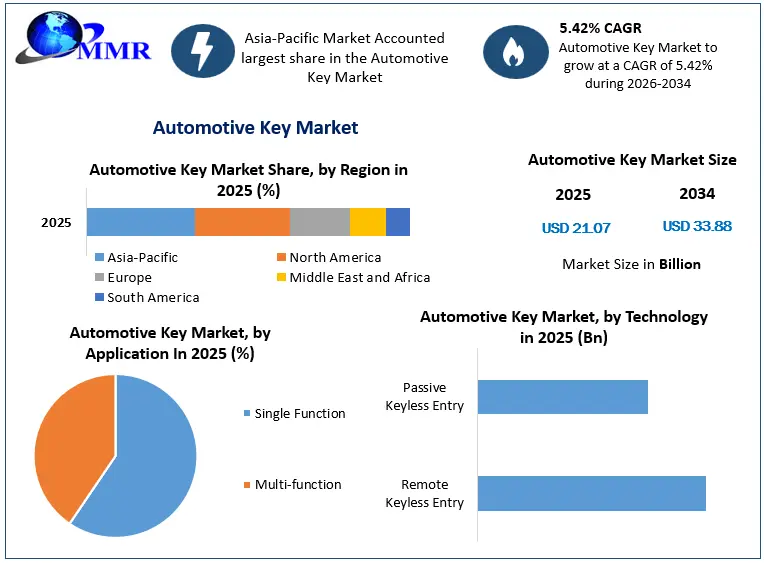
Market valuation stood at USD 21.07 billion in 2025 and is projected to scale to USD 33.88 billion by 2034, compounding at a 5.42% CAGR.
The smart key fob segment is expanding at a steady 3.1% CAGR, sustained by rising consumer demand for premium entry functions in affordable vehicle classes.
Bio-security integration emerges as a critical paradigm shift, highlighted by Leap Motor’s deployment of facial and fingerprint recognition systems.
Technological vulnerabilities remain a primary market constraint, exemplified by high-profile cyber-bypasses of leading electric vehicle access systems.
Software-defined vehicle architectures are delivering measurable bottom-line efficiencies, with centralized key management reducing long-term maintenance costs by 15%.
Why This Matters Now
The structural transformation of vehicle access systems from standalone mechanical components into integrated digital nodes is disrupting traditional automotive hardware supply chains. Original Equipment Manufacturers (OEMs) and Tier-1 suppliers face an urgent imperative to synchronize wireless security protocols with broader vehicle electrification and connectivity architectures. As vehicles transition into software-defined ecosystems, the traditional car key is becoming obsolete, replaced by smartphone-integrated Near Field Communication (NFC), Ultra-Wideband (UWB) tracking, and biometric authentication platforms.
This disruption forces a rapid realignment of capital expenditure toward semiconductor supply chains, cybersecurity infrastructure, and cloud-based credential management. Investors and hardware manufacturers must recognize that the monetization of vehicle entry has shifted from physical unit sales to lifecycle software maintenance and secure digital ecosystems. Failure to secure these digital entry points poses immense reputational risks, while successful execution unlocks seamless vehicle sharing, fleet management efficiencies, and personalized user environments.
Market Overview
The global Automotive key market is experiencing a profound phase of digitization, moving away from purely physical transponders toward multi-functional smart devices. Valued at USD 21.07 billion in 2025, the market is on a trajectory to reach USD 33.88 billion by 2034, exhibiting a steady compound annual growth rate (CAGR) of 5.42% over the forecast period. This growth reflects the ongoing transformation of the automotive industry, where security systems are no longer isolated accessories but core components embedded with microchips, advanced sensors, and radio frequency (RF) communications.
The integration of automatic locking, unlocking, and remote ignition systems without manual intervention has fundamentally changed the baseline expectations of car buyers worldwide. To meet these expectations, vehicle manufacturers are standardizing smart key technologies across diverse product tiers rather than restricting them to premium vehicle lines.
However, the rapid migration toward wireless and digital formats introduces distinct structural constraints. Data security vulnerabilities, the high initial production and replacement costs of wireless technology, and the proliferation of low-cost counterfeit products from manufacturing hubs like China represent major hurdles to stable market expansion.
Key Trends Driving Growth
The overarching catalyst for the automotive key market is the global surge in demand for luxury passenger vehicles and high-performance electric vehicles (EVs). These vehicle segments demand cutting-edge safety, telematics, and Advanced Driver Assistance Systems (ADAS). Because these advanced vehicle platforms rely on synchronized electronic architectures, they naturally necessitate wireless, remote-operated entry technologies that can execute critical operations via secure radio frequencies and digital protocols. The business implication is clear: automakers can no longer design entry systems in isolation; they must treat access control as the foundational layer of the vehicle’s electronic infrastructure.
A parallel driver is the democratization of high-end features. Global automakers like Honda are systematically incorporating advanced smart key functionalities into mass-market, budget-friendly vehicles, matching features that were previously exclusive to luxury sedans. To optimize production costs and satisfy corporate sustainability goals, manufacturers are pivoting toward lightweight, eco-friendly materials for the fabrication of internal microchips and external housing buttons. Furthermore, the development of RF-to-digital signal conversion technologies has increased the reliability and operational range of modern entry systems, giving Tier-1 suppliers a strong lever to drive product replacement cycles.
Segment Insights
Dominant Segment: Passenger Cars remain the dominant vehicle type segment, commanding the largest share of factory installations due to high global production volumes and the immediate consumer expectation for passive keyless entry systems.
Fastest-Growing Segment: Hybrid Electric Vehicles (HEVs) and broader electrified powertrains represent the fastest-growing vehicle segment, driven by rapid fleet electrification and the native integration of digital access systems within high-voltage electronic platforms.
Product Formats: The market remains segmented by smart key fobs, key cards, and smartwatches, with the smart key fob sub-segment maintaining a consistent growth profile at a CAGR of 3.1% through 2034.
Installation Channels: The OEM channel continues to dictate the vast majority of market value, though the aftermarket installation segment captures steady volume from legacy vehicle upgrades and component replacements.
Technology Types: Remote Keyless Entry (RKE) and Passive Keyless Entry (PKE) form the technological bedrock, with PKE gaining rapid market share as hands-free proximity unlocking becomes a baseline industry standard.
Application Depth: Multi-function applications are outpacing single-function keys, as modern access devices are increasingly required to manage remote climate activation, seat memory adjustments, and automated parking features.
Regional Growth Story
The Asia-Pacific region established a dominant position in the global market in 2025, backed by robust vehicle production volumes and substantial domestic consumption across China and India. The rapid adoption of keyless entry features by Chinese and Indian enterprises, combined with surging middle-class purchasing power, has transformed the region into the primary engine of hardware consumption. China’s status as the world’s largest automotive manufacturing powerhouse guarantees a continuous volume demand for baseline smart key electronics and sensor modules, while local suppliers rapidly scale up their production capabilities to meet both domestic and export requirements.
North America occupies the position of the second-largest regional market, characterized by an exceptionally high consumer adoption rate for smart vehicle technologies, remote start functionalities, and premium connected services. Conversely, the European market presents a distinct operational landscape shaped by intense concerns surrounding cybercrime and sophisticated vehicle theft. Because automotive keys function as wireless communication nodes, European regulators and consumers focus heavily on data security frameworks. This high risk of hacking and relay attacks has altered the investment priorities of European OEMs, shifting expenditure away from standard RF hardware toward localized, highly secure cryptographic software architectures.
Competitive Landscape
The competitive matrix of the global automotive key market is defined by an aggressive technological arms race between established semiconductor firms, Tier-1 automotive electronics suppliers, and innovative new entrants. The market structure features highly capitalized leaders like Continental AG, Denso Corporation, Bosch, and Valeo, alongside specialized component manufacturers such as Infineon Technologies, STMicroelectronics, NXP Semiconductors, and Tokai Rika. Competitive advantage is no longer determined by mechanical durability or physical design, but by a company’s ability to guarantee absolute cryptographic security, minimal latency, and seamless integration with mobile operating systems.
This competitive dynamic signals a major shift in supplier pricing power. Companies that master secure localized wireless protocols like Ultra-Wideband (UWB) are successfully locking in long-term OEM contracts, while legacy hardware manufacturers face severe margin compression from low-cost alternative products. The intense competitive pressure is forcing major suppliers to transition into software developers, building secure digital architectures capable of protecting vehicles from sophisticated physical and digital entry breaches.
Recent Developments
On 15 January 2025, Continental AG launched its CoSmA UWB digital key platform optimized for mass-market vehicles, which reduced latency and provided strong protection against advanced relay attacks.
On 12 May 2025, NXP Semiconductors expanded its UWB chipset manufacturing capabilities to meet the growing demand for passive keyless entry systems in emerging global EV markets.
On 20 September 2025, Valeo partnered with a major global OEM to integrate NFC digital key technology directly into smartphone operating systems, deploying physical-keyless access across more than 1 million vehicles.
On 10 February 2026, Bosch introduced a new software-defined vehicle platform featuring centralized digital key management modules, yielding a 15% reduction in long-term maintenance costs via optimized Over-the-Air updates.
Strategic Implications
The threat landscape in vehicle security is forcing immediate strategic realignments across OEM executive suites. The vulnerability of digital entry systems was laid bare on August 28, 2022, when security researchers successfully bypassed the keyless entry system of a Tesla Model S. This incident underscores the business reality that digital connectivity introduces massive cyber liabilities. OEMs can no longer treat vehicle access as a passive hardware purchase; it requires continuous cryptographic monitoring and rapid patch deployment capabilities to maintain consumer trust and protect against catastrophic fleet-wide hacking vulnerabilities.
In response, forward-looking manufacturers are shifting toward biometric and decentralized software architectures. In January 2022, Leap Motor disrupted the market by launching its smart electric coupe S01 model in China featuring the “Leap in” biological access mechanism. By integrating finger recognition and facial recognition technology directly into the vehicle structure, the company bypassed physical fobs and standard RF vulnerabilities entirely. The business implication is profound: as biometrics mature, the traditional Tier-1 supply chain for physical keys faces long-term obsolescence, forcing a strategic shift toward optical sensor validation and localized algorithmic processing.
Future Outlook
Looking ahead, the global automotive key market will split along clear technological lines, driven by the rollout of centralized software-defined vehicle (SDV) architectures. The successful implementation of Over-the-Air (OTA) update capabilities will allow automakers to continually refresh security keys, neutralizing cyber threats throughout the vehicle’s operational lifecycle without requiring physical dealership recalls. As smartphone integration becomes ubiquitous through NFC and UWB, the manufacturing volume of standard physical fobs will inevitably contract, shifting value toward cloud-based digital credential management and biological authentication layers.
Ultimately, the market will separate forward-looking operators from legacy players based on their digital agility. The future market leaders will be those who successfully build secure, hardware-agnostic digital access ecosystems that run on biometrics and smartphone platforms, while the laggards will remain tethered to vulnerable, high-cost physical key architectures that compress OEM margins and invite severe cybersecurity breaches.
Analyst Perspective
“The convergence of software-defined vehicle architectures and advanced biometrics is completely redefining vehicle access parameters. Capital is moving rapidly away from physical transponders toward centralized cryptographic platforms that offer real-time OTA security updates and zero-latency user recognition. Suppliers that fail to pivot from hardware manufacturing to secure software integration will find themselves designed out of next-generation OEM platforms within the decade.”
— Tejaswini Kakade, Principal Analyst, Maximize Market Research
About Maximize Market Research
Maximize Market Research Pvt. Ltd. (MMR) is a global market research and consulting company that provides reliable, data-focused, and practical business insights. The firm serves a wide range of industries, including healthcare, pharmaceuticals, technology, automotive, electronics, chemicals, personal care, and consumer goods. Through market forecasts, competitive analysis, strategic consulting, and industry impact assessments, MMR helps organizations understand changing market conditions, identify growth opportunities, and make informed business decisions for long-term success.
2nd Floor, Navale IT Park Phase 3
Pune Banglore Highway, Narhe
Pune, Maharashtra 411041, India
+91 9607365656
sales@maximizemarketresearch.com
