Key Highlights
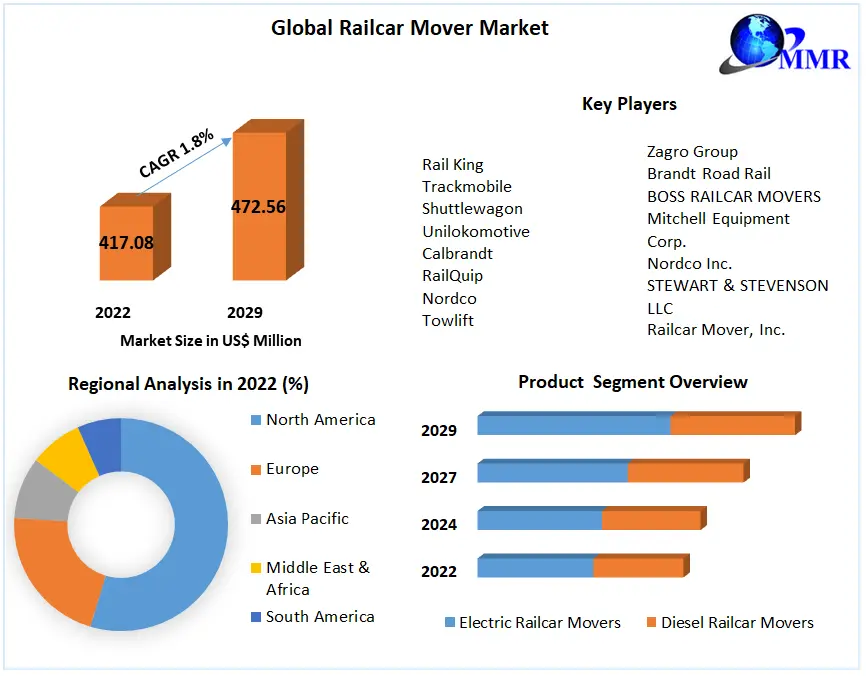
Global Railcar Mover Market size is expected to reach US$ 472.56 million by 2029, growing at a CAGR of 1.8% from a 2022 base of US$ 417.08 million, signaling a mature, steady market rather than a high‑growth segment.
Electric railcar movers are leading the product mix, supported by declining fossil fuel reserves and stringent regulations on carbon emissions that favor low‑emission yard equipment.
Metals and minerals are identified as the primary end‑user segment, reflecting mining‑driven demand for movers to transport heavy bulk commodities from loading sites to mainline trains.
North America held the largest regional share in 2022, with Europe and parts of Asia Pacific also showing strong demand from chemicals, construction, agriculture and manufacturing.
Key players include Rail King, Trackmobile, Shuttlewagon, Unilokomotive, Calbrandt, RailQuip, Nordco, Towlift and Zagro Group, pointing to a specialized competitive field focused on rail logistics equipment.
Why This Matters Now
Railcar movers sit at the intersection of rail freight logistics, industrial production and decarbonization. As shippers push more freight onto rail to cut emissions and costs, efficient and safe yard operations become critical, and movers provide the flexible traction needed to position cars without deploying full locomotives.
At the same time, regulators and corporate ESG agendas increase pressure to cut diesel use and improve worker safety in yards. A market heading to US$ 472.56 million at 1.8% CAGR may look modest, but the strategic role of movers in metals, minerals, chemicals and construction means equipment choices directly affect throughput, emissions performance and accident risk.
Market Overview
The railcar mover market comprises self‑propelled vehicles capable of operating on both rail and road (or dedicated rail movers) to reposition railcars in yards, loading tracks and industrial sites. They provide an alternative to deploying locomotives for short moves, enabling more flexible and cost‑effective handling.
MMR’s forecast from US$ 417.08 million in 2022 to US$ 472.56 million by 2029, at 1.8% CAGR, shows a mature market tied closely to industrial and rail investment cycles rather than consumer demand. Growth is primarily driven by demand for rail equipment and services, especially in Europe, North America and parts of Asia Pacific, where rails serve chemicals, construction, agriculture and manufacturing sectors.
The report also notes that COVID‑19 lockdowns affected revenue patterns differently across regions, emphasizing that railcar mover demand responds to industrial activity, capital spending and logistics needs rather than broader consumer cycles. That gives fleet operators and equipment makers a clearer view of long‑term asset planning.
Key Trends Driving Growth
1. Industrial Bulk Freight and Mining – What Changed?
According to MMR, metals and minerals are the primary end‑user segment for trackmobile railcar movers, driven by growth in the mining industry. Mines and mineral processors rely on movers to marshal heavy loaded cars in confined sidings and loading tracks.
This creates a direct link between commodity cycles and mover demand. When mining and bulk materials exports grow, railcar mover utilization and replacement rates rise. Operators that modernize fleets with higher‑capacity, safer movers gain throughput and reduce manual handling, which improves cost structures and safety performance.
2. Shift Toward Electric Railcar Movers – Why Now?
MMR identifies electric railcar movers as leading the product segment, driven by declining fossil fuel reserves and stringent regulations concerning carbon emissions. Yard operators face increasing pressure to cut diesel use and local pollutants, particularly near communities and in enclosed or partially covered facilities.
Electric movers, including battery‑powered models highlighted in parallel industry sources, allow operators to reduce emissions, noise and maintenance. While initial capex can be higher, they provide a hedge against fuel price volatility and carbon regulation, and they align with the broader rail decarbonization agenda.
3. Multi‑Industry Adoption and Yard Productivity – Who Benefits?
Beyond mining, MMR cites growth in chemical, construction and agricultural industries, plus railroads and manufacturing sectors, as drivers of railcar mover demand in Europe, North America and Asia Pacific. These sectors use movers for plant‑to‑rail interfacing and on‑site switching.
Operators benefit through improved yard productivity—quickly re‑configuring trains, reducing reliance on locomotives, and cutting manual coupling and shunting tasks. That improves asset utilization and safety, enabling shippers to support higher rail volumes without expanding yard footprints.
4. Decarbonization and Regulatory Pressure – What Happens Next?
The combination of fossil fuel constraints and carbon emission regulations highlighted in the MMR report suggests ongoing pressure to replace older diesel movers with electric or more efficient alternatives. As rail operators commit to net‑zero or carbon‑reduction targets, yard equipment becomes part of the emissions balance sheet.
This trend opens opportunities for OEMs that can deliver electric railcar movers with adequate tractive effort, battery life and charging solutions. It also invites new financing and leasing models that spread capex over time, helping industrial and rail operators align equipment transitions with decarbonization roadmaps.
Request a Free Sample Copy or View Report Summary: https://www.maximizemarketresearch.com/request-sample/21918/
Segment Insights
Dominant Segment: Electric railcar movers are identified by MMR as leading the product segment, reflecting regulatory pressure on carbon emissions and fuel constraints. This suggests electric movers currently form the dominant product category by growth focus, though diesel movers remain part of the installed base.
Fastest‑Growing Segment: Metals and minerals are described as the primary end‑user segment, driven by mining growth; this indicates that railcar movers serving the metals and minerals industry represent the fastest‑expanding demand base, even if the report does not provide an explicit numerical growth rate by segment.
On the product axis, electric vs diesel movers offer strategic options: electric for emissions and noise, diesel for remote or heavy‑duty cases without charging infrastructure.
End‑user segmentation—metals and minerals, oil and gas and other industrial applications—shows where OEMs should target product development and sales resources, focusing on yards with high intensity and safety sensitivity.
For equipment makers and investors, these insights point toward prioritizing electric movers for metals/minerals and high‑visibility industrial sites, while maintaining tailored diesel offerings where infrastructure or duty cycles demand them.
Regional Growth Story
MMR identifies North America as the region holding the largest share of the Global Railcar Mover Market in 2022. The region’s extensive freight rail network, heavy use of rail in chemicals, agriculture and energy, and reliance on private industrial sidings create strong baseline demand for yard moving equipment.
Europe and parts of Asia Pacific—particularly markets with strong rail freight and industrial bases—are also highlighted as growth regions, driven by construction, agriculture and manufacturing demand for rail equipment and services. These regions are modernizing yards to handle higher throughput and more complex freight patterns.
The report’s regional breakdown spans North America, Europe, Asia Pacific, Middle East & Africa and South America, indicating globally distributed opportunities. For OEMs, this means product and sales strategies must account for varying regulatory climates, yard configurations and industrial mixes across the United States, Germany, China, India and other major rail markets.
Competitive Landscape
MMR names key players such as Rail King, Trackmobile, Shuttlewagon, Unilokomotive, Calbrandt, RailQuip, Nordco, Towlift and Zagro Group, along with Brandt Road Rail, BOSS Railcar Movers, Mitchell Equipment Corp., Stewart & Stevenson and Railcar Mover Inc. This list points to a specialized, relatively concentrated competitive field.
These companies compete on tractive effort, flexibility (road‑rail capability), reliability, safety features and increasingly on powertrain type (diesel vs electric). Suppliers investing in electric drivetrains, battery systems and ergonomics signal a shift toward technology‑led differentiation, not just mechanical robustness.
For OEMs, offering tailored solutions for metals/minerals, oil and gas and heavy industry yards enhances positioning. Those that can integrate telematics and connectivity into movers—tracking utilization, safety events and energy use—will gain analytical leverage and new service business, foreshadowing software‑supported yard operations.
Recent Developments
MMR confirms electric railcar movers as the leading product segment, anchored in fossil fuel concerns and carbon emission regulations.
Metals and minerals are named as the primary end‑user segment, driven by mining‑related demand for railcar movers in bulk commodity logistics.
Regional analysis indicates North America held the highest share of the Global Railcar Mover Market in 2022, reflecting its mature freight rail and industrial base.
Broader industry commentary highlights growing use of railcar movers in warehousing and manufacturing facilities, as operators seek compact, maneuverable movers for confined yard spaces.
Strategic Implications
For railcar mover OEMs, the shift toward electric products and metals/minerals end‑users points to clear priorities: invest in electric platform development and durability for harsh mining and industrial environments, while building sales and service capabilities in North America and other high‑share regions.
Industrial operators and railroads should treat mover decisions as part of their broader decarbonization and efficiency strategies. Upgrading to electric movers where feasible reduces emissions and noise, supports ESG commitments and can improve worker safety, while modern diesel movers still play short‑term roles where infrastructure lags.
Fleet operators that integrate movers into digital yard management—combining equipment data with train and cargo information—will gain visibility on dwell times, safety events and energy use. This opens pathways to optimize yard flows and support future autonomous or semi‑automated yard solutions.
Future Outlook
With the Global Railcar Mover Market expected to grow from US$ 417.08 million in 2022 to US$ 472.56 million by 2029 at a modest 1.8% CAGR, the segment will likely remain a low‑growth but strategically essential niche tied to industrial logistics and rail freight flows. The key changes will be in technology mix—electric versus diesel—and integration with broader yard modernization and decarbonization efforts.
The decisive split ahead is clear: future market leaders will treat railcar movers as strategic assets in rail and industrial logistics—investing in electric platforms, safety features and connected yard operations—while laggards will treat them as generic shunting equipment and see their yards fall behind on efficiency, emissions performance and safety in a rail system that is steadily modernizing.
Related Reports
Global Semitrailer Market https://www.maximizemarketresearch.com/market-report/global-semitrailer-market/29349/
Automotive Auxiliary Lamps Market https://www.maximizemarketresearch.com/market-report/global-automotive-auxiliary-lamps-market/78899/
Automotive Valves Market https://www.maximizemarketresearch.com/market-report/automotive-valves-market/2918/
Analyst Perspective
“Railcar movers may operate out of sight in yards, but they sit at the heart of rail logistics, and as metals, minerals and industrial freight grow and carbon rules tighten, the choice of mover technology will directly shape yard efficiency and emissions,” said Tejaswini Kakade, Analyst.
About Maximize Market Research
Maximize Market Research Pvt. Ltd. (MMR) is a global market research and consulting company that provides reliable, data-focused, and practical business insights. The firm serves a wide range of industries, including healthcare, pharmaceuticals, technology, automotive, electronics, chemicals, personal care, and consumer goods. Through market forecasts, competitive analysis, strategic consulting, and industry impact assessments, MMR helps organizations understand changing market conditions, identify growth opportunities, and make informed business decisions for long-term success.
2nd Floor, Navale IT Park Phase 3
Pune Banglore Highway, Narhe
Pune, Maharashtra 411041, India
+91 9607365656
sales@maximizemarketresearch.com
