Key Highlights
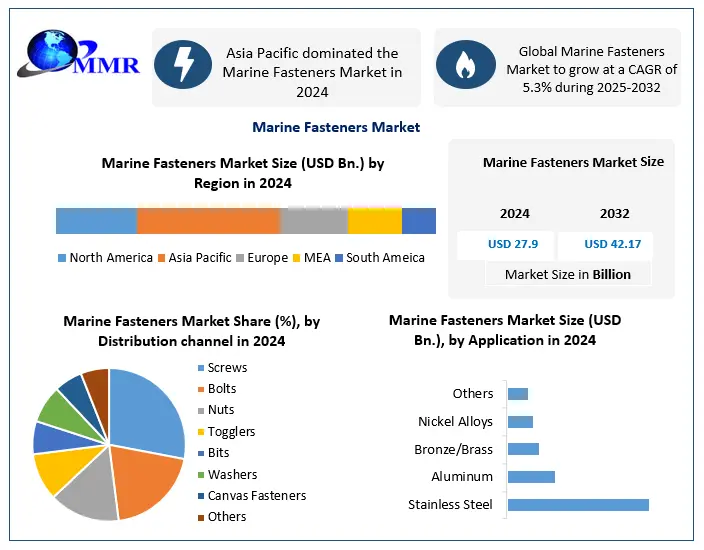
Marine Fasteners Market was valued at USD 27.9 billion in 2024, confirming that bolts, screws, studs and bonded fasteners represent a sizeable, specialized niche across shipbuilding and marine equipment.
Total global marine fasteners revenue is expected to grow at a CAGR of 5.3% from 2025 to 2032, reaching nearly USD 42.17 billion, signaling steady expansion aligned with global shipbuilding pipelines and repair backlogs rather than short‑term cycles.
Growth drivers identified include global shipbuilding and repair activities, showing that fastener demand is tied directly to the volume and complexity of vessel construction and maintenance workloads.
Marine fasteners must deliver high corrosion resistance, strength and vibration tolerance to ensure structural integrity and long‑term performance in hulls, decks, machinery and interior fittings.
This market scale and growth path make fastener selection a strategic issue for shipyards and fleet operators, affecting safety, warranty costs and total lifecycle maintenance.
Why This Matters Now
Shipyards and fleet operators face a convergence of pressures: rising trade volumes, more complex vessels, stricter safety and structural rules, and tougher environmental regulations. Fasteners sit at every joint that holds those vessels together; failure in a corrosive, high‑load marine environment can mean costly repairs or catastrophic incidents.
At the same time, global shipbuilding and repair activities are growing, lifting demand for high‑performance marine hardware. A market moving from USD 27.9 billion to about USD 42.17 billion by 2032 at 5.3% CAGR shows that choices on materials, designs and suppliers for seemingly simple fasteners now carry strategic weight in shipyard competitiveness and fleet reliability.
Market Overview
Marine fasteners are specialized bolts, screws, nuts, studs, washers and bonded solutions designed for shipbuilding and marine applications. They must resist salt‑water corrosion, high humidity, shock loads and constant vibration while maintaining clamp force and structural integrity over long service lives.
The market’s valuation at USD 27.9 billion in 2024 reflects widespread use across hull assembly, deck structures, superstructures, interiors and mechanical and electrical installations on commercial, naval and offshore vessels. Growth to nearly USD 42.17 billion by 2032 at 5.3% CAGR indicates that rising global newbuild and repair activity is steadily expanding hardware requirements, both in volume and in specification complexity.
For executives and investors, this means marine fasteners are part of the hidden infrastructure of maritime transport. They influence vessel safety records, classification compliance, dry‑dock frequency and long‑term corrosion and fatigue risks—factors that drive both brand reputation and total cost of ownership.
Key Trends Driving Growth
1. Global Shipbuilding and Repair Momentum – What Changed?
Orderbooks for commercial ships, naval vessels and specialized units such as offshore support ships and ferries have grown, and many fleets are undergoing extended life and retrofit programs. Every newbuild and major repair campaign requires thousands to millions of fasteners, making growth in shipbuilding and repair a direct driver of fastener demand.
This momentum changes the importance of fastener planning. Shipyards must secure reliable supply across diverse fastener types and sizes; fleet operators must plan for replacement and retrofit parts that match OEM standards. Manufacturers able to support project timelines and offer certified products gain preferred‑supplier status in a market where delays and quality lapses are expensive.
2. Corrosion and Material Innovation – Why Now?
Marine environments impose extreme corrosion challenges. Salt spray, immersion, temperature swings and mechanical stress accelerate material degradation. Shipowners, naval authorities and classification societies are placing greater emphasis on materials and coatings that reduce corrosion‑related failures and maintenance.
This puts stainless steels, high‑grade alloys and advanced coatings at the center of fastener innovation. Suppliers investing in corrosion‑resistant materials and bonded fastener technologies can help shipyards extend inspection intervals and reduce unexpected failures, improving uptime and lowering lifecycle maintenance costs.
3. Structural Integrity and Safety – Who Benefits?
Fasteners literally hold the hull and critical structures together. In high‑load areas—keel, frames, decks, superstructures, machinery foundations—fastener failure risks structural compromise and safety incidents. As vessels become larger and more complex, and as passenger and naval safety expectations rise, structural integrity standards harden.
Shipyards that treat fastener engineering as part of structural design—matching fastener grades, sizes and installation procedures with loads and fatigue expectations—benefit through smoother classification approvals and fewer post‑delivery issues. Fastener manufacturers that provide engineering support, testing data and documentation become valued technology partners rather than commodity suppliers.
4. MRO and Retrofit Demand – What Happens Next?
A significant portion of fleet spending now goes to maintenance, repair and overhaul. Aging vessels require fastener replacement during dry‑dock and repair, especially in corrosion‑prone zones. Retrofit projects—such as ballast water management systems, scrubber installations or deck equipment upgrades—also need certified marine fasteners.
This drives recurring demand in the aftermarket. Distributors and fastener brands that ensure traceability, material certificates and compatibility with original designs can capture repeat business from shipowners and repair yards. As more fleets pursue life‑extension programs instead of newbuilds, aftermarket fastener strategy will become a growing revenue stream.
Request a Free Sample Copy or View Report Summary: https://www.maximizemarketresearch.com/request-sample/124659/
Segment Insights
Dominant Segment: Marine fasteners directly serving shipbuilding and vessel construction form the dominant segment, as the market description ties revenue growth primarily to global shipbuilding activity. Shipyards’ demand for structural and assembly fasteners across hulls, decks and superstructures accounts for the bulk of volumes and value.
Fastest‑Growing Segment: Fasteners used in repair and retrofit activities represent the fastest‑growing segment, given the report’s explicit reference to growth in shipbuilding and repair and the industry’s push to extend vessel life and upgrade systems; however, detailed numeric split by segment is not provided, so growth is recognized qualitatively.
Product types span standard bolts and screws, high‑strength structural fasteners, bonded marine fasteners for specialized applications, and corrosion‑resistant hardware for decks and exposed structures.
End‑use segments include commercial shipping, naval fleets, offshore energy, ferries and smaller marine craft, with commercial and offshore segments driving the largest share of installed fasteners due to vessel size and equipment density.
For strategists, this segmentation suggests allocating R&D and sales resources to construction fasteners for large hulls and high‑value aftermarket solutions for repair and retrofit yards.
Regional Growth Story
Demand for marine fasteners follows shipbuilding and repair hubs. In Asia, major shipbuilding nations such as China, South Korea and Japan drive high volumes of construction fasteners, supported by export‑oriented yards and large domestic fleets. In Europe, countries like Germany and other maritime economies support marine fastener consumption through naval programs, commercial shipping and offshore projects.
The United States and other North American markets contribute via naval procurement, commercial coastal and inland fleets, and offshore energy activities. India and emerging shipbuilding markets add incremental demand as local yards grow and fleets modernize.
Regional regulation and classification rules influence fastener specifications. Markets with stricter corrosion and safety requirements push higher‑grade materials and more thorough documentation. Fastener manufacturers and distributors that establish presence close to major hubs gain responsiveness and local certification familiarity, improving competitiveness.
Competitive Landscape
The marine fasteners space includes global fastener companies with dedicated marine lines, specialized marine hardware manufacturers and regional suppliers serving local shipyards and MRO providers. Competition centers on material quality, corrosion performance, dimensional consistency, certifications and delivery reliability.
Suppliers investing in high‑grade stainless steels, specialty alloys and advanced coatings signal a move toward technology‑led differentiation. Some players develop bonded and engineered fasteners for specific naval and high‑performance applications, targeting segments where failure tolerance is very low and margins are higher.
From a strategic viewpoint, companies that integrate marine engineering support, documentation and logistics services—stock management, kitting for shipyards, just‑in‑time delivery—gain deeper relationships and pricing power. Those treating marine fasteners as generic catalog items risk losing share where yards and fleets demand technical and compliance support.
Recent Developments
Market sizing at USD 27.9 billion in 2024 with a forecast to USD 42.17 billion by 2032 at 5.3% CAGR reflects strengthening orderbooks and repair pipelines across global maritime regions.
Industry commentary highlights marine bonded fasteners as an emerging solution to combat corrosion and enhance durability in naval and high‑performance applications.
Technical publications emphasize the role of fasteners in hull assembly, deck hardware, interior fittings and mechanical and electrical fixtures, reinforcing their centrality to vessel integrity.
Multiple external market studies report similar growth ranges and confirm increasing interest from fastener majors in marine‑specific segments, suggesting intensifying competitive focus on the category.
Strategic Implications
For shipyards, fastener strategy must be integrated into design, procurement and quality management. Selecting appropriate grades, coatings and suppliers for critical joints reduces rework, speeds classification approvals and lowers risk of structural issues. Investing in standardization and long‑term supplier partnerships helps stabilize costs and availability.
Fastener manufacturers and distributors have a clear opportunity to move up the value chain by offering engineering support, application‑specific solutions and certified supply programs tailored to shipyards and MRO providers. Differentiating through corrosion performance, documentation and logistics can translate into sustained share and margin in a market that is large but operationally demanding.
Fleet operators should treat fasteners as part of their asset integrity programs. Establishing guidelines for replacement, inspection and use of certified marine hardware in repairs and retrofits will improve safety and reduce unexpected failures. This is especially relevant as vessels carry more complex equipment and face tougher operating and regulatory environments.
Future Outlook
With the Marine Fasteners Market projected to grow from USD 27.9 billion in 2024 to nearly USD 42.17 billion by 2032 at 5.3% CAGR, marine hardware will remain a critical but often hidden driver of shipbuilding quality, repair efficiency and fleet safety. The market’s evolution will be shaped less by headline volumes and more by material, design and supply‑chain decisions made in response to corrosion, regulatory and operational pressures.
The decisive split ahead is clear: future market leaders will treat marine fasteners as engineered integrity components—investing in corrosion‑resistant materials, bonded solutions, documentation and yard‑centric services—while laggards will treat them as interchangeable commodities and watch their vessels, yards and fleets fall behind on safety, reliability and lifecycle economics in an increasingly demanding maritime environment.
Related Reports
Global Electric Scooter Lift and Carrier Market https://www.maximizemarketresearch.com/market-report/global-electric-scooter-lift-and-carrier-market/114078/
Global Aerodynamic Automotive Market https://www.maximizemarketresearch.com/market-report/global-aerodynamic-automotive-market/14736/
Europe Hyperloop Technology Market https://www.maximizemarketresearch.com/market-report/europe-hyperloop-technology-market/2431/
Analyst Perspective
“Marine fasteners may be invisible once installed, but they sit at the junction of vessel safety, lifecycle cost and shipyard performance, and as global shipbuilding and repair accelerate, decisions around fastener materials, design and suppliers become strategically important,” said Tejaswini Kakade, Analyst.
About Maximize Market Research
Maximize Market Research Pvt. Ltd. (MMR) is a global market research and consulting company that provides reliable, data-focused, and practical business insights. The firm serves a wide range of industries, including healthcare, pharmaceuticals, technology, automotive, electronics, chemicals, personal care, and consumer goods. Through market forecasts, competitive analysis, strategic consulting, and industry impact assessments, MMR helps organizations understand changing market conditions, identify growth opportunities, and make informed business decisions for long-term success.
2nd Floor, Navale IT Park Phase 3
Pune Banglore Highway, Narhe
Pune, Maharashtra 411041, India
+91 9607365656
sales@maximizemarketresearch.com
