Key Highlights
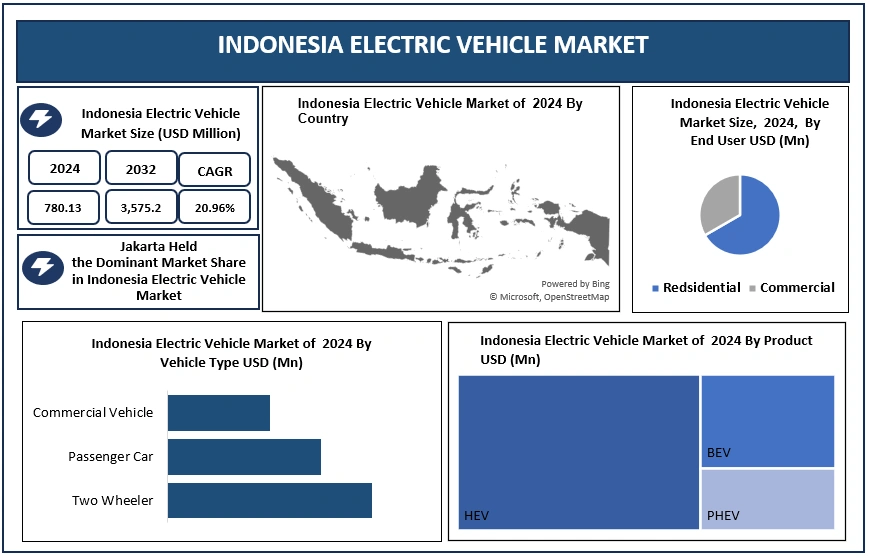
Indonesia Electric Vehicle Market was valued at USD 780.13 million in 2024, marking a tangible base for a country historically dominated by ICE two‑wheelers and cars.
Market size is estimated to grow at a CAGR of 20.96%, reaching USD 3,575.24 million by 2032, signaling a multi‑year acceleration rather than a short‑term spike.
Presidential Decree 55/2019 and a cluster of sectoral regulations explicitly position battery‑electric vehicles as a tool for energy efficiency, air quality improvement and greenhouse gas reduction.
Multiple fiscal incentives, from import duty relief to VAT reductions and vehicle tax breaks at regional level, directly lower EV acquisition and operating costs.
Conversion rules and type‑approval standards for battery electric vehicles show regulators actively structuring the technical and certification path for EV rollout.
Why This Matters Now
Indonesia is Southeast Asia’s largest automotive and two‑wheeler market, and its cities face rising congestion, pollution and fuel import exposure. Moving from ICE to EVs is no longer a peripheral environmental project; it is central to energy security, industrial policy and urban livability.
A market projected to grow from USD 780.13 million in 2024 to USD 3,575.24 million in 2032 at 20.96% CAGR signals a decisive inflection for OEMs, tier‑1 suppliers and investors. Those that align with Indonesia’s EV acceleration program gain access to a fast‑growing market and a strategic manufacturing base; those that hesitate risk losing share in a country building its own EV ecosystem.
Market Overview
Maximize Market Research defines the Indonesia Electric Vehicle Market as covering battery‑based electric motorized vehicles for road transportation, including cars, buses and two‑wheelers. The market valuation of USD 780.13 million in 2024 captures early but significant momentum.
With a forecast to USD 3,575.24 million by 2032 at a 20.96% CAGR, EVs shift from niche offerings to mainstream growth engines for the automotive sector. Policy documents emphasize energy efficiency, energy security and conservation, clean air and greenhouse gas reduction as guiding objectives, linking the EV market directly to national climate and energy agendas.
For executives, this means Indonesia’s EV story is not just about vehicle sales; it is tied to upstream mining, battery production, downstream mobility services and power infrastructure. EV decisions in Indonesia will shape long‑term industrial footprints and supply‑chain dependencies across ASEAN.
Key Trends Driving Growth
1. Policy‑Led EV Acceleration – What Changed?
Indonesia’s EV push is anchored in Presidential Decree 55/2019, which sets out a program to accelerate battery‑based electric motorized vehicles in road transport. It explicitly seeks energy efficiency, clean air and emission reductions, and aims to make Indonesia a production base and exporter of electric motorized vehicles.
The decree is supported by multiple acts across ministries—Transport, Finance, Industry, Trade, Energy, Domestic Affairs and the National Police—covering conversion, type approval, certification costs, charging infrastructure, domestic content and tax treatment. This multi‑ministry architecture is a structural change: EV decisions shift from isolated pilot projects to coordinated state policy.
2. Aggressive Fiscal Incentives – Why Now?
The Ministry of Finance and local governments have rolled out fiscal incentives ranging from import duty relief for machinery and materials to corporate income tax deductions, VAT borne by government on specific BEVs and local vehicle tax reductions for EVs in provinces such as DKI Jakarta, West Java, Central Java and Bali.
Transport ministry acts cut vehicle test and certification costs for EVs, making compliance less onerous than for conventional vehicles. Together, these incentives lower upfront prices and reduce regulatory friction, improving EV business cases for OEMs and lowering ownership barriers for consumers.
3. Conversion and Type‑Approval Pathways – Who Benefits?
Acts 65/2020, 87/2020, 92/2021, 15/2022 and subsequent regulations define conversion rules for electric motorcycles and other EVs, physical type approval, certification and cost structures. This creates legal clarity for both new EVs and converted vehicles.
Local assemblers, retrofitters and small manufacturers benefit, as they can bring products and conversion services to market with a defined regulatory roadmap. OEMs gain certainty on technical specs and testing requirements for BEVs, enabling them to plan localized models and production with clear compliance expectations.
4. Charging Infrastructure and Power Integration – What Happens Next?
Act 13/2020 from the Ministry of Energy and Mineral Resources sets provisions for electric power charging infrastructure for BEVs. That moves charging from ad‑hoc installations to a regulated, system‑planned asset.
As utilities and private operators deploy charging stations under this framework, EV range anxiety reduces and fleet electrification becomes more practical. It also links EV growth to power grid modernization and renewable integration, creating opportunities for energy companies, charging network operators and smart‑grid solution providers.
Request a Free Sample Copy or View Report Summary: https://www.maximizemarketresearch.com/request-sample/65817/
Segment Insights
Dominant Segment: The policy stack places strong emphasis on battery‑based electric motorized vehicles for road transport, with motorcycles and passenger cars highlighted in fiscal and certification incentives. Given Indonesia’s historic dominance of two‑wheelers and growing interest in BEV cars, these segments are the dominant contributors to EV market value, though the MMR summary itself does not break out explicit shares by segment.
Fastest‑Growing Segment: Conversion policies for electric motorcycles and broader EVs suggest that two‑wheelers and small vehicles undergoing conversion, alongside new BEV passenger cars, form the fastest‑growing segment in unit terms; however, the supplied MMR text does not assign a specific CAGR per segment, so this is recognized qualitatively based on regulatory focus rather than numerically.
By technology, battery electric vehicles (BEVs) sit at the center of regulation and incentives, with acts focused on BEV specifications, type approval and charging infrastructure.
By user type, both private consumers and fleet operators (buses, logistics, ride‑hailing) are targeted through tax and financing support, suggesting rising opportunities in both retail and commercial EV segments as the market grows.
This segmentation indicates that OEM strategies should prioritize Indonesian‑specific BEV car and two‑wheeler offerings and conversion‑friendly platforms.
Regional Growth Story
Indonesia’s EV market sits within a wider regional EV push in Asia, where China, Japan, South Korea and India advance their own electrification programs. Indonesia’s policies focus domestically but aim to make the country a production base and exporter of EVs and related technologies.
Presidential and ministerial acts encourage mastery of technology in the industrial sector and vehicle design, highlighting ambitions to capture more value from upstream nickel and battery industries and to export finished EVs rather than only raw materials. This creates a regional dynamic where Indonesia competes with other manufacturing hubs for OEM investment and platform allocation.
Collaboration and trade flows—import of complementary goods, market test units and after‑sales support as regulated in Act 59/2020—show that Indonesia wants foreign technology and vehicles while building domestic capabilities. That balance will shape how global OEMs and tier‑1s decide on local assembly, component sourcing and export routes.
Competitive Landscape
While the MMR summary focuses on market size and CAGR, Indonesia’s policy environment reveals implicit competitive signals. Import duty exemptions for machinery and materials, domestic content regulations (Act 27/2020) and BEV specifications (Act 28/2020) collectively push OEMs and suppliers to localize production and meet content thresholds.
Corporate income tax deductions and financing support from banking regulations (e.g., S‑14/D.03/2020) favour firms that commit capital to EV production, battery manufacturing and upstream supply chains. Manufacturers that invest early in Indonesian facilities will capture these benefits and secure cost and supply advantages.
Semiconductor and battery supply chains are indirectly pulled into Indonesia through these policies. By tying EV acceleration to industrial development and export ambitions, the state signals that tier‑1 suppliers with regional plants and technology partnerships will be better positioned than those serving Indonesia purely through imports.
Recent Developments
Maximize Market Research reports Indonesia Electric Vehicle Market at USD 780.13 million in 2024, with a projected CAGR of 20.96% leading to USD 3,575.24 million in 2032.
Presidential Decree 55/2019 established a national EV acceleration program, aligning energy efficiency, air quality and emission goals with battery EV adoption.
Subsequent acts across ministries define conversion rules, type‑approval, certification costs, charging infrastructure, domestic content requirements, tax treatments and financing support for EVs.
Local government acts in provinces such as DKI Jakarta, West Java, Central Java, Bali and others introduce vehicle tax reductions for EVs, creating regional pockets of stronger consumer incentives.
Strategic Implications
For global and regional OEMs, Indonesia’s EV trajectory means that platform allocation, localization and partnership decisions are urgent. A 20.96% CAGR to 2032 and a tightly coordinated policy framework indicate that EVs will move rapidly from niche to mainstream; OEMs that delay local EV strategies risk losing share to rivals that embrace domestic content and incentive structures.
Tier‑1 suppliers in batteries, power electronics and EV‑specific components should view Indonesia as a core node in their Asian networks, not just an export destination. Domestic content rules and upstream nickel resources create room for local cell and pack manufacturing, module plants and electronics assembly, with incentives reducing capital and operating barriers.
Fleet operators, mobility platforms and public transport agencies gain from lower certification costs, tax incentives and expanding charging infrastructure. They should align procurement with national programs, using EV adoption to cut fuel exposure and emissions while benefiting from supportive financing and tax structures.
Future Outlook
With Indonesia Electric Vehicle Market projected to grow from USD 780.13 million in 2024 to USD 3,575.24 million by 2032 at 20.96% CAGR, the country is on a fast path from ICE dependence to a diversified EV ecosystem spanning vehicles, batteries, infrastructure and services. Policy coordination across ministries suggests that EV adoption will be embedded into broader industrial and energy strategies rather than treated as standalone transport projects.
The decisive split ahead is sharp: future market leaders—OEMs, suppliers and mobility players—will treat Indonesia as a strategic EV production and innovation base, engaging deeply with its regulatory, fiscal and industrial programs, while laggards will see it only as a late‑stage sales market and watch their regional competitiveness erode as Indonesia leverages its resources, policies and manufacturing capacity to become a pivotal hub in Asia’s electric mobility and battery value chain.
Related Reports
Global Automotive Vehicle Fleet Leasing Market https://www.maximizemarketresearch.com/market-report/global-automotive-vehicle-fleet-leasing-market/73865/
Global Fuel Cell Commercial Vehicle Market https://www.maximizemarketresearch.com/market-report/global-fuel-cell-commercial-vehicle-market/81016/
Two-wheeler Brake Pad Market https://www.maximizemarketresearch.com/market-report/global-two-wheeler-brake-pad-market/81495/
Analyst Perspective
“Indonesia’s electric vehicle market is moving from policy declarations to measurable growth, and with a near 21% CAGR to 2032, the winners will be the companies that treat Indonesia as a core EV manufacturing and innovation base—not just another export destination,” said Tejaswini Kakade, Analyst.
About Maximize Market Research
Maximize Market Research Pvt. Ltd. (MMR) is a global market research and consulting company that provides reliable, data-focused, and practical business insights. The firm serves a wide range of industries, including healthcare, pharmaceuticals, technology, automotive, electronics, chemicals, personal care, and consumer goods. Through market forecasts, competitive analysis, strategic consulting, and industry impact assessments, MMR helps organizations understand changing market conditions, identify growth opportunities, and make informed business decisions for long-term success.
2nd Floor, Navale IT Park Phase 3
Pune Banglore Highway, Narhe
Pune, Maharashtra 411041, India
+91 9607365656
sales@maximizemarketresearch.com
