The South Sudan Petroleum Downstream Processing Market is gradually developing as the country seeks to strengthen its energy sector and reduce reliance on imported refined petroleum products. Downstream processing involves refining crude oil into usable fuels such as gasoline, diesel, kerosene, and other petrochemical products, as well as distribution and retail operations.
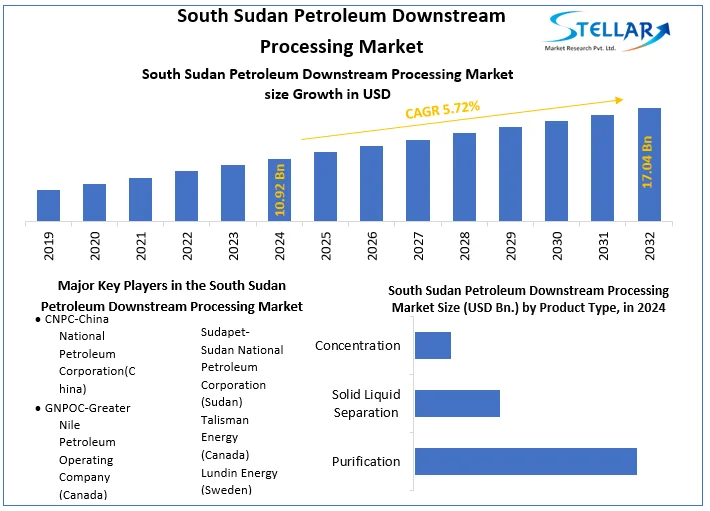
South Sudan Petroleum Downstream Processing Market was valued at USD 10.92 billion in 2024 and is estimated to reach a value of USD 17.04 billion in 2032. South Sudan Petroleum Downstream Processing Market size is estimated to grow at a CAGR of 5.72% over the forecast period.
As one of Africa’s oil-producing nations, South Sudan is focusing on building domestic refining capacity and improving fuel supply chains to support economic growth and energy security.
A Market Driven by Energy Demand and Infrastructure Development
A defining trend in the South Sudan petroleum downstream market is the increasing focus on local refining and fuel distribution infrastructure. Rapid urbanization and economic activities are driving demand for transportation fuels and energy products.
Efforts to develop refineries and storage facilities are aimed at ensuring a stable and reliable fuel supply.
Key Market Insights
- Downstream processing includes refining, distribution, and retail of petroleum products.
- Diesel and gasoline are the most in-demand fuels.
- Infrastructure development is a key growth factor.
- Import dependency remains significant.
- Government initiatives support energy sector expansion.
- Storage and logistics systems are improving.
- Regional trade influences market dynamics.
Market Drivers Accelerating Growth
1. Rising Demand for Fuel and Energy
Transportation, power generation, and industrial sectors are driving fuel consumption.
2. Development of Refining Capacity
Local refining initiatives aim to reduce reliance on imported fuels.
3. Government Focus on Energy Security
Policies promoting domestic energy production are supporting market growth.
Market Challenges and Restraints
1. Limited Infrastructure
Refining, storage, and distribution infrastructure are still developing.
2. Political and Economic Instability
Uncertain conditions can impact investment and market expansion.
Technology and Innovation Trends
Innovation in the South Sudan petroleum downstream processing market is driven by advancements in refining technologies, storage systems, and logistics management.
Modern refining techniques are being explored to improve efficiency and output quality. Investment in modular refineries is gaining attention due to their lower cost and scalability.
Digital technologies are enhancing supply chain management, enabling better monitoring of fuel distribution and storage. Automation and data analytics are improving operational efficiency and reducing losses.
Sustainability is gradually becoming a focus area, with interest in cleaner fuels and reduced emissions. Integration of renewable energy sources with traditional fuel systems is also being explored.
Visual Snapshot: Downstream Petroleum Processing
Regional Insights: Urban and Industrial Areas Drive Demand
Demand for petroleum products in South Sudan is concentrated in urban centers such as Juba and other developing regions. These areas require fuel for transportation, construction, and power generation.
Infrastructure development projects and growing industrial activities are increasing fuel consumption. Cross-border trade with neighboring countries also plays a role in market dynamics.
Efforts to improve logistics and transportation networks are supporting the efficient distribution of petroleum products.
Recent Industry Developments
- South Sudan Ministry of Petroleum (2025): Promoted downstream sector development initiatives.
- Nilepet (2024): Focused on expanding fuel distribution networks.
- African Development Bank (2025): Supported infrastructure development projects.
- World Bank (2024): Funded energy sector improvements.
- ExxonMobil (2025): Continued global downstream operations and investments.
Competitive Landscape
The South Sudan petroleum downstream processing market is developing, with state-owned enterprises, regional players, and international companies participating in the sector.
Companies are focusing on infrastructure development, supply chain efficiency, and strategic partnerships to strengthen their market position. Investment in refining and distribution systems is key to competitiveness.
Analyst Perspective
A senior market analyst notes:
“South Sudan’s downstream petroleum market has strong potential but requires significant infrastructure investment. Local refining and logistics improvements will be critical for growth.”
Future Outlook
The South Sudan Petroleum Downstream Processing Market is expected to witness gradual growth, driven by rising fuel demand, infrastructure development, and government initiatives.
The establishment of modular refineries and improved distribution networks will enhance market stability and reduce import dependency. Investment in technology and logistics will further support market expansion.
As the country continues to develop its energy sector, downstream processing will play a crucial role in ensuring energy security and supporting economic growth.
Overall, the market presents promising opportunities for investors, energy companies, and infrastructure developers aiming to contribute to South Sudan’s evolving petroleum industry.
