Key Highlights
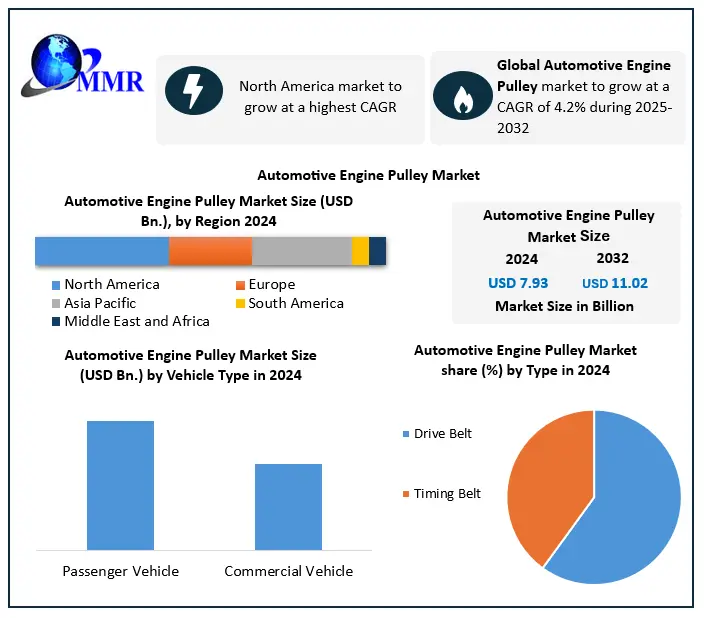
Global Automotive Engine Pulley Market size was valued at USD 7.93 billion in 2024, confirming engine pulleys as a sizeable and still‑relevant segment within the wider powertrain component industry.
Market revenue is expected to grow by 4.2% from 2025 to 2032, reaching nearly USD 11.02 billion, indicating modest but persistent demand even as EV penetration increases.
Engine pulleys remain essential to accessory drive systems in ICE vehicles, transmitting power to alternators, pumps and other units, directly affecting efficiency and reliability.
Growth rates in the low‑single‑digit band point to a mature market where incremental technology gains and regional ICE demand, rather than explosive expansion, shape revenues.
This trajectory forces OEMs and suppliers to decide how to manage investment, capacity and product roadmaps for a hardware category whose long‑term outlook is tied to ICE phase‑down schedules.
Why This Matters Now
Powertrain strategies are in flux. OEMs are pouring capital into battery packs, e‑axles and software‑defined platforms while continuing to sell millions of ICE and hybrid vehicles that rely on engine pulleys and belt drives for core functions. Engine pulley decisions now sit at the intersection of short‑term margin and long‑term transition.
A market climbing from USD 7.93 billion to nearly USD 11.02 billion by 2032 at 4.2% growth shows there is still meaningful value in optimizing ICE hardware. For executives, this is a question of timing: how long to push incremental efficiency and cost improvements in pulleys and accessory drives before reallocating engineering and capex towards EV‑only architectures.
Market Overview
Maximize Market Research defines the Global Automotive Engine Pulley Market around pulleys used in engine accessory drives—crankshaft pulleys, tensioner pulleys and idler pulleys—across passenger and commercial vehicles. These components transmit mechanical power from the engine to alternators, power steering pumps, water pumps, air conditioning compressors and other accessories via belts.
The market size of USD 7.93 billion in 2024, with expected revenue reaching nearly USD 11.02 billion by 2032, reflects continued ICE vehicle production and extended lifecycles in many regions. Engine pulleys must combine strength, dimensional accuracy, balance and NVH performance while managing cost pressures, making them a key site for material and design optimization in ICE powertrains.
From an industry perspective, pulleys sit in a complex supply chain that spans metal casting, machining, coatings, bearing integration and belt system design. As electrification progresses unevenly across regions and segments, demand for these components will increasingly diverge between markets with slow ICE phase‑down and those shifting aggressively to BEVs.
Key Trends Driving Growth
1. ICE Fleet Persistence and Emerging Markets – What Changed?
Despite aggressive EV targets in Europe, the United States and parts of Asia, ICE vehicles still account for a large share of global production and in‑use fleets, particularly in emerging markets. The forecast to nearly USD 11.02 billion by 2032 at 4.2% growth implies that many OEMs will continue building ICE and hybrid architectures for years.
This persistence alters how engine pulley suppliers plan. Rather than ramping down immediately, they must support long tails of ICE demand in Asia, Latin America, Africa and rural markets in developed economies, even as they prepare for eventual decline. The business opportunity lies in serving these segments efficiently while avoiding stranded assets.
2. Lightweighting and Efficiency – Why Now?
Fuel‑economy and emissions regulations keep pressure on ICE efficiency. Engine pulleys contribute by enabling optimized accessory loads and supporting lightweight materials and improved belt drive systems. Market commentary on automotive pulley segments notes a focus on materials and design to reduce weight and improve durability.
For OEMs, modest efficiency gains at the accessory drive level accumulate across millions of vehicles, helping them meet fleet‑average CO₂ and fuel‑economy targets. Suppliers who offer lighter, more durable pulleys using advanced metals or composites can secure preferred positions and protect margins even in a static or slowly growing market.
3. Aftermarket Demand and Lifecycle Extension – Who Benefits?
Large global ICE fleets require replacement parts as vehicles age. Engine pulleys see wear from belt loads, environmental exposure and bearing stress. As some regions extend ICE vehicle lifecycles due to economic constraints or slow EV rollout, aftermarket demand for pulleys remains strong.
Independent aftermarket distributors and OE‑aligned service networks benefit by stocking reliable, cost‑effective pulleys. Suppliers with strong catalogue coverage and quality reputation can capture recurring revenue long after vehicle production ends, smoothing the eventual decline in OEM orders.
4. Interface with Hybrid Architectures – What Happens Next?
Hybrids blend ICE engines with electric motors and batteries. Many hybrid designs still rely on engine pulleys for accessory drives, though some accessories migrate to electrified systems. As hybrids serve as a transitional solution in multiple regions, engine pulleys may see extended relevance within these architectures.
Pulley and belt system suppliers that collaborate closely with OEMs on hybrid powertrain layouts can adapt products for altered load profiles and packaging constraints. This creates a bridge between pure ICE hardware and more electrified platforms, buying time to repurpose expertise toward e‑drive ancillaries and related components.
Request a Free Sample Copy or View Report Summary: https://www.maximizemarketresearch.com/request-sample/101858/
Segment Insights
Dominant Segment: Passenger‑vehicle engine pulleys form the dominant segment in revenue terms, given global passenger car volumes and the widespread use of belt‑driven accessories on ICE and many hybrid engines; MMR’s headline figures reference the total market but do not explicitly split passenger versus commercial shares, so the dominance is understood qualitatively through typical industry structure.
Fastest‑Growing Segment: Pulley applications in emerging‑market and light‑commercial ICE fleets are likely to post above‑average growth as vehicle ownership expands and EV penetration remains slower in many of these regions; the MMR summary, however, does not provide segment‑specific CAGRs, so this growth is acknowledged without quantification.
By type, crankshaft and accessory pulleys carry the highest technical and value significance, while idler and tensioner pulleys serve critical support roles in belt system stability.
By channel, OEM supply dominates volumes, with aftermarket sales growing steadily as fleets age and maintenance cycles drive replacement.
These segments suggest that strategies should prioritize passenger‑car and light‑commercial applications and balance OEM and aftermarket portfolios to manage lifecycle risk.
Regional Growth Story
While the MMR summary provides global figures, broader analyses show regional differences in ICE persistence and EV transition. Markets such as China, India and Southeast Asia continue to produce and operate large ICE fleets, supporting ongoing demand for engine pulleys well into the 2030s.
In Europe, Japan and South Korea, strict emissions rules and strong EV policies compress ICE timelines, but hybrids and transitional models still require pulleys in the near term. OEMs there may push more aggressive lightweighting and cost optimization in remaining ICE lines.
For the United States, a mixed pattern emerges: strong EV momentum in some states combined with enduring ICE trucks and SUVs elsewhere. Suppliers with flexible regional footprints and multi‑market exposure can rebalance capacity as ICE declines faster in one region and slower in another.
Competitive Landscape
The automotive engine pulley market includes global tier‑1 and tier‑2 component suppliers, metal and forging specialists and integrated belt‑drive system providers. Research reports mention multiple manufacturers profiled by sales and revenue across 2019–2024, indicating a fragmented but globally active supplier base.
Competitive signals now revolve around material innovation, cost control and the ability to support OEMs through transition. Companies investing in high‑precision manufacturing, lightweight alloys and improved surface treatments position themselves as efficiency partners for OEMs seeking marginal CO₂ gains from remaining ICE platforms.
As EV powertrains scale, some pulley and belt specialists will pivot toward other rotating components, thermal‑management hardware or structural parts. Those that stay focused on ICE pulleys without a transition plan face long‑term volume decline, especially in regions accelerating toward EVs and SDV architectures.
Recent Developments
Maximize Market Research reports Global Automotive Engine Pulley Market size at USD 7.93 billion in 2024, with revenue expected to reach nearly USD 11.02 billion by 2032 at a 4.2% growth rate.
Broader automotive pulley studies reference similar low‑single‑digit growth ranges to 2030, reflecting a mature, slowly expanding market.
Industry commentary highlights growing interest in lighter, more durable pulleys and in belt‑drive optimization to support fuel‑efficiency and emissions targets.
Some analyses mention early integration of sensors and monitoring into rotating components, pointing toward future potential for condition‑based maintenance in accessory drive systems.
Strategic Implications
For OEMs, the key decision is how to allocate engineering and sourcing effort between legacy ICE hardware such as pulleys and emerging EV components. Leveraging engine pulley optimization for near‑term efficiency gains makes sense while ICE fleets remain large; however, long‑term competitiveness will hinge on shifting talent and capex toward electrified architectures.
Tier‑1 suppliers must manage a staged transition. In the short to medium term, they should secure ICE and hybrid pulley business with cost‑competitive, lightweight and durable designs, while using existing relationships and manufacturing know‑how to expand into adjacent EV components.
Aftermarket players should plan for a long tail of ICE demand. Building strong catalogues, distribution and quality assurance for pulleys can yield stable cash flows that fund diversification into EV service parts and digital diagnostics as fleets gradually electrify.
Future Outlook
With the Global Automotive Engine Pulley Market projected to grow from USD 7.93 billion in 2024 to nearly USD 11.02 billion by 2032 at a 4.2% rate, engine pulleys will remain part of the automotive hardware landscape through at least the next decade, especially in ICE and hybrid segments. The market’s evolution will be defined less by raw growth and more by how suppliers and OEMs reposition their portfolios as electrification reshapes powertrains.
The high‑stakes split ahead is direct: future market leaders will treat engine pulleys as a cash‑generating, efficiency‑focused legacy segment—optimizing designs while actively redeploying capabilities into EV and SDV components—whereas laggards will cling to pulleys as a core growth bet and find themselves over‑exposed to a gradually shrinking ICE world that leaves them behind in the next wave of automotive powertrain and software‑defined mobility.
Related Reports
Global Aircraft Filters Market https://www.maximizemarketresearch.com/market-report/global-aircraft-filters-market/114145/
Global Automotive Biometrics Market https://www.maximizemarketresearch.com/market-report/global-automotive-biometrics-market/120252/
Global Gasoline Fuel Injector Market https://www.maximizemarketresearch.com/market-report/global-gasoline-fuel-injector/89726/
Analyst Perspective
“Engine pulleys sit at the heart of ICE accessory drives, and as global powertrain strategies pivot toward electrification, the companies that treat this market as a bridge—optimizing efficiency today while investing in tomorrow’s electrified components—will be best positioned to preserve value through the transition,” said Tejaswini Kakade, Analyst.
About Maximize Market Research
Maximize Market Research Pvt. Ltd. (MMR) is a global market research and consulting company that provides reliable, data-focused, and practical business insights. The firm serves a wide range of industries, including healthcare, pharmaceuticals, technology, automotive, electronics, chemicals, personal care, and consumer goods. Through market forecasts, competitive analysis, strategic consulting, and industry impact assessments, MMR helps organizations understand changing market conditions, identify growth opportunities, and make informed business decisions for long-term success.
2nd Floor, Navale IT Park Phase 3
Pune Banglore Highway, Narhe
Pune, Maharashtra 411041, India
+91 9607365656
sales@maximizemarketresearch.com
