The stratosphere the atmospheric layer stretching roughly 10 to 50 kilometers above the Earth’s surface is rapidly becoming the new frontier for telecommunications, military intelligence, and environmental monitoring. High-Altitude Platform Stations (HAPS) and stratospheric Unmanned Aerial Vehicles (UAVs) are progressively filling the operational gap between lower-tier commercial drones and expensive orbital satellites. At the core of this technological leap lies the payload: the collection of sensors, cameras, radars, and transmitters that make these long-endurance flights valuable.
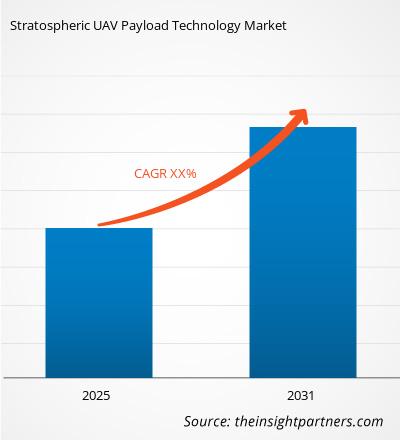
According to a comprehensive study by The Insight Partners, the global Stratospheric UAV Payload Technology Market size is expected to reach US$ 5.84 Billion by 2034 from US$ 1.33 Billion in 2025. The market is estimated to record a rapid Compound Annual Growth Rate (CAGR) of 17.84% from 2026 to 2034. This monumental growth is propelled by escalating defense budgets, the global race for persistent 5G/6G connectivity, and rapid advancements in lightweight, highly efficient solar-electric propulsion systems.
Market Dynamics & Growth Drivers
The surge in demand for stratospheric UAV payloads is structurally tied to three major factors:
1. The Demand for “Eye-in-the-Sky” Persistence
Traditional low-Earth orbit (LEO) satellites move rapidly across the sky, leaving coverage gaps, while geostationary satellites sit too far away to capture highly detailed imagery without massive, heavy lenses. Stratospheric UAVs, operating as pseudo-satellites, can hover over a single geographic zone for weeks or months at a time. This unparalleled persistence is invaluable for border security, maritime surveillance, and real-time disaster management.
2. Bridging the Digital Divide via Telecom Payloads
Telecommunication companies are actively investing in HAPS to beam high-speed broadband and 5G connectivity to rural, island, or disaster-stricken areas where ground infrastructure is economically or physically unfeasible. Lightweight communication payloads equipped with phased-array antennas and laser transceivers are designed to broadcast signals over thousands of square miles from the stratosphere.
3. Advances in Miniaturization and Energy Efficiency
Historically, the harsh thermal conditions and thin air of the stratosphere made operations difficult. However, next-generation materials science has paved the way for ultra-lightweight payloads. Micro-gimbal optical sensors, synthetic aperture radars (SAR), and software-defined radios (SDR) are now highly compact, requiring only a fraction of the power they used to, making them perfect for solar-powered aircraft.
Get a PDF Sample– https://www.theinsightpartners.com/sample/TIPRE00010091
Key Industry Players
The stratospheric ecosystem is highly specialized, requiring a unique blend of aerospace expertise, advanced materials science, and software engineering. Prominent players actively shaping the competitive landscape of this market include:
Airbus S.A.S (Pioneers of the Zephyr solar-powered HAPS program)
ARCA
Boeing (Driving advanced autonomous aerostructures and defense payloads)
HAPSMobile Inc. (A joint venture pushing broadband-beaming stratospheric solutions)
Kea Aerospace (Innovating in high-altitude aerial imaging systems)
Lockheed Martin Corporation (Developing high-altitude defense surveillance integrations)
Near Space Corp. (Specialists in stratospheric testing and platform execution)
QinetiQ (Leading developers of high-altitude aerospace technology and materials)
Thales Group (Innovators behind the Stratobus, focusing on dual-use telecom and surveillance payloads)
UAVOS INC (Pioneering flight control systems and solar-powered UAV autopilots)
Segment Highlights
While defense applications currently command a dominant share of the payload market due to the immediate demand for Intelligence, Surveillance, and Reconnaissance (ISR) capabilities, the commercial segment is gaining swift momentum.
Geographically, North America continues to lead the global market, heavily backed by robust funding from the U.S. Department of Defense and rapid development programs. Concurrently, the Asia-Pacific region is projected to experience the fastest growth rate over the forecast window, driven by national border-monitoring initiatives, maritime security programs, and regional infrastructure pushes for satellite-independent communications.
Get Full Copy of This Report- https://www.theinsightpartners.com/buy/TIPRE00010091
Future Outlook
Looking ahead, the Stratospheric UAV Payload Technology Market is positioned at the intersection of aerospace innovation and artificial intelligence. The next generation of payloads will not simply gather data; they will process it directly in the sky using edge-computing AI. This onboard intelligence will filter out useless visual data, such as cloud cover, and only beam down critical, actionable information, drastically saving bandwidth. Furthermore, as regulatory frameworks mature to systematically integrate high-altitude platforms into civilian airspace, we can expect a commercial boom. The stratospheric layer will transition from a highly specialized military testing ground into a mainstream, everyday utility layer permanently linking global communications and planet-wide observations.
Related Reports-
About Us
The Insight Partners is a one-stop industry research provider of actionable intelligence. We help our clients in getting solutions to their research requirements through our syndicated and consulting research services. We specialize in industries such as Semiconductor and Electronics, Aerospace and Defense, Automotive and Transportation, Biotechnology, Healthcare IT, Manufacturing and Construction, Medical Devices, Technology, Media, and Telecommunications, as well as chemicals and Materials.
Contact Us
If you have any queries about this report or if you would like further information, don’t hesitate to get in touch with us:
Contact Person: Ankit Mathur
E-mail: ankit.mathur@theinsightpartners.com
