Key Highlights
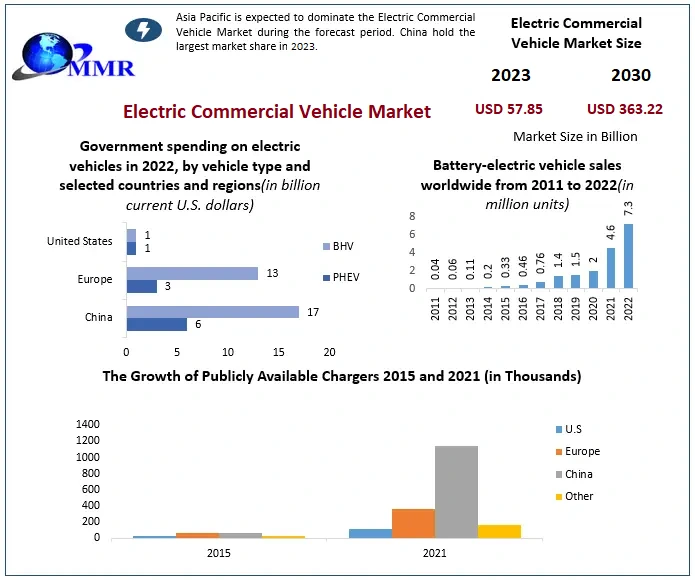
- The Global Electric Commercial Vehicle Market was valued at USD 57.85 Billion in 2023, reflecting accelerating adoption of zero-emission transportation across logistics, public transit, and industrial fleets.
- The market is projected to reach USD 363.22 Billion by 2030, creating substantial opportunities for OEMs, battery manufacturers, charging providers, Tier-1 suppliers, and fleet operators.
- The market is expected to expand at a CAGR of 30.01% from 2024 to 2030, demonstrating one of the fastest growth trajectories across the automotive industry.
- Fleet electrification is becoming a strategic priority as governments and businesses pursue lower operating costs and emissions reductions.
- Battery innovation, software-defined vehicle platforms, and connected fleet technologies continue transforming commercial transportation economics.
Why This Matters Now
Commercial transportation is entering its largest technological transition since diesel engines reshaped freight mobility decades ago. Fleet operators are no longer evaluating electric commercial vehicles as pilot projects—they are becoming central to long-term fleet strategies, emissions compliance, and operating efficiency.
The Electric Commercial Vehicle Market Size, valued at USD 57.85 Billion in 2023, highlights the rapid commercialization of zero-emission transportation. Its projected expansion to USD 363.22 Billion by 2030, growing at a 30.01% CAGR, signals a structural shift that will redefine vehicle manufacturing, logistics, infrastructure investment, and supply-chain economics.
Market Overview
Electric commercial vehicles have evolved from niche transportation solutions into mainstream assets across logistics, municipal transportation, construction, public transit, and urban delivery networks.
Advances in battery technology, vehicle connectivity, intelligent fleet management, and charging infrastructure are making electrification increasingly practical across both light-duty and heavy-duty commercial applications.
The market reflects broader changes across the transportation ecosystem. Commercial fleet purchasing decisions increasingly consider total cost of ownership, digital fleet integration, predictive maintenance, and sustainability objectives rather than upfront vehicle costs alone.
As governments strengthen emissions regulations and businesses accelerate decarbonization initiatives, electric commercial vehicles are becoming strategic investments rather than regulatory responses.
Key Trends Driving Growth
Fleet electrification remains the primary catalyst for industry expansion. Logistics companies, municipal operators, and commercial fleet owners increasingly replace conventional vehicles with battery-electric alternatives to improve efficiency and reduce operating expenses.
Battery innovation continues strengthening vehicle performance. Improvements in battery efficiency, charging capability, and energy management support longer operating ranges while enhancing commercial vehicle productivity.
Charging infrastructure expansion remains equally important. Public and private investments in high-capacity charging networks are reducing operational barriers while enabling broader deployment of electric commercial fleets.
Software-defined vehicles are transforming fleet management through over-the-air updates, predictive diagnostics, intelligent energy optimization, and digital vehicle monitoring.
Connected vehicle technologies allow fleet operators to optimize routing, monitor vehicle health, improve utilization rates, and reduce downtime using real-time operational data.
Autonomous driving technologies continue influencing long-term commercial vehicle strategies. Although widespread deployment remains gradual, advanced driver assistance systems and automation continue improving operational safety and fleet efficiency.
Supply-chain localization also remains a strategic priority as manufacturers strengthen battery production, semiconductor availability, and electric powertrain manufacturing capacity.
Segment Insights
- Dominant Segment: Information available in the Maximize Market Research report.
- Fastest-Growing Segment: Information available in the Maximize Market Research report.
- Battery-electric commercial vehicles continue expanding across logistics and public transportation.
- Fleet electrification remains a major driver of long-term market demand.
Regional Growth Story
China continues leading global electric commercial vehicle deployment through large-scale manufacturing, battery production, charging infrastructure expansion, and supportive industrial policies. Its integrated supply chain reinforces its position as the world’s largest commercial EV ecosystem.
The United States is accelerating commercial fleet electrification through investments in charging infrastructure, logistics modernization, and advanced manufacturing. Large fleet operators increasingly integrate electric trucks and delivery vehicles into nationwide transportation networks.
Germany remains a global engineering leader, focusing on premium commercial vehicle technologies, intelligent manufacturing, and next-generation electric mobility solutions.
Japan continues advancing electric commercial transportation through precision engineering, hybrid expertise, and investments in sustainable mobility technologies.
South Korea benefits from advanced battery manufacturing and automotive electronics, strengthening its role in the commercial EV value chain.
India is emerging as an important growth market through urban transportation modernization, electric bus deployment, commercial fleet electrification, and expanding charging infrastructure.
Across major automotive regions, commercial vehicle electrification is becoming a cornerstone of transportation modernization strategies.
Competitive Landscape
Competition in the electric commercial vehicle industry increasingly centers on complete mobility ecosystems rather than vehicle manufacturing alone.
OEMs are integrating battery systems, software platforms, digital fleet management, connected services, and predictive maintenance into comprehensive transportation solutions. Companies capable of delivering integrated ecosystems strengthen customer retention while expanding recurring revenue opportunities.
Tier-1 suppliers continue investing in electric powertrains, thermal management systems, battery integration, advanced electronics, and vehicle connectivity technologies supporting future commercial vehicle platforms.
Battery supply chains have become a strategic competitive advantage. Manufacturers capable of securing battery production, semiconductor availability, and scalable manufacturing capacity improve long-term production resilience and pricing flexibility.
Competitive differentiation increasingly depends on software capability, charging partnerships, manufacturing scalability, and digital fleet services rather than hardware specifications alone.
Recent Developments
- Fleet operators continue expanding electric commercial vehicle procurement strategies.
- Investments in battery manufacturing and charging infrastructure continue supporting market growth.
- Connected fleet management platforms are improving operational efficiency.
- OEMs continue developing dedicated electric commercial vehicle platforms.
- Advanced software and over-the-air capabilities are becoming standard across commercial EV ecosystems.
Strategic Implications
For OEMs, commercial vehicle electrification creates opportunities to diversify revenue through integrated mobility services, digital fleet platforms, and software-enabled transportation solutions.
Tier-1 suppliers benefit from rising demand for advanced batteries, electric drivetrains, thermal management systems, semiconductors, and intelligent vehicle electronics.
Fleet operators gain advantages through reduced operating costs, predictive maintenance, improved vehicle utilization, and stronger sustainability performance.
Investors should recognize that commercial electrification extends beyond vehicle sales. Charging infrastructure, battery manufacturing, fleet software, energy management, digital services, and connected mobility platforms represent expanding long-term value creation opportunities.
The aftermarket will also evolve as electric fleets increasingly require specialized diagnostics, software maintenance, charging support, and battery lifecycle services.
Future Outlook
The Global Electric Commercial Vehicle Market is projected to grow from USD 57.85 Billion in 2023 to USD 363.22 Billion by 2030, expanding at a 30.01% CAGR. That growth reflects one of the fastest transformations occurring anywhere in the global automotive industry.
The next phase of competition will extend beyond electrification toward intelligent fleet ecosystems integrating batteries, charging networks, artificial intelligence, software-defined vehicles, predictive maintenance, and connected logistics platforms. Companies capable of delivering complete mobility ecosystems rather than standalone vehicles will establish enduring competitive advantages.
As commercial transportation becomes increasingly electric, connected, and software-driven, manufacturers leading battery innovation, digital fleet intelligence, and scalable zero-emission mobility platforms will shape the future of global logistics, while organizations that delay electrification risk falling behind in one of the industry’s most significant competitive shifts.
Analyst Perspective
“Commercial vehicle electrification is rapidly becoming a strategic transformation rather than a technology transition. Organizations investing in battery innovation, connected fleet platforms, intelligent charging ecosystems, and software-defined commercial vehicles will define the next era of global transportation,” says Tejaswini Kakade, Analyst, Maximize Market Research.
About Maximize Market Research
Maximize Market Research Pvt. Ltd. (MMR) is a global market research and consulting company that provides reliable, data-focused, and practical business insights. The firm serves a wide range of industries, including healthcare, pharmaceuticals, technology, automotive, electronics, chemicals, personal care, and consumer goods. Through market forecasts, competitive analysis, strategic consulting, and industry impact assessments, MMR helps organizations understand changing market conditions, identify growth opportunities, and make informed business decisions for long-term success.
2nd Floor, Navale IT Park Phase 3
Pune Banglore Highway, Narhe
Pune, Maharashtra 411041, India
+91 9607365656
sales@maximizemarketresearch.com
