Key Highlights
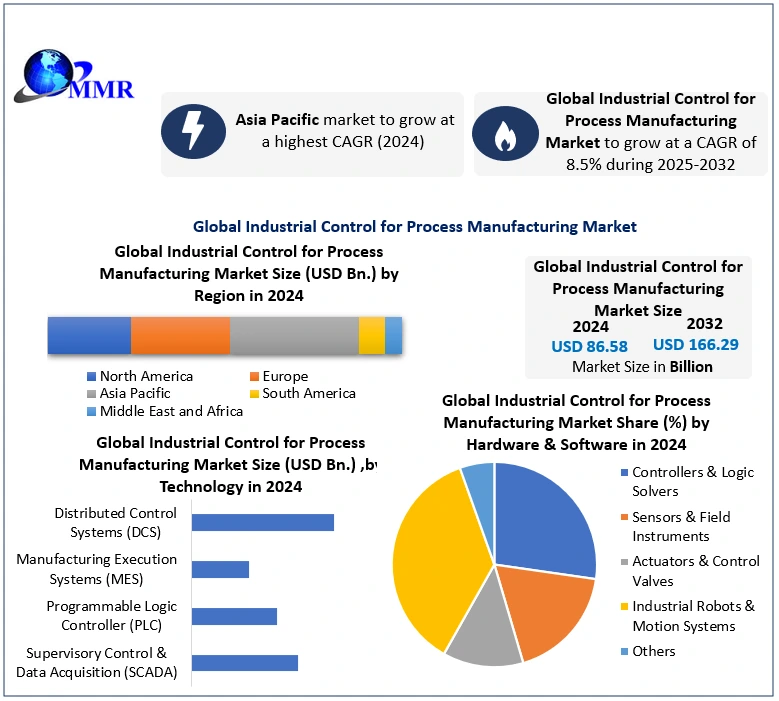
- The Global Industrial Control for Process Manufacturing Market was valued at USD 86.58 Bn in 2024. This valuation highlights the increasing role of automation technologies in improving industrial productivity, efficiency, and operational visibility.
- The market is projected to reach USD 166.29 Bn by 2032, expanding at a CAGR of 8.5% from 2025 to 2032. This growth reflects rising investment in digital manufacturing, industrial automation, and connected production environments.
- Process industries are accelerating adoption of intelligent control systems to improve efficiency and reduce operational risks.
- Industrial IoT, artificial intelligence, and predictive analytics are transforming traditional manufacturing operations.
- Companies are investing in automation platforms to improve productivity, sustainability, and supply chain resilience.
Why This Matters Now
Manufacturing industries are entering a new phase where automation, data intelligence, and connected operations determine competitiveness. Process manufacturers are under pressure to improve efficiency, reduce energy consumption, strengthen quality control, and respond faster to market disruptions.
The Industrial Control for Process Manufacturing Market Size reflects this transformation. Valued at USD 86.58 Bn in 2024, the market is expected to reach USD 166.29 Bn by 2032, growing at an 8.5% CAGR. This expansion signals a major shift toward digitally managed production environments where industrial control systems become strategic assets.
Market Overview
Industrial control systems for process manufacturing enable automated management of complex production environments across industries such as chemicals, pharmaceuticals, energy, food processing, and manufacturing.
These systems include technologies such as distributed control systems, supervisory control and data acquisition platforms, programmable automation solutions, industrial software, and connected monitoring technologies.
The industry is moving from isolated automation toward integrated digital ecosystems. Manufacturers increasingly require real-time operational intelligence, predictive maintenance capabilities, and flexible production systems to compete in global markets.
The growth of industrial control technologies is also linked to broader manufacturing trends, including smart factories, industrial IoT adoption, and sustainable production strategies.
Key Trends Driving Growth
Digital transformation remains the primary growth driver. Manufacturers are integrating industrial control systems with cloud platforms, analytics tools, and connected devices to improve decision-making and operational performance.
Industrial IoT is changing how factories operate. Connected sensors and intelligent control platforms provide real-time production data, enabling manufacturers to identify inefficiencies, optimize processes, and reduce downtime.
Artificial intelligence and machine learning are expanding the capabilities of industrial automation. Predictive maintenance systems can identify equipment issues before failures occur, helping manufacturers reduce maintenance costs and improve production continuity.
Energy efficiency has become another important priority. Process industries face increasing pressure to reduce emissions and optimize resource consumption. Advanced control systems help manage energy usage while improving overall plant efficiency.
Cybersecurity is becoming a critical consideration as industrial networks become more connected. Manufacturers are investing in secure automation architectures to protect operational systems from digital threats.
The rise of smart factories is also accelerating demand. Companies are adopting flexible manufacturing models that require intelligent control systems capable of supporting automation, robotics, and real-time production adjustments.
Segment Insights
- Dominant Segment: The report identifies the dominant market segment contributing the largest share of Industrial Control for Process Manufacturing Market revenue.
- Fastest-Growing Segment: The report identifies the fastest-growing segment expected to experience the strongest expansion during the forecast period.
- Process industries are increasingly adopting integrated automation platforms to improve operational efficiency.
- Digital control systems are gaining importance as manufacturers transition toward connected production environments.
- Industrial software and analytics capabilities are becoming essential components of modern manufacturing strategies.
Regional Growth Story
The United States continues investing in advanced manufacturing, industrial automation, and production modernization. Companies are adopting digital control systems to improve competitiveness, operational efficiency, and supply chain resilience.
Germany remains a global leader in industrial engineering and smart manufacturing innovation. The country’s focus on Industry 4.0 continues driving adoption of advanced automation and connected production technologies.
China is expanding industrial automation deployment through large-scale manufacturing modernization initiatives. Growing demand for efficient production systems is supporting adoption of advanced control technologies across multiple industries.
Japan continues leveraging its strengths in robotics, automation, and precision manufacturing. Industrial control technologies remain essential for maintaining productivity and operational excellence.
South Korea is strengthening automation adoption through investments in advanced manufacturing sectors, electronics production, and industrial digitalization.
India is emerging as a growing market for industrial automation as manufacturers expand production capacity and adopt smart factory technologies. Increasing industrial investment is creating opportunities for automation providers and technology suppliers.
Competitive Landscape
Competition in industrial control systems is increasingly focused on software capabilities, cybersecurity, analytics integration, and ecosystem development rather than hardware alone.
Technology providers are expanding their portfolios to deliver complete automation solutions that combine industrial hardware, software platforms, cloud connectivity, and artificial intelligence.
For manufacturers, supplier selection is becoming a strategic decision. Companies that provide scalable automation platforms help customers improve productivity, reduce operational costs, and achieve sustainability targets.
The competitive landscape also reflects growing collaboration between industrial automation companies, software developers, and technology providers. These partnerships are accelerating innovation while enabling more connected manufacturing environments.
Future market leadership will depend on the ability to integrate automation, data intelligence, cybersecurity, and flexible production capabilities into unified industrial platforms.
Recent Developments
- Manufacturers continue investing in smart factory technologies and connected production systems.
- Industrial automation providers are expanding digital platforms to support predictive analytics and real-time monitoring.
- Companies are increasing adoption of AI-driven process optimization solutions.
- Cybersecurity investments are growing as industrial systems become increasingly connected.
- Process manufacturers are accelerating automation initiatives to improve efficiency and operational resilience.
Strategic Implications
Industrial control technologies have become critical components of modern manufacturing strategies. They influence productivity, quality management, energy efficiency, and long-term operational competitiveness.
For manufacturers, investment in advanced control systems enables greater flexibility and faster response to changing market conditions. Automation also supports workforce optimization by shifting operational focus from manual monitoring toward data-driven decision-making.
For technology suppliers, opportunities are expanding beyond traditional automation hardware. Software integration, cybersecurity, cloud platforms, and analytics capabilities are becoming key competitive differentiators.
Investors should view industrial control solutions as a fundamental enabler of the global manufacturing transformation. The market benefits from multiple long-term trends, including automation adoption, industrial digitization, sustainability requirements, and supply chain modernization.
Future Outlook
The Industrial Control for Process Manufacturing Market, valued at USD 86.58 Bn in 2024, is expected to reach USD 166.29 Bn by 2032, growing at an 8.5% CAGR from 2025 to 2032. This growth reflects the increasing importance of intelligent automation, connected factories, and data-driven industrial operations.
The future of process manufacturing will be defined by companies that successfully combine automation expertise, artificial intelligence, cybersecurity, and digital platforms to create adaptive production ecosystems, while organizations relying on traditional control methods will struggle to compete in an increasingly intelligent industrial landscape.
Analyst Perspective
“Industrial control systems are becoming the foundation of next-generation manufacturing as companies prioritize automation, operational intelligence, and digital resilience. The shift toward smart factories will create significant opportunities for technology providers capable of delivering integrated and scalable industrial solutions,” says Tejaswini Kakade, Analyst.
About Maximize Market Research
Maximize Market Research Pvt. Ltd. (MMR) is a global market research and consulting company that provides reliable, data-focused, and practical business insights. The firm serves a wide range of industries, including healthcare, pharmaceuticals, technology, automotive, electronics, chemicals, personal care, and consumer goods. Through market forecasts, competitive analysis, strategic consulting, and industry impact assessments, MMR helps organizations understand changing market conditions, identify growth opportunities, and make informed business decisions for long-term success.
2nd Floor, Navale IT Park Phase 3
Pune Banglore Highway, Narhe
Pune, Maharashtra 411041, India
+91 9607365656
sales@maximizemarketresearch.com
