Key Highlights
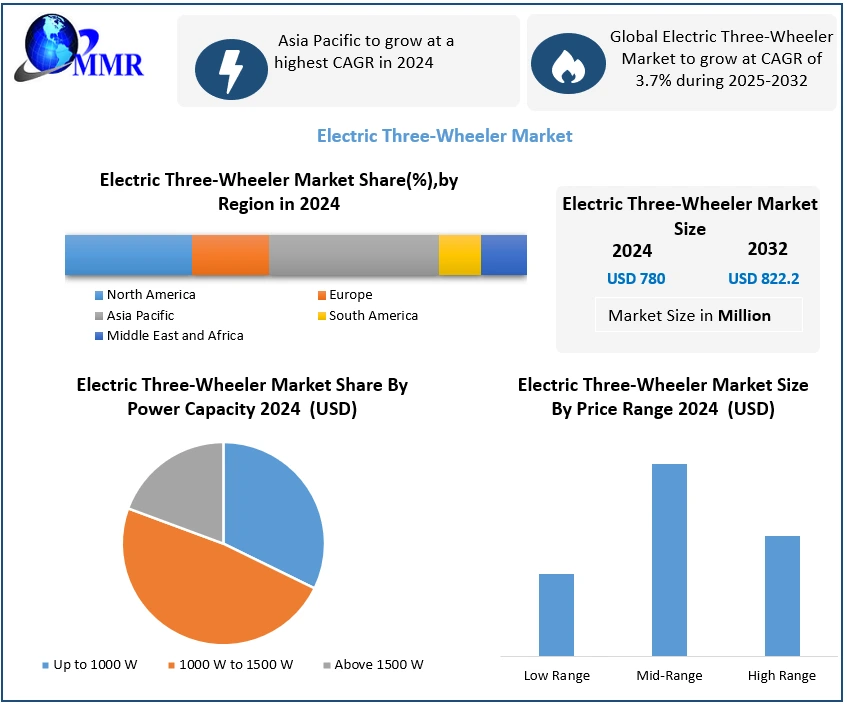
Market Scale: The market was valued at USD 780 million in 2024 and is forecast to grow to USD 822.2 million by 2032.
Growth Velocity: The industry is advancing with a projected CAGR of 3.7% during the 2025–2032 forecast period.
Dominant End-Use: Passenger carriers remain the primary application, serving high-density urban populations.
Strategic Catalyst: E-commerce logistics and the urgent need for cost-effective, low-emission intra-city transport are the core drivers of market adoption.
Key Growth Factors: Rising environmental awareness, government subsidies, and the significant operational cost savings compared to internal combustion engine (ICE) alternatives.
Why This Matters Now
The urban logistics landscape is undergoing a massive structural shift as megacities face unprecedented traffic congestion and environmental degradation. Electric three-wheelers have moved past their reputation as simple passenger “e-rickshaws” to become the most viable, cost-effective tool for last-mile freight. For fleet operators and logistics strategists, these vehicles offer a direct pathway to operational efficiency, bypassing the prohibitive acquisition and fuel costs of traditional fossil-fuel vehicles while meeting stringent municipal carbon-neutrality targets.
Market Overview
The Electric three-wheelers Market , encompassing both passenger carriers and goods-carrying load vehicles, are carving out a high-utility niche in the global automotive hierarchy. Valued at USD 780 million in 2024, the market is defined by its focus on economy and agility. By replacing noisy, polluting ICE counterparts, electric three-wheelers provide a practical solution to “last-mile” friction—the most expensive and complex part of the global supply chain—enabling faster, cheaper, and cleaner movement of goods and people in densely populated urban centers.
Key Trends Driving Growth
Operational cost parity is the most significant trend accelerating adoption. As battery prices stabilize and energy efficiency improves, the total cost of ownership (TCO) for electric three-wheelers is increasingly favorable compared to diesel or gasoline engines, often requiring significantly less maintenance. Furthermore, the rise of “shared mobility” platforms is integrating these vehicles into digital ecosystems, where real-time tracking and optimized routing are boosting the productivity of individual drivers and fleet operators alike.
Segment Insights
Dominant Segment: Passenger Carriers. Still the largest segment by volume, these vehicles remain the backbone of urban transport in developing nations, where shared mobility culture is deeply entrenched.
Fastest-Growing Segment: Goods Carriers (Load Carriers). Bolstered by the e-commerce boom and the rapid growth of “quick-commerce” grocery and package delivery, the demand for compact, electric freight vehicles is surging.
Regional Growth Story
Asia-Pacific leads the global market, anchored by high-density urban markets in India, China, and Southeast Asia. The region’s dominance is bolstered by large-scale government initiatives that provide direct subsidies for electric commercial vehicle adoption, coupled with a massive demographic of middle-income consumers who rely on these vehicles for daily transit. While North America and Europe currently represent smaller shares, urban freight initiatives and the emergence of “low-speed, zero-emission” zones are creating high-potential niches for these compact electric workhorses.
Competitive Landscape
The market is characterized by a diverse mix of specialized electric manufacturers and traditional automotive giants diversifying their portfolios. Companies like Piaggio & C. SpA and others are investing heavily in modular chassis designs that allow the same platform to serve both passenger and cargo needs. This signals a strategic move toward “dual-use mobility,” where versatility is the key to maximizing factory utilization and capturing a broader range of commercial customers.
The competitive landscape is also seeing a surge in startups focusing on “smart” three-wheelers, integrating telematics and IoT to appeal to large-scale logistics providers like Amazon and Flipkart. This indicates that the battleground is shifting from simple mechanical assembly to platform-level integration; OEMs that can provide not just a vehicle, but a connected asset that plugs into existing logistics software, will command the largest market share in the years to come.
Recent Developments
Strategic M&A: Recent acquisitions of smaller electric three-wheeler manufacturers by major auto groups signal a consolidation phase aimed at scaling production capacity and acquiring critical battery-management IP.
Technological Maturation: Manufacturers are moving toward standardized lithium-ion battery architectures, reducing the “range anxiety” that historically hindered widespread adoption in commercial sectors.
Infrastructure Expansion: Municipal investments in localized charging points are beginning to address the “last-mile infrastructure” gap, providing the reliability that commercial fleet operators require.
Strategic Implications
For automotive decision-makers, the message is clear: the three-wheeler is no longer a “bottom-of-the-pyramid” product. It is a vital component of the modern, digitized urban economy. Organizations that fail to address this segment are leaving the most explosive growth area of the last-mile logistics market to agile, tech-focused entrants. The strategic priority should be to develop scalable, modular platforms that offer the durability required for 12-to-16-hour daily commercial usage while keeping the acquisition cost low enough to satisfy the price-sensitive operator.
Future Outlook
The electric three-wheeler market is approaching a critical inflection point where it will transition from a public-transport alternative to the standard vehicle for urban commercial logistics. Market leaders will be defined by their ability to provide integrated “mobility-as-a-service” solutions—combining the vehicle, the battery, and the tracking software into a single, high-uptime package. The laggards—those who continue to prioritize internal combustion platforms or fail to embrace the digital connectivity of the modern logistics chain—will find themselves rapidly sidelined as urban centers move toward mandatory zero-emission freight mandates.
Analyst Perspective
“The electric three-wheeler is transforming from an urban necessity into a strategic logistics asset,” states Tejaswini Kakade, Analyst at Maximize Market Research. “As we look toward 2032, the players that dominate this space will be the ones who treat the vehicle not just as a machine, but as a digital gateway for the future of hyper-efficient urban delivery.”
About Maximize Market Research
Maximize Market Research Pvt. Ltd. (MMR) is a global market research and consulting company that provides reliable, data-focused, and practical business insights. The firm serves a wide range of industries, including healthcare, pharmaceuticals, technology, automotive, electronics, chemicals, personal care, and consumer goods. Through market forecasts, competitive analysis, strategic consulting, and industry impact assessments, MMR helps organizations understand changing market conditions, identify growth opportunities, and make informed business decisions for long-term success.
2nd Floor, Navale IT Park Phase 3
Pune Banglore Highway, Narhe
Pune, Maharashtra 411041, India
+91 9607365656
sales@maximizemarketresearch.com
