Key Highlights
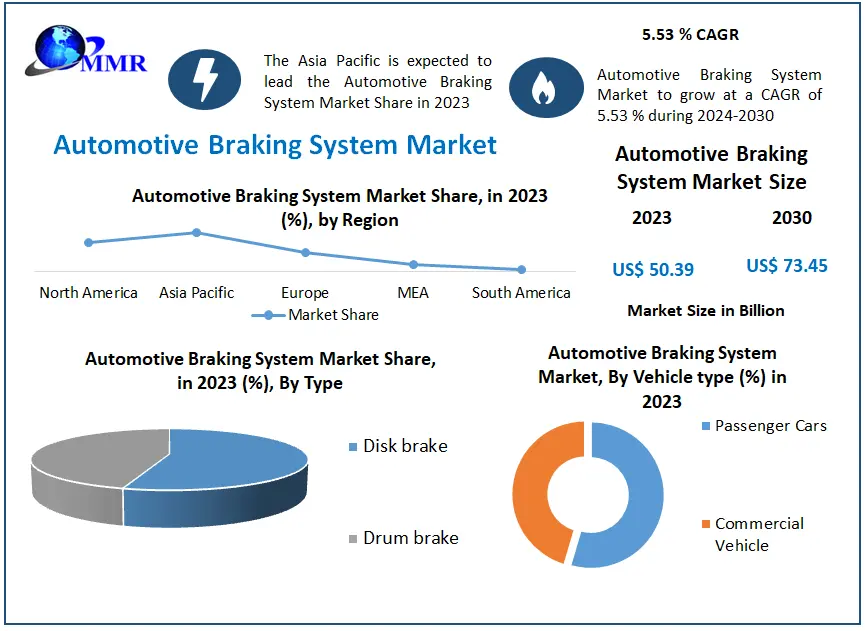
- Automotive Braking System Market was valued at USD 50.39 billion in 2023.
- Market revenue is projected to reach nearly USD 73.45 billion by 2030, expanding at a 5.53% CAGR.
- Electrification is accelerating demand for intelligent braking technologies compatible with regenerative systems.
- ADAS adoption is increasing the integration of electronically controlled braking platforms.
- Brake-by-wire technologies are gaining strategic importance as software-defined vehicles become mainstream.
- Safety regulations continue to influence OEM investment priorities across developed and emerging automotive markets.
- Tier-1 suppliers are strengthening digital braking capabilities to support autonomous mobility.
Why This Matters Now
The automotive industry is redesigning the vehicle around software, electrification, and automation. Braking systems have moved from being mechanical safety components to becoming intelligent control platforms that directly influence vehicle efficiency, autonomous capability, and occupant safety.
For OEMs, suppliers, fleet operators, and investors, braking technology is no longer a compliance requirement alone. It has become a competitive differentiator that determines vehicle performance, software integration, energy recovery, and readiness for next-generation mobility.
Market Overview
The Automotive Braking System Market Size was valued at USD 50.39 billion in 2023 and is expected to reach nearly USD 73.45 billion by 2030, growing at a CAGR of 5.53% between 2024 and 2030. This expansion signals sustained investment in vehicle safety technologies while reflecting the industry’s transition toward electrified and digitally connected mobility.
Braking technology now sits at the intersection of safety regulation, vehicle electrification, and autonomous driving. Modern braking systems must simultaneously deliver precise stopping performance, communicate with advanced driver assistance systems, support regenerative braking in electric vehicles, and integrate seamlessly with increasingly software-centric vehicle architectures.
Manufacturers are therefore prioritizing electronic braking solutions capable of supporting multiple vehicle platforms while reducing weight, improving reliability, and enabling future software upgrades.
Key Trends Driving Growth
Electrification continues to redefine braking system requirements. Electric vehicles depend on sophisticated coordination between regenerative braking and traditional friction braking, requiring higher levels of electronic control than conventional internal combustion vehicles.
ADAS deployment is also increasing braking system complexity. Automatic emergency braking, adaptive cruise control, collision avoidance, and lane assistance all depend on braking systems capable of responding instantly to sensor inputs and software commands.
Software-defined vehicles represent another structural shift. Braking systems are becoming integrated digital subsystems connected with vehicle operating platforms, allowing continuous software optimization, diagnostics, and over-the-air functionality.
Safety regulations remain another powerful growth catalyst. Governments continue strengthening vehicle safety requirements, encouraging broader deployment of electronic stability control, anti-lock braking systems, and advanced emergency braking technologies across passenger and commercial vehicles.
Meanwhile, fleet operators increasingly evaluate braking technologies through the lens of total operating cost. Intelligent braking improves vehicle uptime, lowers maintenance requirements, and supports predictive maintenance strategies that reduce unexpected downtime.
Semiconductor availability has also become strategically important. Electronic braking modules rely heavily on reliable chip supplies, making supplier resilience and component sourcing critical competitive factors for OEM production planning.
Segment Insights
- Dominant Segment: The report identifies the leading market segment within the Automotive Braking System Market. Its leadership reflects widespread adoption across vehicle categories and continued OEM investment in proven safety technologies.
- Fastest-Growing Segment: The report highlights the fastest-growing segment driven by increasing vehicle electrification, advanced safety adoption, and next-generation electronic braking technologies.
- Passenger vehicles continue to account for significant braking system demand as consumers increasingly prioritize safety features.
- Commercial vehicle operators are expanding investments in advanced braking technologies to improve fleet safety, regulatory compliance, and operational efficiency.
- Electronic braking technologies continue gaining importance as OEMs prepare for higher levels of vehicle automation and connectivity.
Regional Growth Story
North America continues emphasizing vehicle safety innovation through strong consumer demand for advanced driver assistance systems and continued OEM investment in intelligent vehicle platforms. The United States remains central to connected vehicle development and autonomous mobility testing, supporting demand for advanced braking technologies.
Europe remains heavily influenced by stringent safety and emissions regulations. Germany continues serving as a major engineering hub where premium manufacturers integrate sophisticated braking solutions alongside electrified powertrains and software-defined vehicle architectures.
China continues expanding its influence through large-scale electric vehicle production and rapid technology commercialization. Growing EV penetration increases demand for electronically controlled braking systems capable of maximizing regenerative efficiency while maintaining high safety standards.
Japan and South Korea continue leveraging strong automotive manufacturing ecosystems and advanced supplier capabilities. Innovation in precision engineering, electronics integration, and vehicle automation supports ongoing braking technology development.
India represents an expanding opportunity as vehicle production increases alongside regulatory efforts to improve road safety standards. Rising passenger vehicle ownership and greater safety awareness are encouraging broader adoption of advanced braking systems across multiple vehicle categories.
Competitive Landscape
Competition increasingly revolves around software capability rather than hardware alone. OEMs are selecting suppliers capable of delivering integrated braking platforms that support autonomous driving, connected vehicle ecosystems, and future software upgrades throughout vehicle lifecycles.
Tier-1 suppliers are strengthening investments in electronic control units, brake-by-wire systems, digital diagnostics, and integrated safety architectures. These investments position suppliers not simply as component manufacturers but as long-term technology partners supporting vehicle intelligence.
Platform standardization is becoming another strategic priority. Suppliers capable of developing scalable braking systems compatible across passenger vehicles, commercial fleets, hybrid vehicles, and battery electric vehicles gain stronger pricing power while helping OEMs reduce engineering complexity.
As electrification accelerates, competitive advantage increasingly depends on combining regenerative braking optimization, software integration, cybersecurity readiness, and functional safety certification into unified braking platforms capable of supporting next-generation mobility.
Recent Developments
- OEMs continue expanding investments in intelligent braking technologies compatible with electric vehicle platforms.
- Brake-by-wire development remains a major innovation focus supporting software-defined vehicle architectures.
- ADAS integration continues increasing demand for electronically controlled braking systems.
- Tier-1 suppliers are strengthening digital engineering capabilities through technology investments and platform development.
- Growing autonomous driving initiatives continue accelerating demand for precision electronic braking technologies.
- Connected vehicle ecosystems are driving closer integration between braking systems and vehicle software platforms.
Strategic Implications
Automotive braking is becoming a strategic software platform rather than a standalone mechanical subsystem. Suppliers capable of integrating braking, sensing, connectivity, and vehicle intelligence will occupy stronger positions within future OEM supply chains.
Fleet operators also stand to benefit as connected braking systems improve predictive maintenance, enhance driver safety, and optimize vehicle utilization. Investors increasingly view braking technology as an enabling component of broader mobility transformation rather than an isolated automotive category.
For manufacturers, technology partnerships will become increasingly important. Success will depend on combining mechanical expertise with software engineering, semiconductor resilience, cybersecurity capabilities, and functional safety excellence.
Future Outlook
The next generation of automotive competition will not be decided solely by engine performance or battery range. It will be determined by how effectively OEMs integrate braking intelligence into connected, autonomous, and software-defined mobility ecosystems. Companies that invest early in intelligent braking platforms will define future transportation standards, while those relying on conventional mechanical architectures risk losing strategic relevance as mobility becomes increasingly digital.
Analyst Perspective
“The Automotive Braking System Market is entering a phase where software integration, electrification, and advanced safety technologies are reshaping competitive priorities. OEMs and suppliers that successfully combine intelligent braking platforms with evolving mobility ecosystems will be best positioned to capture long-term industry value,” says Tejaswini Kakade, Analyst at Maximize Market Research.
About Maximize Market Research
Maximize Market Research Pvt. Ltd. (MMR) is a global market research and consulting company that provides reliable, data-focused, and practical business insights. The firm serves a wide range of industries, including healthcare, pharmaceuticals, technology, automotive, electronics, chemicals, personal care, and consumer goods. Through market forecasts, competitive analysis, strategic consulting, and industry impact assessments, MMR helps organizations understand changing market conditions, identify growth opportunities, and make informed business decisions for long-term success.
2nd Floor, Navale IT Park Phase 3
Pune Banglore Highway, Narhe
Pune, Maharashtra 411041, India
+91 9607365656
sales@maximizemarketresearch.com
