Key Highlights:
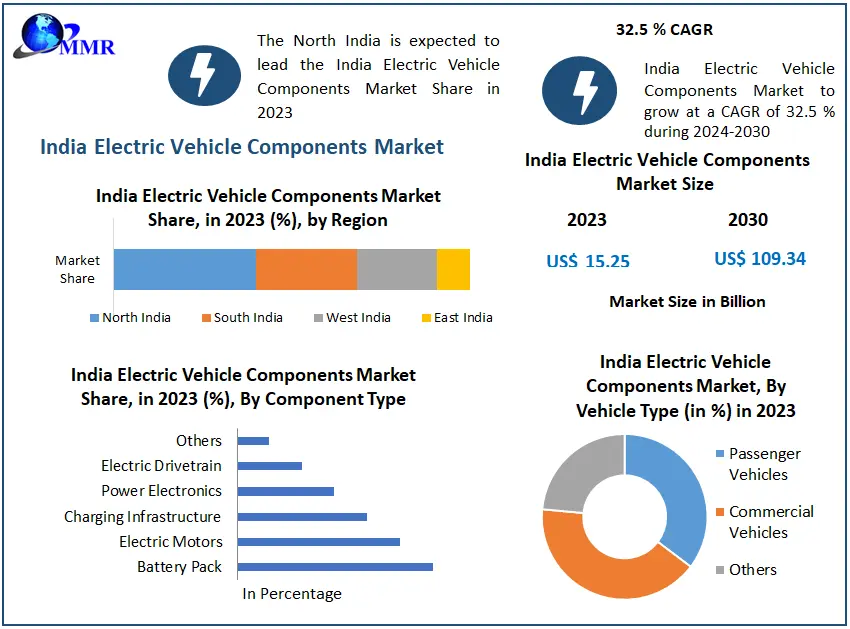
Market Capitalization: The India electric vehicle components market scale was valued at USD 15.25 billion in 2023 and is projected to reach USD 109.34 billion by 2030, growing at an explosive compound annual growth rate (CAGR) of 32.5%.
Propulsion Supremacy: Battery Electric Vehicles (BEVs) dominated the propulsion landscape in 2023, capturing the largest market share due to zero tailpipe emissions and rigid urban air quality mandates.
Cost Architecture: Battery packs remain the single most critical financial component, accounting for 30% to 40% of total electric vehicle manufacturing costs across domestic platforms.
Geographical Hub: The National Capital Region (NCR), including Delhi, Noida, and Gurugram, operates as a primary hub for EV innovation, supported by direct consumer subsidies and a dense concentration of research facilities.
Fiscal Stimulus: Localized component manufacturing gains high structural momentum from the government’s USD 5 billion Production Linked Incentive (PLI) scheme for advanced automotive technologies.
Why This Matters Now
The Indian automotive manufacturing ecosystem is undergoing its most intensive operational transformation since economic liberalization as original equipment manufacturers (OEMs) attempt to swap out legacy internal combustion engine (ICE) assembly architecture for high-voltage electric platforms. Historical reliance on imported power electronics and cells from China, Japan, and South Korea is introducing severe supply chain vulnerabilities, exposing local assembly lines to currency shifts and international logistics friction. Original equipment manufacturers and component designers face immediate market irrelevance unless they secure localized production linkages for heavy-duty electric motors, power inverters, and high-density battery packs.
What changed is the scale of domestic policy enforcement, shifting from simple consumer purchase incentives to aggressive multi-billion-dollar localized manufacturing mandates that penalize non-localized components. Why now is driven by deteriorating urban air quality metrics and India’s formal national commitment to install 40% of its cumulative electric power capacity from non-fossil fuel resources by 2030, accelerating automotive modernization timelines. Tier-1 engineering firms and domestic component specialists that successfully establish localized micro-machining, cell sorting, and automated thermal-layer assembly setups stand to capture massive supply volume allocations. What happens next is a definitive division between market players: advanced, localized sub-assembly manufacturers will command the market, while basic vehicle assemblers reliant entirely on un-localized import kits will face high border duties and structural margin collapse.
Market Overview
The India electric vehicle components market is moving along a highly aggressive development trajectory, climbing from a established baseline of USD 15.25 billion in 2023 to an anticipated revenue peak of USD 109.34 billion by 2030. This expansion reflects a remarkable compound annual growth rate (CAGR) of 32.5% across the forecast horizon. This steady revenue progression indicates that the domestic EV component sector has transitioned from a small experimental niche into the primary growth vector for the country’s broader industrial manufacturing matrix.
This financial trajectory demonstrates that local component suppliers are capturing high margins by successfully shifting from traditional metal stampings and mechanical gears to high-value power electronics. Fleet operators, corporate logistics platforms, and shared mobility networks are expanding their electrified orders to capitalize on lower per-kilometer operating costs and escape volatile fossil fuel overheads. Consequently, global capital syndicates and institutional investors are focusing significant funding toward localized component joint ventures, realizing that India’s vast domestic market offers structural protection against slowing growth in mature Western economies.
Key Trends Driving Growth
The primary catalyst transforming the Indian components landscape is the widespread development and adoption of indigenous electric vehicle technologies and localized manufacturing capabilities. Domestic automotive laboratories and research institutions are actively building custom component configurations optimized to survive India’s severe thermal conditions and uneven road surfaces. This technical effort has resulted in localized electric motors that convert electrical energy into kinetic energy with high thermal efficiency, supporting specialized regenerative braking loops that extend urban driving range.
Simultaneously, the high integration of advanced power inverters is playing a business-critical role in managing vehicle velocity variations and managing battery charge states. These highly complex components handle the high-velocity transition of power from direct current (DC) to alternating current (AC) and vice versa, shielding delicate vehicle electronic networks from power spikes during rapid charging cycles. Furthermore, growing environmental consciousness among urban populations and targeted regional clean-air policies are encouraging passenger vehicle buyers to favor domestic electric formats over legacy diesel alternatives.
Segment Insights
Dominant Propulsion Segment: The Battery Electric Vehicle (BEV) segment dominated the market share footprint in 2023, driven by absolute zero tailpipe emission performance, deep alignment with national carbon reduction targets, and favorable regional registration fee exemptions.
Dominant Architectural Components: The Battery Pack and Electric Motor segments maintain the highest individual revenue weightings, with battery assemblies alone commanding between 30% to 40% of complete vehicle building budgets.
Regional Growth Story
North India, anchored by the dense National Capital Region (NCR) encompassing Delhi, Noida, and Gurugram, operates as a significant hub for EV innovation, technological development, and structural component adoption. High population concentration and intense urbanization have prompted regional governments to enforce targeted local actions, such as the comprehensive Delhi EV Policy, which offers direct cash subsidies and registration waivers to eliminate buying barriers. Consequently, Noida and Gurugram have drawn a high concentration of component manufacturing plants, software facilities, and engineering testing labs, forming a highly integrated regional industrial cluster.
Across Western and Southern Indian automotive belts—including major manufacturing corridors around Mumbai, Pune, Bengaluru, and Chennai—established automotive conglomerates are converting historic combustion facilities into dedicated EV hubs. These regions leverage their dense, existing networks of Tier-1 suppliers to quickly scale up production of advanced cast housings, electrical connectors, and localized cooling systems. Furthermore, rising foreign direct investment (FDI) inflows into these historic manufacturing zones are funding automated assembly infrastructure, enabling regional components to satisfy both domestic assembly needs and strict international export standards.
Competitive Landscape
The competitive landscape of the India electric vehicle components market is highly dynamic and fiercely contested, characterized by strategic alliances between historic engineering groups, agile local startups, and global technology providers. Corporate leadership is no longer determined by simple manufacturing volume; instead, it depends on a vendor’s capability to secure local component certifications under changing government validation standards. This strict regulatory setup gives an immense competitive edge to well-capitalized domestic giants who can finance large-scale R&D and secure domestic battery cell allocations.
Prominent global and domestic participants are executing aggressive capital expansion plans, building advanced testing yards, and forming joint ventures to defend their structural pricing power. Industry leaders—including SEG Automotive India Private Limited, Tata Motors Limited, Mahindra Electric Mobility Limited, Avtec Limited, Exide Industries Ltd., Bosch Limited, and Ashok Leyland—are leading the development of localized electric drivetrains. This technical concentration forces small, non-automated component shops to seek niche aftermarket roles, as major vehicle platforms prioritize large suppliers capable of delivering complete, digitally tracked, and warranty-backed component assemblies.
Recent Developments
Production Capital Scaling: Leading domestic component groups have initiated construction on large-scale manufacturing facilities dedicated to electric drivetrains and power electronics, leveraging the USD 5 billion PLI automotive scheme.
Battery Supply Chain Reinforcements: Top-tier Indian component providers have completed strategic material agreements to set up localized battery pack assembly operations, reducing reliance on direct East Asian imports.
Smart Motor Technical Launches: Advanced engineering firms have introduced localized high-efficiency electric motor lines featuring integrated thermal shielding designed specifically to withstand severe domestic operating temperatures.
Strategic Implications
For senior manufacturing executives and global technology investors, the explosive growth path of the Indian EV components market highlights the absolute necessity of fast-tracking localized manufacturing capacity. Component providers that delay moving past the basic assembly of imported kits run the risk of holding stranded assets as the government tightens localization mandates. Capital deployment plans must prioritize building automated winding lines, advanced cleanrooms for inverter assembly, and sophisticated battery management system validation cells to guarantee platform inclusion.
Furthermore, forming collaborative innovation loops among domestic manufacturers, technical startups, and global research institutions is shifting from a progressive asset to a primary commercial requirement. Because the domestic market requires unique cost-to-performance ratios, engineering teams must co-develop custom component form factors that balance high performance with economic mass production. Sourcing local components and securing long-term materials agreements will allow top-tier manufacturers to insulate their operating margins from international shipping shocks, securing long-term supply dominance.
Future Outlook
Over the coming decade, the Indian automotive supply chain will experience a definitive structural sorting, separating highly automated, localized component engineering firms from legacy import-dependent operations. Advanced component manufacturers will secure exceptional, high-margin revenue streams by supplying certified, climate-resilient power electronics and battery networks directly to the country’s fast-expanding electric passenger and commercial fleets. Conversely, slow-moving component vendors that stick to legacy combustion assemblies or fail to localize their tech stacks will face rapid margin erosion and ultimate exclusion from new vehicle platforms. Ultimately, future market leadership belongs to agile component engineers that master localized drivetrain fabrication and embed advanced thermal management systems within their architectures, while un-retooled operators face steady business decline as the transport matrix electrifies.
Analyst Perspective
“The India electric vehicle components market is undergoing an unprecedented structural shift as the combination of the USD 5 billion PLI auto scheme and strict localization mandates forces a total reimagining of the component supply chain. Long-term profitability belongs exclusively to manufacturers that move past import dependency and establish deep, indigenous engineering operations capable of building high-efficiency, cost-optimized electric drivetrains.” — Tejaswini Kakade, Research Analyst, Maximize Market Research
About Maximize Market Research
Maximize Market Research Pvt. Ltd. (MMR) is a global market research and consulting company that provides reliable, data-focused, and practical business insights. The firm serves a wide range of industries, including healthcare, pharmaceuticals, technology, automotive, electronics, chemicals, personal care, and consumer goods. Through market forecasts, competitive analysis, strategic consulting, and industry impact assessments, MMR helps organizations understand changing market conditions, identify growth opportunities, and make informed business decisions for long-term success.
2nd Floor, Navale IT Park Phase 3
Pune Banglore Highway, Narhe
Pune, Maharashtra 411041, India
+91 9607365656
sales@maximizemarketresearch.com
