Key Highlights
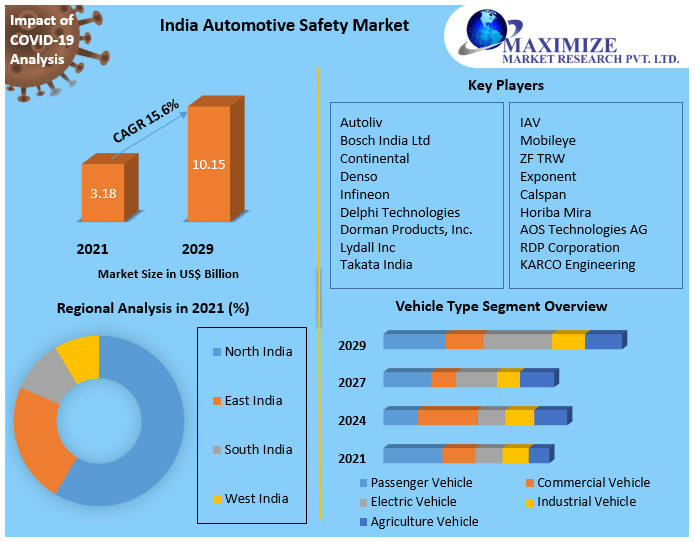
Market Scale: The market is forecast to reach USD 10.15 billion by 2029, growing at a robust CAGR of 15.6% during the forecast period.
Dominant Segment: Active safety systems currently hold the largest market share, driven by increasing consumer demand for intelligent collision-avoidance technology.
Regulatory Catalyst: The introduction of the Bharat New Vehicle Safety Assessment Program (BNVSAP)—or Bharat NCAP—is the primary driver for standardized crash-test ratings and consumer-driven safety adoption.
Strategic Shift: Safety features, once considered “luxury,” are now standard, as vehicle cost increases of 8–15% are being absorbed to ensure compliance with emerging safety norms.
Core Drivers: A rising middle class with higher disposable income, stringent government oversight, and a clear migration toward global safety standards.
Why This Matters Now
India has officially ascended to one of the world’s top ten car markets, yet it is undergoing a critical transition: from prioritizing affordability to prioritizing survivability. The surge in road accidents, despite a reported 4.1% decline in the total number of incidents, has seen fatality rates climb by 3.2%, creating urgent pressure on OEMs and regulators to rethink vehicle architecture. For automotive stakeholders, safety is no longer a peripheral feature—it is the central pillar of brand equity and a non-negotiable gateway to the modern Indian consumer.
Market Overview
The India Automotive Safety Market is witnessing a fundamental transformation in its technical DNA. As the market moves toward global compliance, manufacturers are heavily investing in both passive systems—like advanced airbag configurations and reinforced chassis—and active technologies, such as Anti-Lock Braking Systems (ABS) and Electronic Stability Control (ESC). This transition is effectively redefining the cost-benefit analysis of the Indian automotive sector, where the integration of electronic control units (ECUs) and sensors is becoming as essential as the engine itself.
Key Trends Driving Growth
The most potent trend is the consumer-led demand for transparency, crystallized by the Bharat NCAP initiative. By assigning star ratings to vehicles based on safety performance, the government is fostering a competitive “safety race” among manufacturers. Concurrently, the rise of electric vehicles (EVs) is pushing safety innovation into the battery domain, with manufacturers adopting sophisticated Battery Management Systems (BMS) and fire-resistant enclosures to prevent thermal runaways. This shift reflects a broader commitment to safety that encompasses the entire lifecycle of the vehicle.
Segment Insights
Dominant Segment: Active Safety Systems. These proactive measures—which manage steering, braking, and propulsion to avoid accidents before they occur—account for the largest share and continue to gain momentum as vehicle automation increases.
Fastest-Growing Segment: Advanced Driver Assistance Systems (ADAS). With a growing trend toward luxury vehicle adoption and a future-looking push for autonomous capabilities, ADAS features are seeing the steepest adoption curve in the current market.
Regional Growth Story
North India dominates the regional market share, driven by high population density, rapid industrial development, and the concentration of major automotive manufacturing hubs. However, the growth is nationwide; Tier-1 and Tier-2 cities are mirroring these trends as vehicle ownership increases among middle-class families. This regional spread is compelling Tier-1 suppliers to expand their local footprint, ensuring that high-tech safety components are manufactured closer to the assembly lines to optimize supply chain resilience and cost-efficiency.
Competitive Landscape
The competitive landscape is defined by the strategic collaboration between global technology leaders and domestic manufacturing giants. Players like Autoliv, Bosch India, Continental, Denso, Infineon, and Wabco-TVS are setting the pace by localizing the production of critical safety sensors and ECUs. Their ability to deliver “India-specific” safety solutions—optimizing for the country’s unique road infrastructure and climatic challenges—is a significant competitive advantage.
The entry of these players indicates a transition in market direction: OEMs are moving away from imported, off-the-shelf modules in favor of deep-integrated partnerships. Future leaders will be the companies that provide modular, scalable safety platforms that allow an OEM to move from a 3-star to a 5-star Bharat NCAP rating without necessitating a complete vehicle overhaul.
Recent Developments
Regulatory Upgrades: The implementation of Bharat NCAP 2.0 and the integration of ADAS-focused testing protocols are forcing manufacturers to rethink their R&D priorities.
Capacity Expansion: Tier-1 suppliers have announced significant manufacturing capacity additions in India to localize the production of sensors, radar modules, and airbag controllers.
Aftermarket Evolution: A burgeoning aftermarket sector for safety-enhancing telematics and aftermarket parking assistance is further expanding the market’s reach beyond new vehicle sales.
Strategic Implications
For OEMs, the strategic mandate is clear: safety is the new currency of market penetration. While compliance increases vehicle costs by approximately 8–15%, the ability to market a 5-star safety rating is a powerful lever for gaining market share among the increasingly safety-conscious Indian consumer. Suppliers must focus on reducing the complexity of these electronic systems, as the industry eventually seeks to achieve economies of scale that can bring high-tech safety features down to the entry-level vehicle segments.
Future Outlook
India is at the threshold of a safety-driven automotive revolution. The coming years will see a decisive shift where the market is no longer defined by how many vehicles are sold, but by how intelligently they protect their occupants and the pedestrians around them. Future market leaders will be the OEMs that aggressively integrate ADAS and passive safety as standard equipment across all segments, effectively distancing themselves from laggards who view safety as a cost-to-be-minimized rather than a value-to-be-maximized.
Analyst Perspective
“The Indian automotive safety market is moving from a regulatory-driven necessity to a consumer-driven demand,” states Tejaswini Kakade, Analyst at Maximize Market Research. “The convergence of Bharat NCAP standards and increased technological affordability is establishing a new baseline where vehicle safety is the primary metric for the future of Indian mobility.”
About Maximize Market Research
Maximize Market Research Pvt. Ltd. (MMR) is a global market research and consulting company that provides reliable, data-focused, and practical business insights. The firm serves a wide range of industries, including healthcare, pharmaceuticals, technology, automotive, electronics, chemicals, personal care, and consumer goods. Through market forecasts, competitive analysis, strategic consulting, and industry impact assessments, MMR helps organizations understand changing market conditions, identify growth opportunities, and make informed business decisions for long-term success.
2nd Floor, Navale IT Park Phase 3
Pune Banglore Highway, Narhe
Pune, Maharashtra 411041, India
+91 9607365656
sales@maximizemarketresearch.com
